






Is a Mini Split Better Than Central Air in Humid Climates? What Houston Homeowners Need to Know
Is a mini split better than central air in humid climates — and specifically in Northeast Houston, where summer humidity can make a correctly cooled room still feel sticky and uncomfortable? The short answer is: in most cases, yes. Mini splits handle moisture more consistently than central air, thanks to inverter technology that keeps the system running in long, steady cycles instead of blasting on and off. But the right answer depends on your home's setup.
Here is a quick breakdown to help you decide:
Mini Split vs. Central Air in Humid Climates — At a Glance
| Factor | Mini Split | Central Air |
|---|---|---|
| Humidity control | Better — steady cycles pull moisture consistently | Can struggle with short run times |
| Energy efficiency | Higher SEER2 ratings (18–38+) | Lower SEER2 ratings (14–21) |
| Duct energy loss | None | 20–30% of cooled air lost through ducts |
| Zoning | Built-in room-by-room control | Requires costly add-ons |
| Best for | Older homes, additions, hot spots | Homes with existing, well-sealed ducts |
| Noise level | 19–26 dB (whisper-quiet) | Varies by system and duct design |
Northeast Houston summers are long — often eight to ten months of heavy cooling demand. In that kind of climate, your AC system is not just fighting heat. It is fighting latent load, which is the moisture in the air that makes 78°F feel like 85°F. That invisible humidity is what leaves you feeling sweaty even when the thermostat says the temperature is right where you set it.
Both mini splits and central air systems cool your home by circulating refrigerant to absorb heat and moisture indoors and release it outside. But how they do it — and how well they handle humidity specifically — is where these two systems start to pull apart.
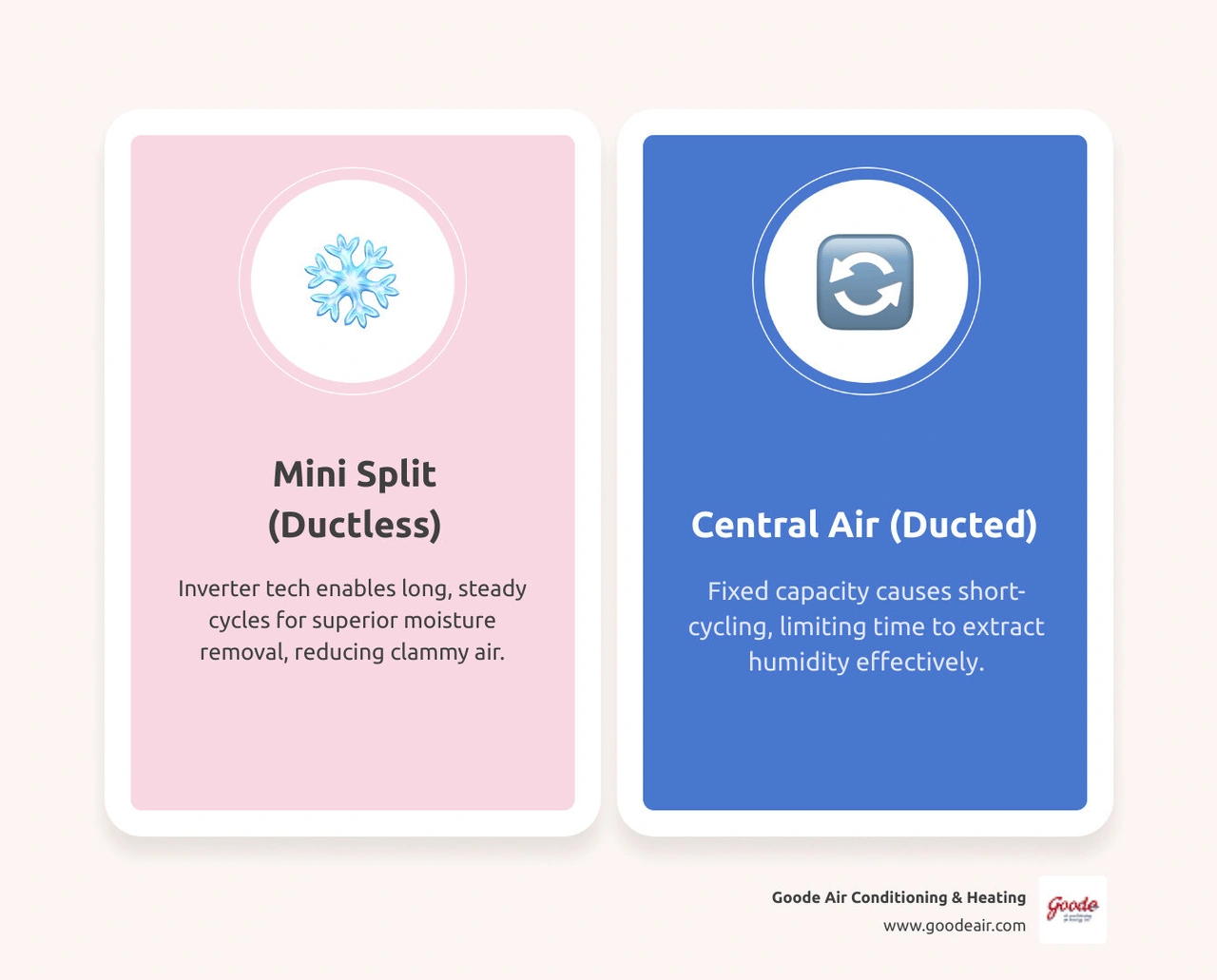
Humidity Control Performance: Inverter vs. Fixed Capacity
In a high-moisture region like Humble or Porter, the biggest challenge for any HVAC system is the "latent cooling load." This is the energy required to remove moisture from the air rather than just lowering the temperature. Traditional central air systems often struggle with this because they operate on a fixed capacity. They blast on at 100% power, quickly reach the target temperature on your thermostat, and then shut off.
The problem? Removing humidity takes time. If the system only runs for 10 minutes before reaching the temperature setpoint, it hasn't had enough time to pull the moisture out of the air. This leads to "short-cycling," leaving you with a home that is cold but "clammy."
Mini Splits utilize inverter technology, which is a game-changer for Humidity Indoor Air Quality. Instead of a simple "on/off" switch, the inverter allows the compressor to modulate its speed. It can run at 20%, 50%, or 100% capacity depending on the need. In a humid climate, the system will often run for longer, steadier cycles at a lower speed. This constant airflow over the cooling coils ensures consistent moisture extraction.
For many of our neighbors, especially those looking into Whole House Dehumidification Porter TX or Whole House Dehumidifier Installation Fall Creek TX, a mini split offers a built-in advantage. By maintaining a steady cycle, it prevents the spikes in humidity that occur when a central unit sits idle.
Is a mini split better than central air in humid climates for energy efficiency?
Efficiency is where the data really favors ductless systems. As we move through April 2026, federal efficiency standards have become more stringent, and mini splits are leading the charge. While high-end central AC systems typically range from 18 to 21+ SEER2, high-end ductless mini splits can achieve staggering SEER2 ratings of 33 to 38+.
| Efficiency Metric | Central Air (Standard) | Mini Split (High-End) |
|---|---|---|
| SEER2 Rating | 14.3 – 17 | 33 – 38+ |
| Ductwork Loss | 20% – 30% | 0% |
| Potential Energy Savings | Baseline | 30% – 50% lower |
One of the "hidden" drains on your Air Conditioning efficiency is ductwork. Even the best-installed duct systems in homes across Atascocita or Kingwood leak an average of 20% to 30% of conditioned air through gaps, loose connections, and thermal transfer. This is especially problematic in Houston, where ducts often run through sweltering attics. You are essentially paying to cool your attic before that air ever reaches your living room.
Because mini splits are ductless, they eliminate this waste entirely. Industry data shows that mini split systems use 30% to 50% less energy than traditional central units. When you combine the lack of duct loss with HVAC Maintenance for Maximum Energy Savings, the long-term impact on your utility bills during our 10-month cooling season is significant.
Zoning and Comfort: Solving the "Sticky Room" Problem
We have all experienced that one room in the house—maybe a south-facing bedroom in Summerwood or a converted garage in New Caney—that never seems to get cool enough. Central air systems rely on a single thermostat, meaning they cool the whole house based on the temperature in one hallway. This often leaves "hot spots" or "sticky rooms" where humidity lingers.
Mini splits offer localized comfort through independent thermostats for each indoor unit. This allows for Mini Split Installation Kingwood TX that targets specific zones. If you spend your day in a home office, you can keep that room at a crisp 72°F while letting the rest of the house stay at 78°F, drastically reducing energy waste.
Furthermore, mini splits are incredibly quiet. While a central air handler might roar to life and rattle your vents, mini split indoor units often operate at 19 to 26 dB. To put that in perspective, that is softer than a whisper. This makes them ideal for bedrooms and nurseries where peace and quiet are just as important as the temperature.
Is a mini split better than central air in humid climates for room-by-room control?
Yes, because it allows for personalized temperature and humidity settings. In a multi-zone setup, each family member can control their own environment. This flexibility is a core part of our Mini Split AC Installation Guide Kingwood TX. Whether you are looking for an Affordable Ductless Air Conditioner Guide Summerwood TX or a whole-home solution, the ability to "turn off" cooling in unused rooms can cut your energy costs by about 30%, according to the U.S. Department of Energy.
When we perform an AC Installation Kingwood TX, we often find that homeowners prefer the precision of ductless heads over the "all-or-nothing" approach of a central system.
Indoor Air Quality and Maintenance in High-Moisture Regions
In Northeast Houston, high humidity isn't just a comfort issue; it's an Indoor Air Quality issue. Moisture provides the perfect breeding ground for mold and mildew. Central air systems can inadvertently spread these allergens through ductwork if the ducts are not properly maintained or if they have developed leaks that pull in unfiltered air from the attic or crawlspace.
Mini splits feature multi-stage air filters in each indoor unit. Because there are no ducts to harbor dust or microbial growth, the air stays cleaner. However, because these systems handle so much moisture, HVAC Maintenance Tavola TX is essential. We recommend cleaning the filters every two to four weeks during the peak of summer to ensure optimal airflow and drainage.
If you ever notice a musty smell or see water dripping from your unit, it is time for AC Repair Kingwood TX. Our AC Repair Kingwood TX Complete Guide emphasizes that proper condensate drainage is critical in our climate. Mini splits use a small drain line to carry moisture outside; if this line clogs, it can lead to indoor leaks.
Is a mini split better than central air in humid climates for older homes?
For many older homes in areas like Roman Forest or Crosby, a Mini Ductless AC Roman Forest TX is often the only viable choice. Many older properties were built without the space for bulky ductwork. Installing central air in these homes often requires dropping ceilings or losing closet space, which can be invasive and expensive.
Our AC Installation Kingwood TX Complete Guide highlights that mini splits are non-invasive. They only require a small three-inch hole in the wall to connect the indoor and outdoor units. This makes them perfect for:
- Historic homes that want to preserve original architecture.
- Room additions where extending existing ductwork is impractical.
- Attic or garage conversions that need dedicated climate control.
Frequently Asked Questions about Humidity and HVAC
Which system removes more moisture during a long Houston summer?
While both systems remove moisture, a mini split with inverter technology is generally more effective at consistent dehumidification. Because it can run at lower speeds for longer durations, it maintains a steady removal of moisture without the "stops and starts" that allow humidity to rebound in a central air setup.
Do mini splits require more maintenance in high-humidity areas?
The maintenance is different rather than "more." While you don't have to worry about duct cleaning, you do need to be diligent about cleaning the individual filters in each indoor head. In a humid climate like Humble or Kingwood, dust can mix with moisture on the coils, so professional deep cleanings every 6 to 12 months are a best practice to prevent mold growth. You can learn more about this in our HVAC Maintenance Tavola TX resources.
Can I use a mini split to supplement my existing central air?
Absolutely! This is a very popular "hybrid" approach in Northeast Houston. Many homeowners keep their central air for the main living areas but add a single-zone mini split to a primary bedroom or a home office that struggles to stay cool. This allows you to stay comfortable in the rooms you use most without overworking your main system.
Conclusion
When asking is a mini split better than central air in humid climates, the evidence points toward the mini split for its superior efficiency, zoning capabilities, and consistent moisture removal. Whether you are in Roman Forest, Spring, or Kingwood, choosing the right system is about more than just the temperature—it's about the air you breathe and the comfort of your home.
At Goode Air Conditioning & Heating, we bring 50 years of trusted service and family values to every job. We understand the specific challenges of the Northeast Houston climate, from the heavy latent loads in Porter to the unique architectural needs of homes in Humble. We stand by our work with transparent pricing and a 100% satisfaction guarantee.
If you are tired of the "sticky" feeling in your home and want to explore the benefits of Mini Splits, we are here to help. From Roman Forest to Summerwood, we provide the home comfort solutions you need to thrive in the Texas heat. Contact us today to see how we can transform your indoor environment.


Customer Testimonials
See why so many homeowners trust Goode Air Conditioning & Heating, Inc.—our 4.8-star Google rating and hundreds of happy customers speak to the quality, care, and service we deliver every day.

The technician Goode AC is one of the best businesses I know of. I have had their annual maintenance check up for several years. I’m so impressed with the technician who has serviced my AC several times. Always on time, pleasant, considerate, thorough in his work and explains the problems where I can easily understand. Thankful for doing business with professionals.
I have been a customer for at least 30 years. They have replaced 3 air conditioners, a furnace and heat exchanger. Today they replaced the air ducts in my attic that were falling apart and never been cleaned. Wonderful job, polite workers, great clean up. I can already tell the difference in the quality of the air. Love you guys!!
Great experience today with Goode Air Conditioning. Hoger, our technician, was very knowledgeable and provided excellent customer service. We look forward to our Spring maintenance visit.
I have used Goode Air Conditioning and Heating for many years. The company has excellent customer service and the technicians are knowledgeable, thorough and professional.