





Why Your Pre Summer AC Tune-Up Checklist for Texas Is Different From Everywhere Else
A solid pre summer AC tune up checklist for Texas looks different than what homeowners in cooler states need — and for good reason. Texas AC systems run more than 2,400 hours per year, compared to around 600 hours in milder climates. That kind of workload wears components down three to four times faster. Add in Northeast Houston's heavy humidity, spring oak pollen, and brutal heat waves that arrive without much warning, and you have a recipe for an expensive breakdown at the worst possible time.
Here's a quick overview of what your spring AC tune-up checklist should cover:
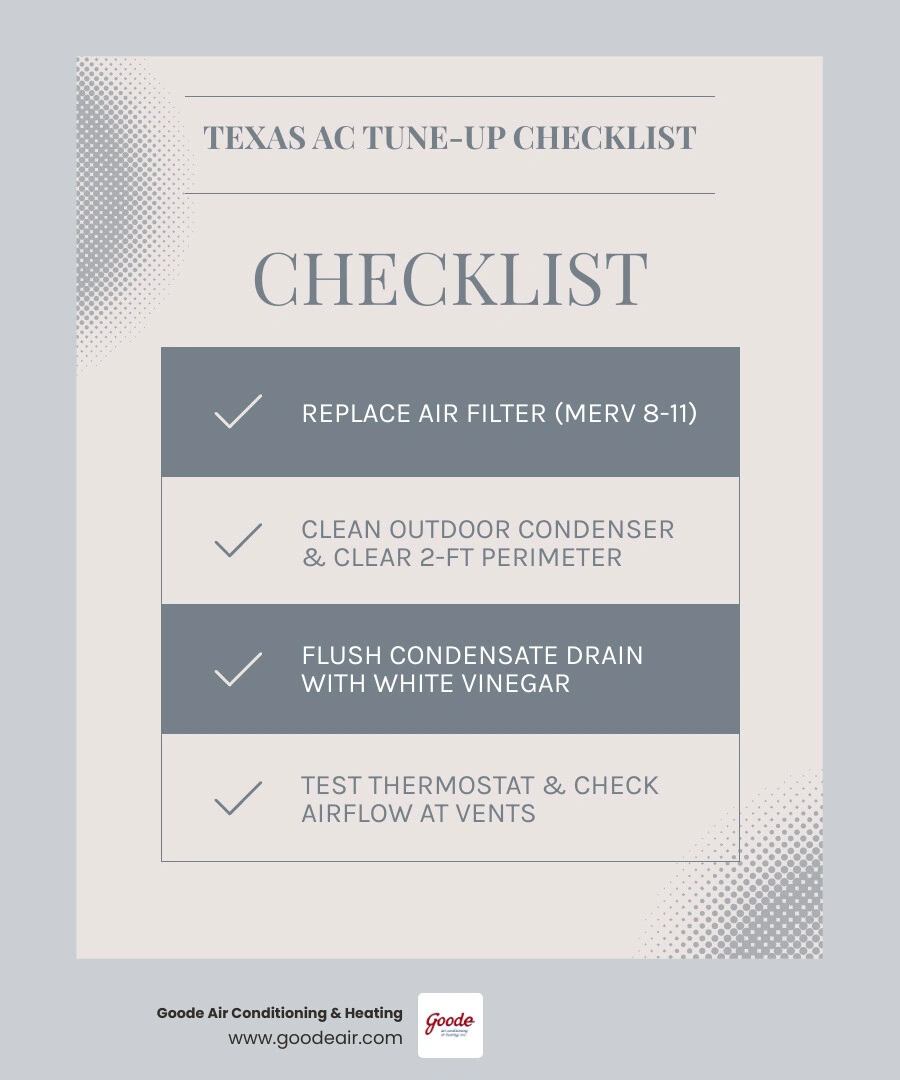
- Replace the air filter (MERV 8-11 recommended)
- Clean the outdoor condenser unit and clear a 2-foot perimeter
- Flush the condensate drain line with white vinegar
- Test your thermostat and replace batteries if needed
- Check airflow at every supply vent in your home
- Inspect refrigerant line insulation for UV damage or cracks
- Run the system when temps are between 60-75°F and verify a 15-20°F temperature split
- Schedule a professional tune-up for electrical components, refrigerant levels, and coil cleaning
The good news? Research consistently shows that 95% of summer breakdowns are preventable with simple spring maintenance. This guide walks you through every step — what you can do yourself, what needs a pro, and how to spot trouble before the first real heatwave hits.
Why Spring AC Maintenance Matters More in Texas
In Northeast Houston, spring AC maintenance is not optional "nice-to-have" home care. It is survival prep with a thermostat.
Our local climate puts air conditioners through a long, punishing cooling season. Humidity stays high, attic temperatures soar, and spring brings heavy pollen that sticks to coils and restricts airflow. When airflow drops, the system runs longer, works harder, and uses more electricity to do less cooling.
A few Texas-specific facts matter here:
- AC systems in Texas often run 2,400+ hours per year
- Dirty evaporator and condenser coils are a major cause of service calls
- Clogged drain lines are one of the most common summer AC problems
- Leaky ductwork can waste 20-30% of cooled air
- A clogged air filter can increase energy use by 5-15%
In humid areas like Humble, Kingwood, Atascocita, Summerwood, and nearby communities, moisture is a constant issue. Your AC removes humidity as it cools, and that water has to drain properly. If the condensate line clogs with algae or biofilm, you can end up with water damage, a tripped float switch, or an AC that suddenly stops cooling right when you need it most.
Why the pre summer ac tune up checklist for texas should start before the first heatwave
The best time to work through your checklist is before the first stretch of serious heat. In our area, that usually means early to mid-spring, not the first 90-degree day when everyone in the neighborhood realizes their system is struggling.
Why schedule early?
- You can test the system under moderate conditions
- Minor repairs are easier to catch before they become major ones
- You avoid the summer service rush
- Your household is not stuck sweating while waiting on service
Think of March and April as the golden window. Once late spring rolls into full Texas heat, breakdowns spike, schedules tighten, and small neglected issues suddenly become emergencies.
Texas-specific challenges that make AC systems fail faster
Texas homes deal with several stressors that homeowners in cooler climates barely think about:
- Humidity that creates heavy condensate and raises indoor comfort demands
- Oak pollen and seasonal debris that clog filters and outdoor coils
- Cottonwood fluff and grass clippings that collect around the condenser
- Strong UV exposure that cracks refrigerant line insulation
- Duct leakage in hot attics that wastes cooling
- Long runtimes that wear out capacitors, contactors, motors, and compressors faster
That last point is huge. Compressor failure is one of the most serious AC problems, and it is often linked to system strain from dirty coils, poor airflow, or ignored maintenance.
Pre Summer AC Tune Up Checklist for Texas Homeowners
Here is the homeowner-friendly version of the checklist we recommend before summer:
- Replace or inspect the air filter
- Test thermostat settings and batteries
- Open and clear all supply and return vents
- Clean around the outdoor condenser
- Gently rinse condenser coils
- Flush the condensate drain line
- Check for weak airflow or hot rooms
- Inspect refrigerant line insulation for sun damage
- Run the AC and monitor cooling performance
- Schedule professional maintenance for the parts you should not touch yourself

Air filter, thermostat, and airflow checks in a pre summer ac tune up checklist for texas
Start with the basics, because the basics cause a surprising number of summer problems.
Air filter
Check the filter first. During Texas spring and summer, especially in humid and high-pollen areas, we recommend checking it monthly. Many homes need replacement every 30 to 60 days, and some need it more often if you have:
- Pets
- Kids in and out constantly
- Ongoing construction nearby
- Allergy concerns
- Heavy pollen buildup
For most homes, a MERV 8-11 filter is a solid fit. It balances filtration and airflow well. Extremely restrictive filters can make older systems struggle.
Make sure the airflow arrow points toward the air handler when installing the new filter.
Thermostat
Then move to the thermostat:
- Replace batteries if your model uses them
- Confirm the system is set to COOL
- Set the fan to AUTO, not ON
- Check that the displayed temperature seems accurate
In Texas heat, 78 degrees is the standard recommendation when you are home for energy efficiency. If you leave, a higher setting can help reduce runtime. Keeping the fan on AUTO also helps humidity control, because the system is not constantly blowing moisture back into the home.
Airflow
Next, walk the house and check each vent:
- Make sure vents are open
- Remove furniture, rugs, or curtains blocking airflow
- Note rooms that feel warmer than the rest of the house
- Listen for whistling or weak airflow
If one room is always hot, the issue may be dirty filters, duct leakage, poor balancing, or a system problem that needs professional attention.
How to clean the outdoor condenser unit safely
Your outdoor unit needs room to breathe. If it is packed with leaves, pollen, and shrubbery, heat cannot escape efficiently.
Before cleaning:
- Turn the thermostat off
- Shut off power at the disconnect or breaker
- Remove leaves, twigs, and debris around the base
- Trim vegetation to keep at least 2 feet of clearance on all sides
Then clean it gently:
- Use your hands or a soft brush to remove loose debris from the cabinet
- Rinse the coils with a garden hose from the outside in
- Use light pressure only
Important: never use a pressure washer. It can bend the aluminum fins and reduce performance.
Also check whether the unit looks level. A noticeably tilted condenser can lead to long-term wear and should be evaluated.
How to clear and maintain the condensate drain line
In humid climates, this step deserves extra attention. Your system may remove gallons of moisture per day in peak summer. If that water cannot drain, trouble follows fast.
A simple homeowner maintenance step:
- Locate the condensate drain access near the indoor unit
- Pour about 1 cup of white vinegar into the line
- Let it sit and flush naturally
This helps reduce algae and sludge buildup. You can also check the drain pan for standing water, rust, or slime.
Warning signs of a drain problem include:
- Water near the indoor unit
- Musty odors
- A full drain pan
- An AC that suddenly shuts off due to the float switch
In our area, clogged drain lines are one of the most common reasons homeowners lose cooling in summer.
How to Test Your AC Before Summer and Spot Problems Early
After cleaning and inspection, run the system before the first real heatwave.
A good test day is when outdoor temperatures are roughly 60-75 degrees. Let the AC run for at least 30 minutes. Then check:
- Is cool air coming from the vents?
- Does the system start and stop normally?
- Is airflow consistent through the house?
- Is there a 15-20 degree difference between return air and supply air?
- Is the indoor humidity reasonable?
You do not need fancy tools for a basic check. A simple thermometer can help you compare the air entering the return and the air coming out of a supply vent near the air handler.
What warning signs mean your AC needs immediate attention
Stop and call for service if you notice any of the following:
- Burning smell
- Buzzing, grinding, or banging noises
- A breaker that keeps tripping
- Ice on the refrigerant line or indoor coil
- Water leaking around the system
- Warm air instead of cool air
- Short cycling
- The system runs constantly but does not cool well
- Indoor air feels sticky or unusually humid
These are not "maybe it will fix itself" issues. In Texas, small AC problems tend to become large summer problems in a hurry.
Warning signs your system needs more than a tune-up
Sometimes maintenance is not enough. A system may need repair planning or replacement evaluation if you have:
- Frequent breakdowns
- Very uneven cooling throughout the home
- Repeated high humidity indoors
- Rising utility bills despite normal use
- Major duct leakage
- An older unit with recurring repair needs
- Compressor-related symptoms
- Refrigerant problems that keep returning
Here is a quick comparison:
| Tune-up may be enough | Needs deeper repair evaluation |
|---|---|
| Dirty filter | Frozen coil |
| Outdoor debris buildup | Repeated breaker trips |
| Mild drain buildup | Water leaks from the unit |
| Thermostat battery issue | Warm air during cooling cycle |
| Slightly dirty coil | Loud electrical or mechanical noises |
| Blocked vents | Ongoing uneven cooling in multiple rooms |
DIY vs. Professional AC Maintenance in Texas
A good rule of thumb: if it involves basic cleaning, observation, or a standard filter swap, homeowners can usually handle it. If it involves electricity, refrigerant, internal components, or system measurements, it should be left to a trained HVAC professional.
That split matters for safety, system performance, and protecting equipment life.
What homeowners can safely handle themselves
Most homeowners can do these steps safely:
- Replace air filters
- Clean dust from supply and return grilles
- Adjust thermostat settings
- Clear debris around the condenser
- Gently rinse condenser coils with a garden hose
- Flush the condensate drain line with vinegar
- Check visible insulation on the refrigerant line
- Monitor airflow and room comfort
These simple tasks cover a lot of your spring prep and can help reduce strain before summer.
What a professional AC tune-up should include
A full professional tune-up goes well beyond what is visible from the outside. It should include inspection and testing of key system components such as:
- Electrical connections and controls
- Capacitor and contactor condition
- Refrigerant charge and leak indicators
- Evaporator and condenser coil condition
- Blower performance
- Condensate drain and safety shutoff operation
- Thermostat calibration
- Overall cooling performance
- Ductwork condition where accessible
If you want to learn more about full-service cooling care, visit our air conditioning services page or see our AC maintenance in Kingwood, TX page.
Energy-Saving Habits That Help Your AC Survive a Texas Summer
Maintenance gets your system ready. Daily habits help it stay ready.
Here are the best low-effort, high-impact habits for summer:
- Set the thermostat to 78 degrees when home
- Raise the setting when away
- Keep the fan on AUTO
- Use ceiling fans to improve comfort
- Close blinds on sun-facing windows in the afternoon
- Seal obvious air leaks around doors and windows
- Keep vents unblocked
- Check the filter every month
- Avoid dramatic thermostat swings
Every degree below 78 degrees can increase cooling costs by about 3%. That does not mean you have to suffer in your own living room, but it does mean small thermostat changes matter in Texas.
How often to change your air filter during Texas summers
For most Northeast Houston homes, check the filter every month during summer. Replace it every 30-60 days in many homes, and more often if airflow drops or the filter looks dirty sooner.
You may need more frequent changes if your home has:
- Pets
- Allergy-sensitive family members
- Heavy dust
- High pollen exposure
- Continuous AC use during long heat stretches
A dirty filter is one of the fastest ways to reduce efficiency and strain your system.
How regular maintenance lowers bills and reduces summer risk
Regular maintenance helps in two ways: it lowers wasted energy and reduces the chance of breakdowns.
Well-maintained systems can operate at 5-15% higher efficiency. That means less runtime, less wear, and lower monthly utility waste. Maintenance also protects expensive components from avoidable strain, especially the compressor.
It also helps uncover hidden losses such as:
- Dirty coils
- Restricted airflow
- Drain clogs
- Weak electrical parts
- Duct leakage
If your ducts are leaking into a hot attic, you could be losing 20-30% of your cooled air before it even reaches the rooms you are paying to cool.
For more reading, explore the benefits of regular AC maintenance in Texas, HVAC maintenance for maximum energy savings, and how to extend the life of your AC in Texas.
When to Schedule Your Tune-Up and Where to Get Local Help
If you wait until the first summer heatwave, you are late.
For homeowners in Roman Forest, Crosby, Eagle Springs, Walden on Lake Houston, Spring, Valley Ranch, Kenswick, Fall Creek, Tavola, Huffman, Summerwood, Atascocita, Foxwood, Kingwood, New Caney, Porter, and Humble, the ideal time to schedule spring maintenance is early in the season before humidity and temperatures fully ramp up.
At Goode Air Conditioning & Heating, we have served Northeast Houston families for 50 years with family values, transparent pricing, and a 100% satisfaction guarantee. Our goal is simple: help you stay comfortable before summer turns your AC into a full-time athlete.
Best time to schedule a spring AC tune-up in Northeast Houston
The best window is typically February through April.
That timing gives you several advantages:
- Better chance to catch problems early
- Enough warm days to test cooling properly
- Less stress before school lets out and schedules get hectic
- More time to plan repairs if needed
- Lower risk of being stuck without cooling in the first big heat spike
April can still work well, but earlier is better. Once late spring turns hot and humid, service demand rises fast.
Helpful local service pages for nearby homeowners
If you are looking for location-specific help, these pages may be useful:
- AC tune-up in Eagle Springs, TX
- AC tune-up in Tavola, TX
- AC tune-up in Huffman, TX
- AC maintenance in Huffman, TX
- AC maintenance in Valley Ranch, TX
Frequently Asked Questions About Spring AC Maintenance in Texas
How often should you service your AC in Texas?
We recommend professional AC maintenance at least once a year, ideally in spring before summer demand peaks. Homeowners should also do monthly visual checks during cooling season, especially filter inspections and drain monitoring.
For more on timing, read how often you should service your AC in Texas.
What thermostat setting is best for energy efficiency in Texas heat?
A good target is 78 degrees when you are home and a higher setting when you are away. Keep the fan on AUTO for better humidity control. Ceiling fans can help you feel cooler without lowering the thermostat as much.
What happens if you skip spring maintenance?
Skipping maintenance can lead to:
- Dirty coils and reduced efficiency
- Clogged drain lines and water issues
- Weak cooling or warm air
- Higher utility bills
- More wear on major parts
- A much greater chance of a summer breakdown
If you want to avoid surprise problems during extreme heat, read how to make sure your AC survives a Texas summer.
Conclusion
A strong spring routine is the smartest way to prepare for a long, humid Texas cooling season. If you remember nothing else, remember this: change the filter, clear the condenser, flush the drain line, test the thermostat, and do not ignore warning signs.
The right pre summer AC tune up checklist for Texas helps your system cool better, control humidity, lower energy waste, and reduce the odds of a midsummer breakdown when you need AC the most.
If you want extra peace of mind, learn more about HVAC maintenance plans or explore our full air conditioning services.

Customer Testimonials
See why so many homeowners trust Goode Air Conditioning & Heating, Inc.—our 4.8-star Google rating and hundreds of happy customers speak to the quality, care, and service we deliver every day.

The technician Goode AC is one of the best businesses I know of. I have had their annual maintenance check up for several years. I’m so impressed with the technician who has serviced my AC several times. Always on time, pleasant, considerate, thorough in his work and explains the problems where I can easily understand. Thankful for doing business with professionals.
I have been a customer for at least 30 years. They have replaced 3 air conditioners, a furnace and heat exchanger. Today they replaced the air ducts in my attic that were falling apart and never been cleaned. Wonderful job, polite workers, great clean up. I can already tell the difference in the quality of the air. Love you guys!!
Great experience today with Goode Air Conditioning. Hoger, our technician, was very knowledgeable and provided excellent customer service. We look forward to our Spring maintenance visit.
I have used Goode Air Conditioning and Heating for many years. The company has excellent customer service and the technicians are knowledgeable, thorough and professional.