





Is It Time to Repair or Replace Your HVAC System? Here's How to Decide
A solid repair vs replace your hvac decision guide can save you from making a costly mistake when your system breaks down at the worst possible time. Whether you're in the middle of a brutal Northeast Houston summer or a cold snap in winter, knowing which path to take makes all the difference.
Here's a quick answer based on industry-standard guidelines:
| Situation | Recommended Action |
|---|---|
| System under 8 years old, minor repair needed | Repair |
| Repair cost x system age is under $5,000 | Repair |
| Repair cost exceeds 50% of new system price | Replace |
| System is 12-15+ years old with recurring issues | Replace |
| System uses R-22 refrigerant | Replace |
| Carbon monoxide risk or cracked heat exchanger | Replace immediately |
| Energy bills rising without explanation | Evaluate for replacement |
| 3 or more repairs in the last 3 years | Replace |
Most homeowners face this decision at the worst possible moment - the system quits, the house is uncomfortable, and a technician is waiting for an answer. There's no one-size-fits-all rule, but there are clear, proven guidelines that take the guesswork out of the process.
This guide walks you through every factor that matters: system age, repair costs, safety risks, efficiency ratings, and long-term comfort - so you can make a confident, informed decision for your home.
The Core Rules of the Repair vs Replace Your HVAC Decision Guide
When we visit a home in Humble or Atascocita, we don’t just look at the broken part; we look at the entire "health profile" of the system. Deciding whether to keep pouring money into an old unit or to invest in a new one is a math problem as much as a comfort problem.
In our 50 years of serving Northeast Houston, we have found that homeowners who use a structured framework feel much more confident in their choice. Instead of relying on a "gut feeling," we recommend using two primary industry standards: the $5,000 Rule and the 50% Rule. These help you see the long-term value of your investment.
If your system is relatively young—say, under eight years old—it is almost always worth fixing. However, as systems enter the "retirement zone" (typically 12 to 15 years for air conditioners and 15 to 20 years for furnaces), the decision becomes more nuanced.
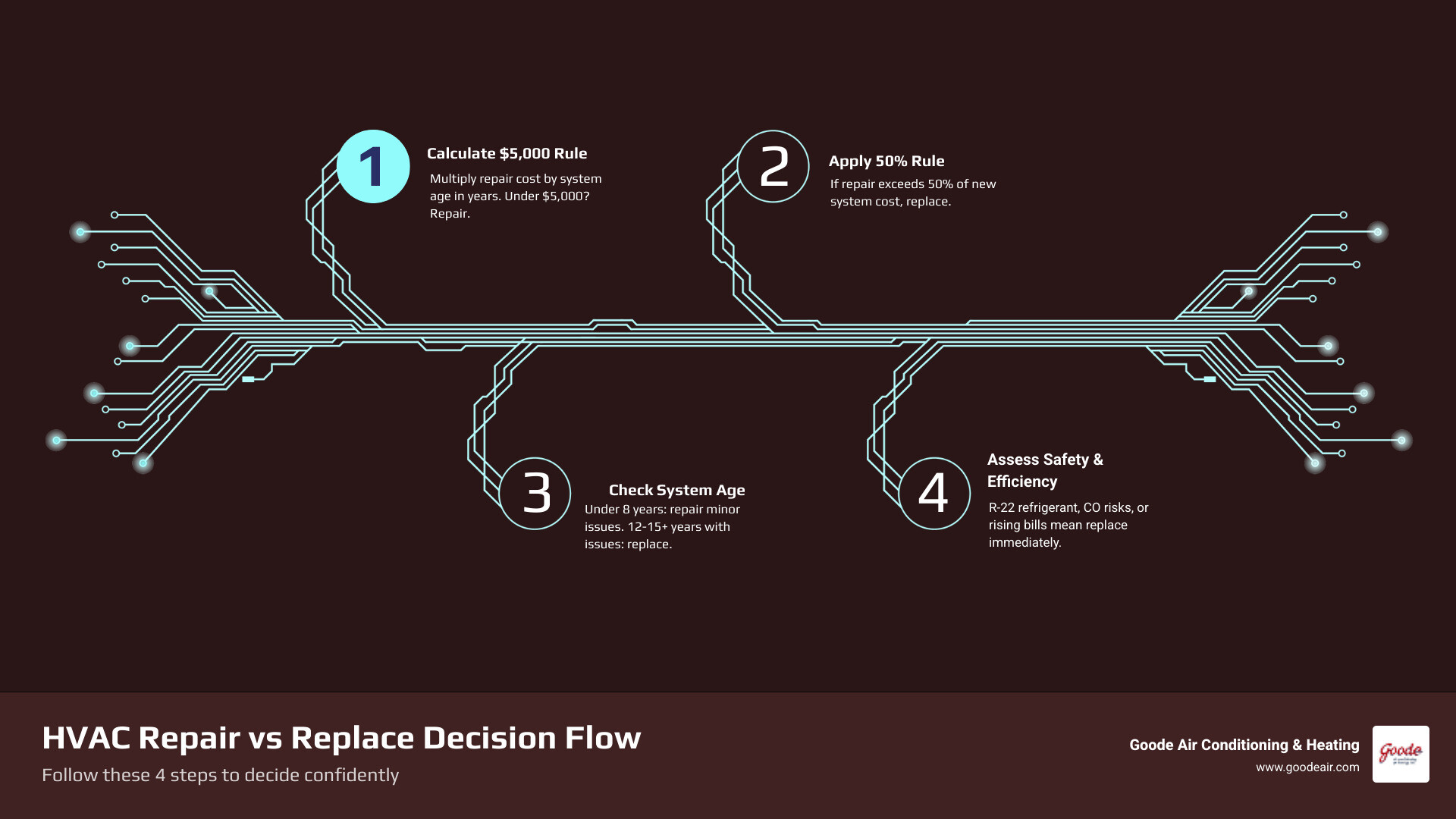
How does the $5,000 rule apply to my repair vs replace your hvac decision guide?
The $5,000 rule is a widely accepted financial tiebreaker in the HVAC industry. It’s a simple multiplication formula that captures the remaining useful life of your equipment.
To use it, take the age of your system in years and multiply it by the quoted repair cost.
- If the result is over $5,000: It is generally time to replace the unit.
- If the result is under $5,000: A repair is likely a defensible financial move.
For example, if you have a 12-year-old AC unit in Kingwood that needs a repair totaling $600, the math looks like this: 12 x 600 = 7,200. Since 7,200 is greater than 5,000, the "retirement" of that unit is the smarter move. Conversely, a 5-year-old unit needing that same $600 repair (5 x 600 = 3,000) is a clear candidate for HVAC Repair Humble TX.
Understanding the 50% rule for major components
The 50% rule is even more direct. If the cost of a single repair exceeds 50% of the value of a brand-new system, replacement is almost always the better choice.
This rule is particularly relevant when dealing with "catastrophic" failures, such as a seized compressor or a leaking evaporator coil. These components are the "engine" of your HVAC system. When they fail on an older unit, it is often a sign of "systemic fatigue." Replacing a compressor on a 14-year-old unit is like putting a brand-new engine in a car with 300,000 miles—the transmission or the radiator is likely to be the next thing to go.
If you find yourself in this situation, we often suggest looking into HVAC Replacement Fall Creek TX to ensure you aren't stuck in a cycle of "domino effect" repairs where one fix leads directly to another.
Safety Risks and Technical Obsolescence
While math is important, safety is non-negotiable. There are certain scenarios where we will recommend replacement regardless of the age or the cost of the repair. Your home should be a sanctuary, and a failing HVAC system can occasionally pose serious risks to your family’s health.
Critical safety hazards that require immediate replacement
The most serious safety concern we encounter is a cracked heat exchanger in a gas furnace. The heat exchanger is the metal wall that separates the combustion process (the fire) from the air that circulates through your home. If this metal develops even a tiny crack, carbon monoxide can leak into your living spaces.
Carbon monoxide is odorless and colorless, making it a "silent killer." Because a heat exchanger cannot be reliably "patched," the only safe options are to replace the component (which is often nearly as expensive as a new furnace) or replace the entire system. If you notice any Warning Signs Your Heating System Needs Immediate Repair, such as soot around the registers or a yellow, flickering burner flame, you must act immediately.
Fire hazards are another concern, particularly with aging electrical components or frayed wiring in older units. While some might consider DIY Heating Repairs vs Hiring Pros, electrical and gas-related issues should always be handled by a professional to prevent catastrophic property damage.
Environmental impact and refrigerant phase-outs
Technical obsolescence is a major factor in our repair vs replace your hvac decision guide. If your air conditioner was manufactured before 2010, it likely uses R-22 refrigerant (often called Freon).
The EPA has phased out R-22 because of its harmful effects on the ozone layer. As of 2026, the supply of R-22 is extremely limited and incredibly expensive. If an older system has a significant refrigerant leak, the cost to "recharge" it can be staggering. Furthermore, putting expensive, restricted refrigerant into a system that is already leaking is often a temporary fix.
Modern systems use R-410A or the even newer R-454B refrigerants, which are more eco-friendly and more efficient at transferring heat. Upgrading to a modern system ensures your home is in compliance with current environmental regulations and protects you from the skyrocketing costs of obsolete parts.
Efficiency Ratings and Comfort Performance
Sometimes, a system "works" in the sense that it blows air, but it fails to provide actual comfort. In Northeast Houston, we don't just deal with heat; we deal with oppressive humidity. If your system is old, it likely lacks the technology to manage the moisture levels in your home effectively.
What are the comfort signs in a repair vs replace your hvac decision guide?
Have you noticed that your home feels "sticky" even when the AC is running? Or perhaps the upstairs bedrooms in your Kingwood home are sweltering while the living room is a freezer? These are signs of poor comfort performance.
Newer systems offer variable-speed technology. Unlike older units that are either "100% on" or "completely off," variable-speed systems can dial their output up or down. This allows them to run for longer, lower-intensity cycles, which is the key to removing humidity from the air. If you are constantly adjusting the thermostat but never feel quite right, it might be time for HVAC Repair Kingwood TX to evaluate if a replacement could solve those chronic comfort issues.
Calculating long-term energy savings
One of the most compelling reasons to replace an aging system is the "hidden tax" of high utility bills. HVAC efficiency is measured by ratings like SEER2 (for cooling), AFUE (for gas furnaces), and HSPF2 (for heat pumps).
- SEER2: Modern minimums are typically 14.3, but high-efficiency units can reach 20 or higher. A system from 15 years ago might only be a 10 SEER.
- AFUE: Older furnaces might be 80% efficient, meaning 20 cents of every dollar spent on gas goes up the chimney. Modern high-efficiency furnaces can reach 95% to 98% AFUE.
Upgrading to a new, standard model can often save you 20% to 40% on your monthly energy costs. Over the 15-year lifespan of a new unit, those savings can actually offset a significant portion of the replacement cost. When you factor in modern features like smart thermostats and zoning, the financial benefits of Heat Pump vs AC Texas Cost Comfort become even clearer.
Additionally, as of April 2026, there are still various federal tax credits and local utility rebates available for homeowners who choose ENERGY STAR® certified equipment. These incentives can further reduce the net investment of a new system.
Frequently Asked Questions about the Repair vs Replace Your HVAC Decision Guide
When is a repair worth the investment?
A repair is usually worth it if your system is under 10 years old and the issue is isolated. For example, replacing a capacitor, a contactor, or a fan motor is a routine fix that can extend the life of a healthy system. If your unit is still under its manufacturer's warranty (which typically lasts 10 years), the cost of parts will be covered, making repair the obvious choice.
What questions should I ask a professional before deciding?
Before you sign off on a major repair, we recommend asking your technician these four questions:
- What caused this failure? (Was it just age, or is there an underlying issue like poor airflow?)
- What is the overall condition of the rest of the system? (Are the coils corroded? Is the compressor showing signs of wear?)
- Are parts for this model still readily available? (This is crucial for systems over 15 years old.)
- How much would I save on my monthly bills if I upgraded today?
How can maintenance delay a full replacement?
The best way to stay on the "repair" side of the guide for as long as possible is through consistent maintenance.
- Filter Changes: Replace your air filters every 1 to 3 months to prevent the system from overworking.
- Coil Cleaning: Dirty coils force the compressor to work harder, leading to early failure.
- Annual Tune-ups: A professional inspection can catch a small issue (like a failing capacitor) before it turns into a big issue (like a blown compressor).
Conclusion
Making the call between repair and replacement doesn't have to be stressful. By using the $5,000 rule, prioritizing safety, and considering the long-term energy savings of modern technology, you can make a choice that fits your budget and your family's needs.
At Goode Air Conditioning & Heating, we have spent the last 50 years helping our neighbors in Northeast Houston navigate these exact decisions. Whether you are in Roman Forest, TX, or Walden on Lake Houston, our family-owned business is built on transparent pricing and a 100% satisfaction guarantee. We aren't here to pressure you into a sale; we're here to provide the honest, expert advice you need to keep your home comfortable for years to come.
If you are still unsure which path is right for you, we invite you to reach out to our team. We can provide a comprehensive system evaluation and help you run the math for your specific home. Visit us today at https://www.goodeair.com/hvac/hvac-company-roman-forest-tx to schedule a consultation with a team that treats your home like our own.

Customer Testimonials
See why so many homeowners trust Goode Air Conditioning & Heating, Inc.—our 4.8-star Google rating and hundreds of happy customers speak to the quality, care, and service we deliver every day.

The technician Goode AC is one of the best businesses I know of. I have had their annual maintenance check up for several years. I’m so impressed with the technician who has serviced my AC several times. Always on time, pleasant, considerate, thorough in his work and explains the problems where I can easily understand. Thankful for doing business with professionals.
I have been a customer for at least 30 years. They have replaced 3 air conditioners, a furnace and heat exchanger. Today they replaced the air ducts in my attic that were falling apart and never been cleaned. Wonderful job, polite workers, great clean up. I can already tell the difference in the quality of the air. Love you guys!!
Great experience today with Goode Air Conditioning. Hoger, our technician, was very knowledgeable and provided excellent customer service. We look forward to our Spring maintenance visit.
I have used Goode Air Conditioning and Heating for many years. The company has excellent customer service and the technicians are knowledgeable, thorough and professional.