





Why the Southeast Texas Climate Is So Hard on Your HVAC System
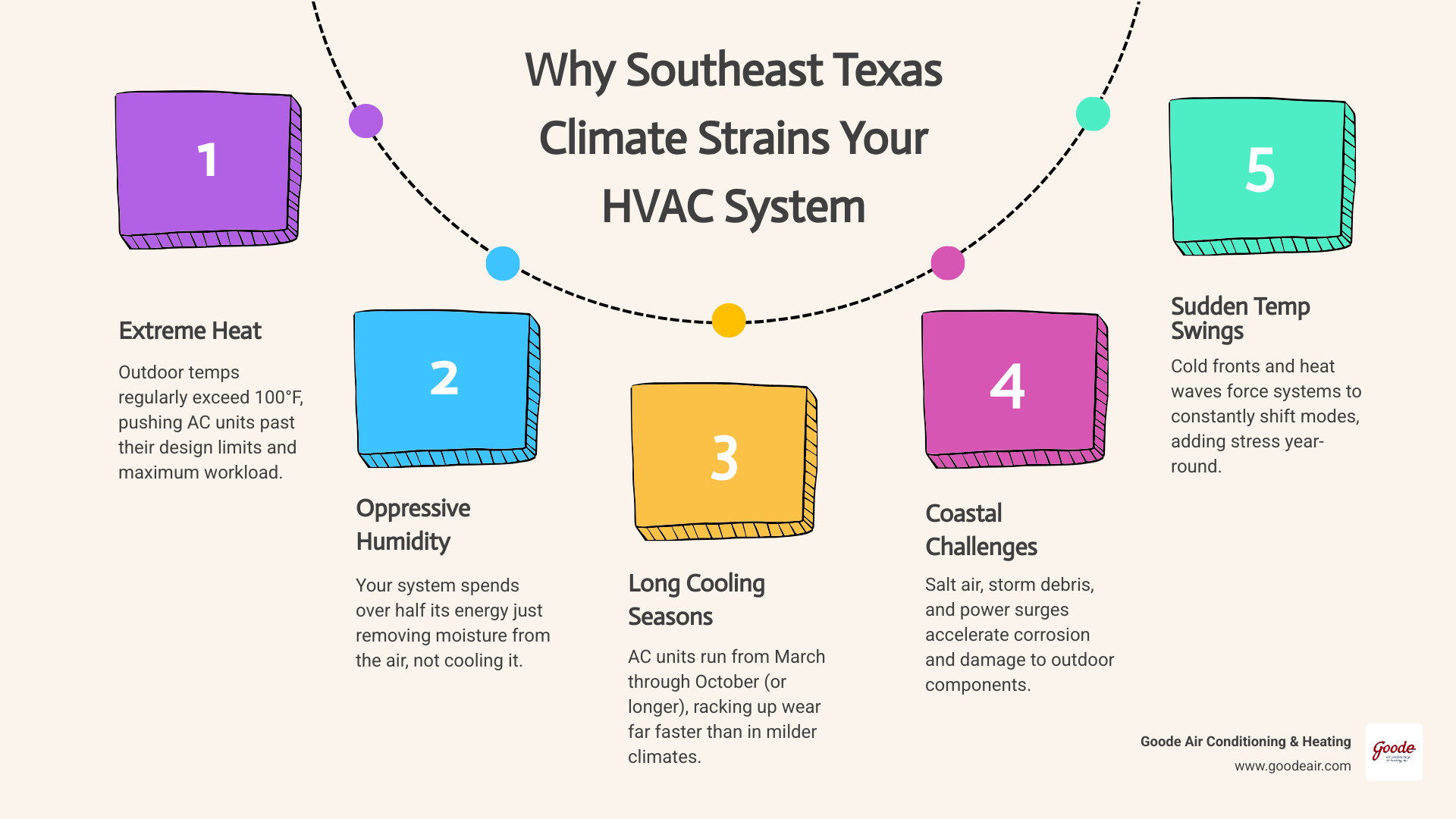
How southeast texas climate affects your hvac system comes down to a few brutal realities working against your equipment all at once:
- Extreme heat - Outdoor temps regularly exceed 100°F, pushing most AC units past their design limits
- Oppressive humidity - Your system spends more than half its energy just removing moisture from the air, not actually cooling it
- Long cooling seasons - AC units in this region run from March through October, sometimes longer, racking up wear far faster than in milder climates
- Salt air and coastal weather - Corrosion from Gulf air, storm debris, and power surges accelerate damage to outdoor components
- Sudden temperature swings - Cold fronts and heat waves force your system to constantly shift modes, adding stress year-round
The result? HVAC systems in Southeast Texas typically last just 10 to 15 years — sometimes less — compared to 20 or more years in cooler, drier parts of the country. And during the hottest weeks of summer, even a perfectly healthy system may struggle to keep your home below 78°F when it's 100°F outside.
If you live in Northeast Houston, you already know this feeling. The air is thick, the summers are long, and your energy bills seem to climb no matter what you do. Your HVAC system isn't failing you — it's just fighting one of the toughest climates in the country, often without the support it needs to do so efficiently.
This guide breaks down exactly what the Southeast Texas climate does to your HVAC equipment, the warning signs that your system is losing the battle, and the practical steps you can take to protect your home comfort and extend your system's life.
The "Texas Tax": How Southeast Texas Climate Affects Your HVAC System
In the HVAC industry, we often talk about the "Texas Tax." It’s not a literal government fee, but rather the heavy price your equipment pays for operating in our unique environment. When we look at how southeast texas climate affects your hvac system, we have to consider that most residential air conditioners are engineered to handle outdoor temperatures up to about 95°F. In cities like Humble, Kingwood, and Atascocita, we routinely blow past that number for weeks at a time.
A critical concept to understand is the difference between sensible heat and latent heat. Sensible heat is what you see on the thermometer. Latent heat is the energy contained in the water vapor in the air. Because our humidity is so high, your Air Conditioning Services have to work twice as hard. The system must first wring the water out of the air (latent cooling) before it can effectively lower the temperature you actually feel (sensible cooling).
Furthermore, there is a physical limit to what a standard AC can do. Most systems are designed to create a 20-degree temperature drop between the outdoor air and the indoor air. On a 100°F day in Crosby or Huffman, your system is technically "winning" if it keeps your living room at 80°F. Pushing it lower than that requires the unit to run non-stop, leading to massive energy consumption spikes and mechanical exhaustion.
Extreme Heat and the 95-Degree Design Limit
When the mercury hits triple digits, your AC enters a state of "maximum workload." Since the unit is designed for a 95-degree threshold, anything above that causes the system to lose capacity. It simply cannot reject heat to the outdoors as efficiently. This is why you might notice your vents blowing air that feels slightly warmer during the hottest part of the afternoon.
If your system is already struggling with a dirty coil or a low refrigerant charge, these 100-degree days are usually when a total breakdown occurs. If you find your home climbing to 82°F or 85°F despite the AC running all day, it’s a sign that the heat has overwhelmed the system’s capacity, and you likely need HVAC Repair in Kingwood, TX to restore its efficiency.
High Humidity: Why Your AC is a Massive Dehumidifier
In Southeast Texas, your air conditioner is essentially a high-powered dehumidifier that happens to blow cold air as a side effect. In fact, in high-humidity environments like Porter or New Caney, an HVAC system can spend more than half of its cooling capacity simply "drying" the air.
This process happens at the evaporator coil. As warm, moist air passes over the cold coils, water condenses and drips into a drain pan. During a typical summer day, a central AC unit can remove several gallons of water from your home’s air. However, if the humidity is too high, the evaporator coil can become saturated, slowing down the cooling process and forcing the system to run longer cycles. This is a primary reason why HVAC Service in New Caney, TX often focuses heavily on moisture management and drainage systems.
Coastal Challenges: Salt Air, Storms, and System Longevity
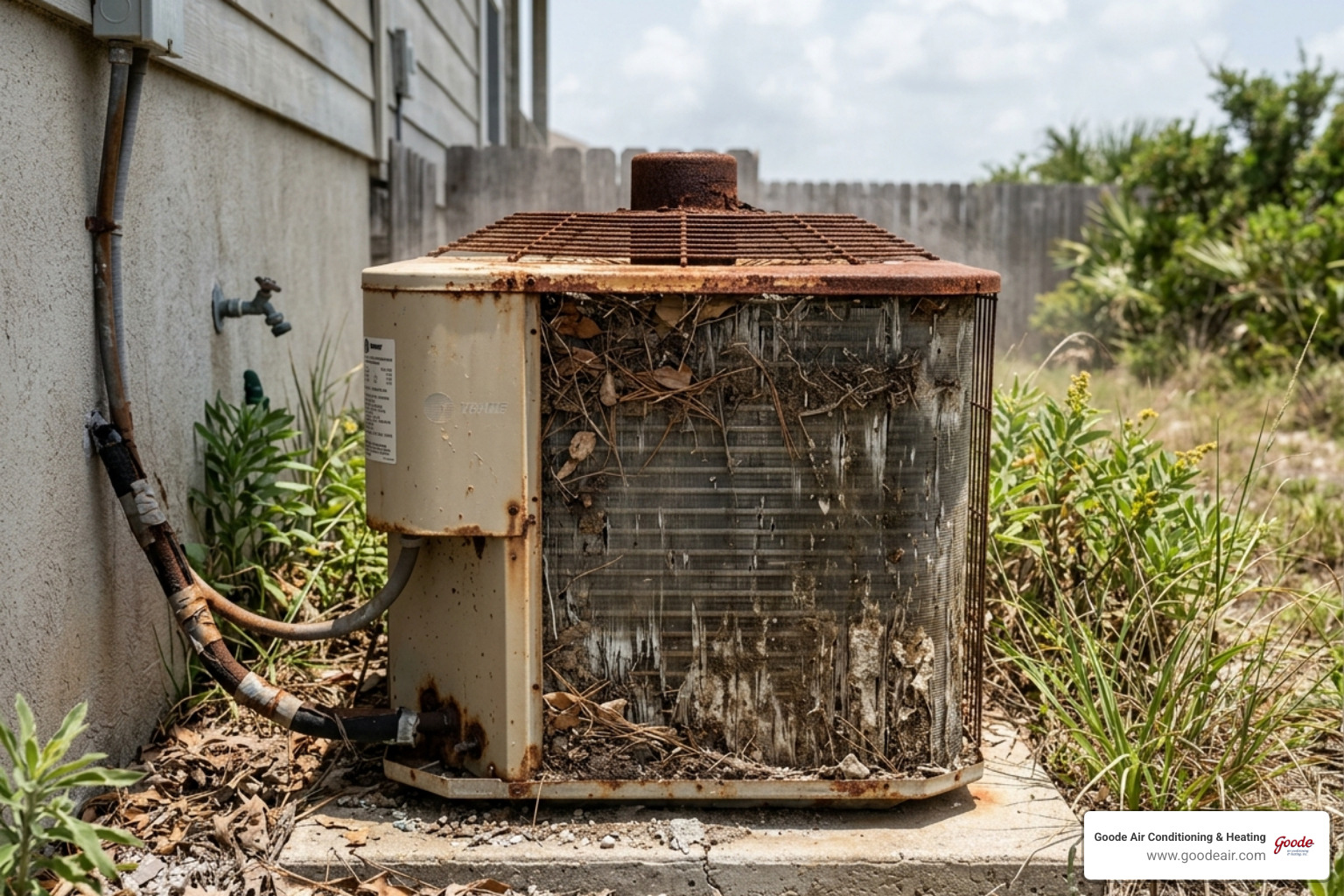
For our neighbors in Summerwood or Fall Creek, proximity to the coast introduces another enemy: salt-laden air. Even if you aren't directly on the beach, the moisture moving inland from the Gulf carries microscopic salt particles. This leads to galvanic corrosion—a chemical reaction that eats away at the aluminum fins and copper tubing of your outdoor condenser.
This corrosion, often called "pitting," creates tiny holes in the coils, leading to refrigerant leaks. While an AC unit in a dry, inland state might last 20 years, the coastal influence means we often ask How Long Does an AC System Last in Texas? and find the answer is closer to 10–12 years. Without regular rinsing and professional coatings, the salt air will literally dissolve your investment from the outside in.
Severe Weather and Electrical Stress
Southeast Texas is no stranger to violent thunderstorms and hurricanes. These events create two major problems for HVAC systems: physical debris and electrical instability. High winds can shove leaves, pine needles, and dirt into the outdoor unit, choking off the airflow it needs to breathe.
Even more dangerous are the power surges that accompany these storms. A sudden spike in the electrical grid can fry sensitive components like capacitors and circuit boards. In the winter, when you rely on Heating Services, a damaged capacitor can prevent your furnace or heat pump from starting, leaving you in the cold during a sudden freeze.
Sudden Temperature Fluctuations and the Southeast Texas Climate
Our climate is famous for "weather whiplash." You might wake up to a 40-degree morning and be wearing short sleeves by a 75-degree afternoon. This constant shifting puts immense stress on the reversing valves and compressors of heat pumps.
Because we use Heat Pump Services year-round for both cooling and heating, these systems never get a "seasonal break." While a furnace in the north sleeps all summer, a Texas heat pump is a marathon runner. Understanding the Heat Pump Benefits for Southeast Texas Homeowners includes recognizing that while they are highly efficient, they require more frequent check-ups because they are always on duty.
Signs Your System is Struggling with the Southeast Texas Climate
How do you know if the climate is winning the war against your comfort? Use the table below to spot the difference between a system that is working hard and a system that is failing.
| Symptom | Normal Operation (Peak Heat) | Climate-Stressed / Failing |
|---|---|---|
| Indoor Temp | Stays within 20°F of outdoor temp | Home temp rises to 80°F+ regardless of setting |
| Run Time | Long cycles during the afternoon | Runs 24/7 without reaching the set point |
| Humidity | Air feels crisp and dry | Air feels "clammy" or sticky indoors |
| Smell | Neutral | Musty, "dirty sock" odors from vents |
| Utility Bills | Expected seasonal increase | Dramatic, unexplained spikes in usage |
If you notice musty odors, it often indicates biological growth on the evaporator coils or inside the ductwork, fueled by excess moisture. This is a clear sign that you need HVAC Maintenance for Maximum Energy Savings to clean the system and restore its dehumidification abilities.
The 5,000 Rule for Replacement
At Goode Air Conditioning & Heating, we often use the "5,000 Rule" to help homeowners in Humble and Spring decide between repair and replacement. Take the age of your equipment and multiply it by the repair quote. If the total exceeds 5,000, it is usually smarter to invest in a new, high-efficiency system.
For example, if a 12-year-old unit needs a $500 repair (12 x 500 = 6,000), you are likely throwing money at a system that is already nearing the end of its 10–15 year Texas lifespan. Replacing it with a modern unit will not only improve your comfort but also slash the energy bills that the old, struggling unit was driving up.
Performance Gaps on 100-Degree Days
On a 100-degree day, your system is at its limit. If there are any gaps in your home’s "envelope"—such as poor attic insulation or leaky ductwork—the AC will never be able to keep up. We often find that "performance gaps" aren't just about the AC unit itself, but about the ductwork losing cold air into a 140-degree attic. Ensuring your ducts are sealed and your insulation is thick is just as important as the AC unit sitting outside.
Proactive Strategies to Protect Your Home Comfort
You don't have to be a victim of the Texas humidity. There are several proactive steps you can take to help your system survive the season. The most important is HVAC Maintenance for Maximum Energy Savings. A clean system is an efficient system. When coils are caked with dust and pollen, they can't transfer heat, forcing the compressor to work harder and die younger.
Maintenance for Maximum Efficiency in Southeast Texas
In our region, the standard "change your filter every 90 days" advice doesn't apply. Because of heavy pollen counts in the spring and constant runtimes in the summer, we recommend checking your 1-inch filters every 30 days. A clogged filter restricts airflow, which can cause your evaporator coil to freeze into a block of ice—even when it's 100°F outside!
Other essential maintenance steps include:
- Clearing Debris: Keep at least two feet of clearance around your outdoor unit.
- Drain Line Cleaning: High humidity means lots of condensation. If your drain line clogs with algae, it can flood your attic or shut down your system.
- Professional Inspections: Our Air Conditioning Services include checking refrigerant levels and electrical connections that the heat can loosen over time.
Upgrading for Resilience: Sizing and Dehumidification in the Southeast Texas Climate
If you are looking to upgrade, don't just buy the biggest unit available. An oversized AC is actually worse for humidity. It will cool the room so fast that it shuts off before it has a chance to remove the moisture, leaving you with a home that is "cold and clammy."
Instead, look for these features:
- Variable-Speed Compressors: These allow the system to run at lower speeds for longer periods, which is the gold standard for removing humidity.
- Whole-Home Dehumidifiers: These work alongside your AC to pull moisture out of the air even when the cooling isn't running.
- SEER2 Compliance: New regulations ensure that systems are tested under more realistic "Texas-style" conditions.
- Heat Pump Efficiency: Modern units offer incredible Heat Pump Benefits for Southeast Texas Homeowners, providing both heating and cooling with much lower energy consumption than older models.
Frequently Asked Questions
Why does my AC struggle when it hits 100°F outside?
Residential AC systems are generally designed to maintain a 20-degree difference from the outdoor temperature. When it hits 100°F, your system is working at absolute maximum capacity to keep the house at 78°F or 80°F. If your home is poorly insulated or your coils are dirty, that "struggle" becomes even more apparent.
How often should I change my filters during a Texas summer?
We recommend checking them every 30 days. Between the heavy oak and pine pollen in the spring and the fact that your system likely runs 12+ hours a day in July, filters get dirty much faster here than the manufacturer's packaging suggests.
Should I turn my AC off when I leave for work to save energy?
Never. In Southeast Texas, turning the AC off allows humidity to soak into your drywall, furniture, and carpet. This can lead to mold growth and "musty" smells. Instead, raise the thermostat by 5 to 7 degrees. This keeps the humidity under control without forcing the system to work for hours to cool the house back down when you get home.
Conclusion
The Southeast Texas climate is undeniably tough on HVAC systems, but with the right care and expert support, you can maintain a cool, dry, and comfortable home regardless of the weather outside. At Goode Air Conditioning & Heating, we have spent over 50 years helping our neighbors in Humble, Kingwood, Atascocita, and across Northeast Houston navigate these challenges.
As a family-owned business, we believe in transparent pricing and stand behind our work with a 100% satisfaction guarantee. Whether you need a quick repair in Valley Ranch, a system replacement in Roman Forest, or a seasonal tune-up in Summerwood, our NATE-certified technicians are ready to help.
Don't let the humidity win. Protect your investment and your family's comfort by staying ahead of the "Texas Tax." Schedule your HVAC maintenance in Humble, TX today and experience the Goode Air difference.

Customer Testimonials
See why so many homeowners trust Goode Air Conditioning & Heating, Inc.—our 4.8-star Google rating and hundreds of happy customers speak to the quality, care, and service we deliver every day.

The technician Goode AC is one of the best businesses I know of. I have had their annual maintenance check up for several years. I’m so impressed with the technician who has serviced my AC several times. Always on time, pleasant, considerate, thorough in his work and explains the problems where I can easily understand. Thankful for doing business with professionals.
I have been a customer for at least 30 years. They have replaced 3 air conditioners, a furnace and heat exchanger. Today they replaced the air ducts in my attic that were falling apart and never been cleaned. Wonderful job, polite workers, great clean up. I can already tell the difference in the quality of the air. Love you guys!!
Great experience today with Goode Air Conditioning. Hoger, our technician, was very knowledgeable and provided excellent customer service. We look forward to our Spring maintenance visit.
I have used Goode Air Conditioning and Heating for many years. The company has excellent customer service and the technicians are knowledgeable, thorough and professional.