





What Is a Heat Pump and How Does It Actually Work?
How does a heat pump work is a surprisingly simple question with a fascinating answer: instead of burning fuel or generating heat from scratch, a heat pump moves existing heat from one place to another using a refrigerant and a small amount of electricity.
Here is the short version:
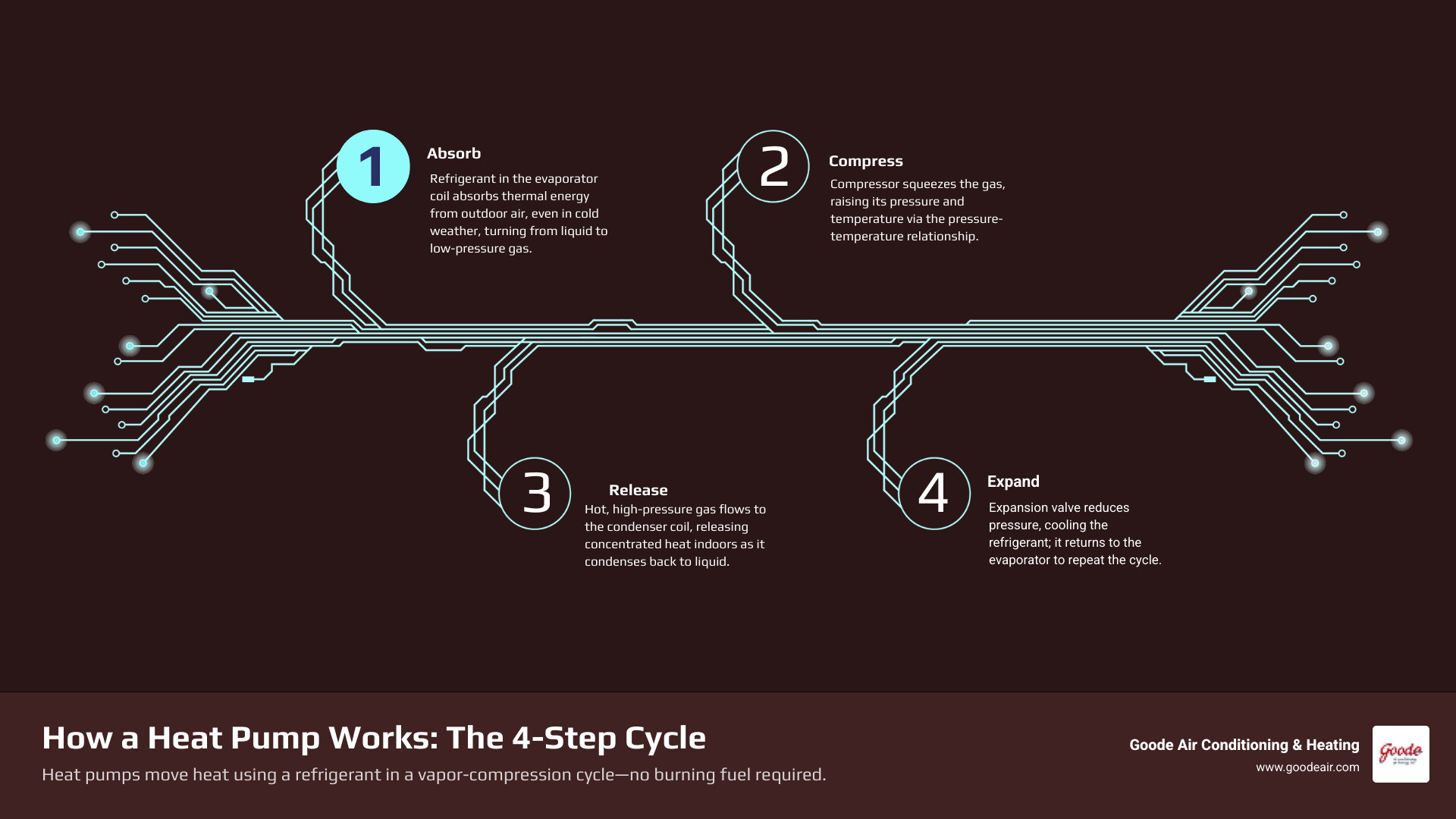
- Absorb - The system pulls heat energy from outdoor air (or the ground) into a refrigerant
- Compress - A compressor raises the refrigerant's pressure, which raises its temperature
- Release - That concentrated heat is transferred indoors through a coil
- Expand - The refrigerant drops in pressure, cools down, and the cycle repeats
In summer, the whole process simply runs in reverse to cool your home.
That's the core idea. For every 1 kilowatt-hour of electricity a heat pump uses, it can deliver up to 4.5 kWh of thermal energy into your home. Compare that to a gas furnace or electric resistance heater, which can only ever deliver what they consume — and you start to see why heat pumps are getting so much attention right now.
For homeowners in Northeast Houston dealing with rising energy bills and unpredictable weather swings, understanding how your HVAC system actually works is the first step toward making a smarter choice for your home and your wallet.
The Core Mechanics: How Does a Heat Pump Work?
To truly grasp the answer to how does a heat pump work, we have to look at the "magic" of the vapor-compression cycle. While it might seem like science fiction that a machine can pull heat out of thin air on a chilly night in Kingwood or Atascocita, it is actually grounded in fundamental physics.
The process relies on a special fluid called refrigerant. This substance has an incredibly low boiling point, meaning it can turn from a liquid into a gas even at temperatures that feel freezing to us. As we follow the refrigerant through its journey, we see it undergo constant phase changes—flipping between liquid and gas states.
When the refrigerant evaporates (turns into gas), it absorbs a massive amount of "latent heat" from its surroundings. When it condenses (turns back into liquid), it releases that heat. By manipulating the pressure of this refrigerant using a compressor and an expansion valve, we can control exactly where and when that heat is absorbed or released.
This entire system is a clever dance with the Second Law of Thermodynamics. Naturally, heat wants to flow from a hot area to a cold area. A heat pump uses a small amount of mechanical energy to reverse that flow, "pumping" heat uphill from the cooler outdoors to the warmer indoors. For a deeper dive into the science behind this, check out our guide on Heat Pump Technology Principles Texas.
The Science of How a Heat Pump Works in Winter
One of the most common questions we get at Goode Air Conditioning & Heating is: "How can there be heat in the air when it's 35 degrees outside in Humble?"
It helps to remember that "heat" is a relative term in physics. Technically, there is thermal energy in the air all the way down to "absolute zero" (-459.67°F). Even on a frosty Texas morning, the outdoor air contains a vast amount of thermal energy.
In heating mode, the outdoor unit acts as an evaporator. The cold, liquid refrigerant flows through the outdoor coils. Because the refrigerant is much colder than the outdoor air, it absorbs heat from that air, causing the refrigerant to boil and turn into a low-pressure gas.
This gas then travels to the compressor, which squeezes it tightly. If you’ve ever used a hand pump to inflate a bicycle tire, you’ve noticed the pump gets hot—that’s the physics of compression in action. By the time the refrigerant leaves the compressor, it is a high-pressure, high-temperature vapor. This hot gas is then sent to the indoor coil, where it releases its heat into your home’s air. This efficiency is why many are switching; learn more about Texas Heat Pumps Energy Savings to see the impact on your utility bills.
Reversing the Flow: How a Heat Pump Works in Summer
The "secret life" of a heat pump is its ability to lead a double life. When the humid Houston summer hits Tavola or Valley Ranch, your heat pump doesn't need to be swapped out for an air conditioner—it becomes an air conditioner.
This transformation is made possible by a component called the reversing valve. When you flip your thermostat to "cool," this valve physically redirects the flow of refrigerant. Now, the indoor coil acts as the evaporator (absorbing heat from your living room) and the outdoor unit acts as the condenser (rejecting that heat into the atmosphere).
Beyond just cooling the air, this process provides essential dehumidification. As warm, humid indoor air passes over the cold indoor coils, moisture condenses on the metal and is drained away. This is a game-changer for comfort in Foxwood and Summerwood, where the humidity can often feel worse than the heat itself. If you're debating between a standard unit and this technology, our comparison of Heat Pump vs AC Texas Cost Comfort breaks down the local benefits.
Essential Components of the Heat Pump System
To understand how does a heat pump work in a practical sense, it helps to know the players involved. A modern system is a finely tuned machine consisting of several key parts:
- The Compressor: Often called the "heart" of the system, this unit sits in the outdoor cabinet. It uses electricity to pressurize the refrigerant, moving it through the cycle and raising its temperature.
- The Reversing Valve: The "traffic cop" that determines whether the system is in heating or cooling mode by switching the direction of the refrigerant.
- The Evaporator and Condenser Coils: These are the heat exchangers. In winter, the outdoor coil is the evaporator and the indoor coil is the condenser. In summer, they swap roles.
- The Expansion Valve: This acts as a regulator, abruptly dropping the pressure of the refrigerant before it enters the evaporator coil, which causes it to cool down rapidly.
- The Refrigerant: The "blood" of the system. Modern units are moving toward low-GWP (Global Warming Potential) options like R32 or R290, which are more environmentally friendly and often more efficient than older chemicals.
At Goode Air, we’ve seen HVAC technology evolve over our 50 years in business. Today’s scroll compressors, for example, are much quieter and more durable than the piston-style compressors of the past. They use two spiral-shaped components to compress the refrigerant, resulting in fewer moving parts and higher reliability for homes in Porter and New Caney.
Understanding Efficiency and the Coefficient of Performance (COP)
When we talk about heat pump efficiency, we use a metric called the Coefficient of Performance, or COP. This is a simple ratio: the amount of heat energy delivered divided by the amount of electrical energy consumed.
If a heater has a COP of 1, it means for every 1 watt of electricity you put in, you get 1 watt of heat out. This is how standard electric "strip" heaters work. However, because heat pumps move heat instead of creating it, they can achieve COPs of 3, 4, or even 5. This means they are 300% to 500% efficient!
| Heat Pump Type | Typical COP (at 47°F) | Energy Transfer Ratio |
|---|---|---|
| Air-Source (ASHP) | 3.0 – 4.5 | 1:4 |
| Ground-Source (Geothermal) | 3.5 – 6.0 | 1:5+ |
| Electric Resistance | 1.0 | 1:1 |
In addition to COP, you’ll see ratings like SEER2 (Seasonal Energy Efficiency Ratio) for cooling and HSPF2 (Heating Seasonal Performance Factor) for heating. These are Department of Energy standards that help homeowners in Kingwood and Spring compare the year-round performance of different models. Higher numbers always mean more savings on your monthly bill. You can find more details on our Heat Pumps service page.
Exploring Different Types of Heat Pump Technology
Not all heat pumps are created equal. Depending on your property in Crosby or Huffman, one type might be significantly better than the rest.
- Air-Source Heat Pumps (ASHP): The most common type. They swap heat with the outside air and are relatively easy to install.
- Ground-Source (Geothermal): These systems use a "loop" of pipes buried underground. Since the earth stays at a consistent temperature (around 65-70°F in Texas) year-round, these are incredibly efficient, though they require more space and a higher initial setup.
- Water-Source Heat Pumps: Similar to geothermal, but they swap heat with a body of water like a lake or a well.
- Mini-Split (Ductless) Systems: Perfect for older homes in Roman Forest or room additions in Eagle Springs that don't have existing ductwork. These allow for "zoning," where you only heat or cool the rooms you are actually using.
- Hybrid (Dual Fuel) Systems: These combine an electric heat pump with a gas furnace. The heat pump handles the mild days, and the furnace kicks in only during those rare, extreme Houston freezes.
If you’re considering an upgrade, our Heat Pump Installation Guide Spring TX provides a localized roadmap for what to expect during the process.
Overcoming Challenges: Defrost Cycles and Performance Factors
No system is perfect, and heat pumps do face a unique challenge in the winter: ice. When it's cold and humid outside—a common scenario in Fall Creek and Kenswick—moisture can freeze on the outdoor coils.
If too much ice builds up, it acts as an insulator, preventing the refrigerant from absorbing heat. To fix this, modern heat pumps have an automatic "defrost mode." The system temporarily reverses itself, sending warm refrigerant to the outdoor coil to melt the ice. You might see a bit of steam rising from the unit or hear a "whoosh" sound—don't worry, that’s just the system doing its job!
Performance can also be affected by:
- Installation Quality: A system that isn't sized correctly or has leaky ducts will never reach its rated efficiency.
- Maintenance: Dirty filters or clogged coils force the compressor to work harder, shortening its lifespan and raising your bills.
- Outdoor Temperature: While modern "cold-climate" heat pumps are amazing, standard models do lose some efficiency as the temperature drops toward freezing.
Frequently Asked Questions about Heat Pump Mechanics
Can a heat pump really heat my home when it's freezing outside?
Absolutely. While older models struggled when the mercury dipped, modern "Cold Climate Heat Pumps" are designed to operate efficiently at temperatures as low as -22°F. In Northeast Houston, where our "freezes" are usually mild and short-lived, a well-maintained heat pump is more than capable of keeping you toasty. Even at 0°F, there is still plenty of thermal energy in the air for the refrigerant to extract.
What is the difference between a heat pump and a furnace?
The main difference is how they get the heat. A furnace burns fuel (like natural gas) or uses high-resistance electric coils to create heat. A heat pump simply moves heat from outside to inside. Because moving heat takes much less energy than creating it, heat pumps have a significantly smaller carbon footprint and lower energy consumption. Plus, a furnace can't cool your home in July, but a heat pump can!
How long do modern heat pump systems typically last?
Most modern systems have a lifespan of 10 to 25 years. The wide range depends heavily on two things: the local climate and how well you maintain the unit. In our humid, salty Gulf Coast air, regular maintenance is vital. We recommend a professional inspection twice a year—once before the cooling season and once before the heating season—to ensure components like the compressor and reversing valve stay in top shape.
Conclusion
Understanding how does a heat pump work reveals a technology that is both elegant and incredibly practical for our Texas climate. By moving heat rather than creating it, these systems offer a path to superior home comfort and lower energy bills. Whether you are in Humble, Kingwood, or Atascocita, the right heat pump system can simplify your home's HVAC needs into one efficient package.
At Goode Air Conditioning & Heating, we’ve spent the last 50 years helping our neighbors in Northeast Houston navigate these choices. As a family-owned business, we value transparency and quality above all else, backed by our 100% satisfaction guarantee. If you're ready to see if this technology is right for your home, take a look at our Heat Pump Installation Humble TX Guide for more local insights.
Don't leave your comfort to chance. Schedule your professional heat pump consultation today and let our experts help you find the perfect solution for your family.

Customer Testimonials
See why so many homeowners trust Goode Air Conditioning & Heating, Inc.—our 4.8-star Google rating and hundreds of happy customers speak to the quality, care, and service we deliver every day.

The technician Goode AC is one of the best businesses I know of. I have had their annual maintenance check up for several years. I’m so impressed with the technician who has serviced my AC several times. Always on time, pleasant, considerate, thorough in his work and explains the problems where I can easily understand. Thankful for doing business with professionals.
I have been a customer for at least 30 years. They have replaced 3 air conditioners, a furnace and heat exchanger. Today they replaced the air ducts in my attic that were falling apart and never been cleaned. Wonderful job, polite workers, great clean up. I can already tell the difference in the quality of the air. Love you guys!!
Great experience today with Goode Air Conditioning. Hoger, our technician, was very knowledgeable and provided excellent customer service. We look forward to our Spring maintenance visit.
I have used Goode Air Conditioning and Heating for many years. The company has excellent customer service and the technicians are knowledgeable, thorough and professional.