
Texas vs. Your AC: How Long Does an AC System Last in Texas?
How long does an ac system last in texas is one of the most important questions a Northeast Houston homeowner can ask — and the honest answer is shorter than most people expect.
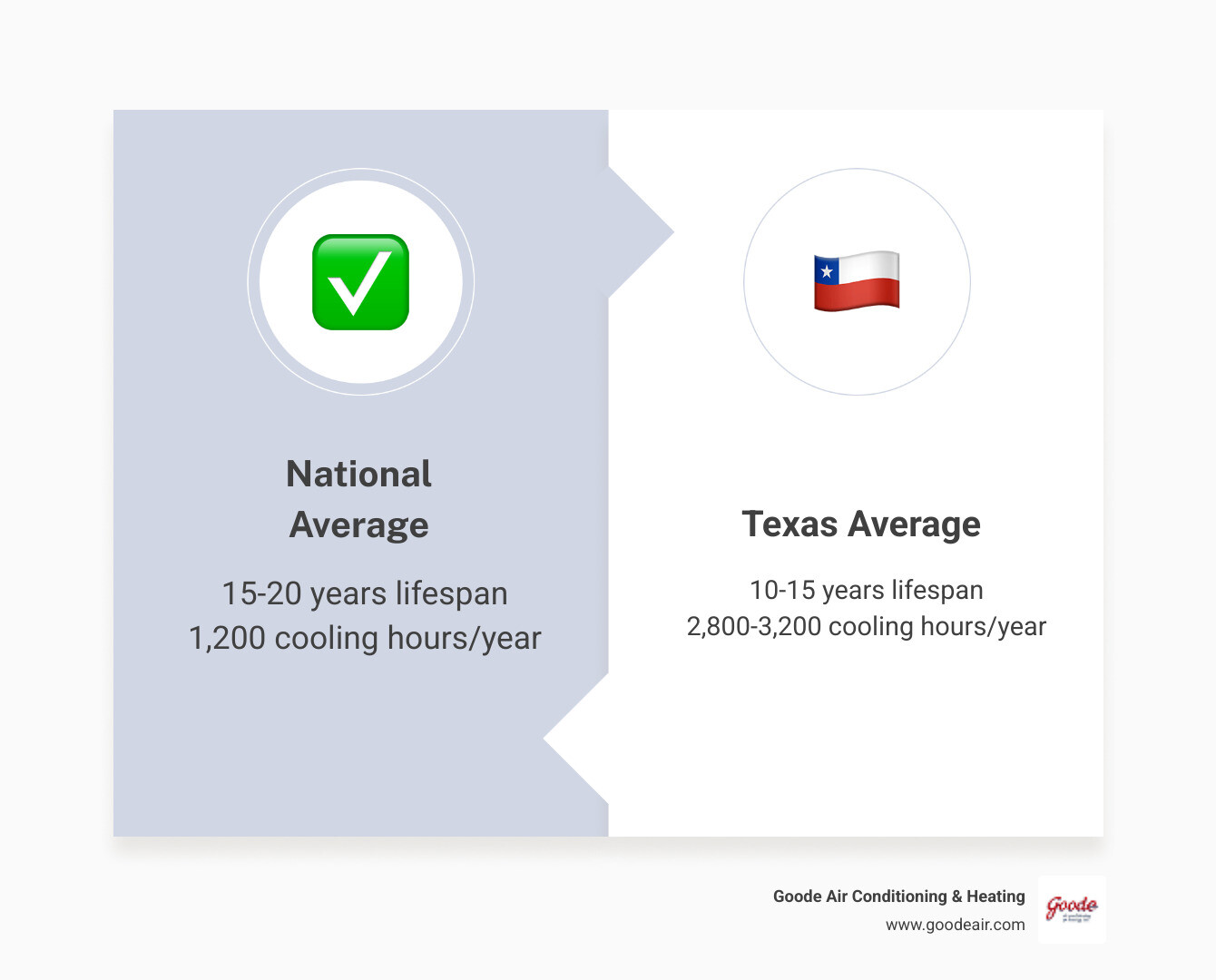
In Texas, most central AC systems last 10 to 15 years. That is a full five years less than the national average of 15 to 20 years. The reason is simple: Texas heat is relentless. Your AC runs nearly twice as many hours per year as a unit in a cooler state, and that extra wear adds up fast.
Here is a quick look at what to expect by system type:
| AC System Type | Texas Lifespan | National Average |
|---|---|---|
| Central Air Conditioner | 12-15 years | 15-20 years |
| Heat Pump | 10-15 years | 10-16 years |
| Ductless Mini-Split | 12-15 years | 15-20 years |
| Window Unit | 8-10 years | 10-12 years |
| Gas Furnace | 20-25 years | 20-30 years |
The gap between Texas and the rest of the country comes down to one thing: your system never really gets a break. In Houston, an AC can log 2,800 to 3,200 cooling hours per year — compared to a national average of roughly 1,200. That is like running a car engine at highway speed for twice as long and expecting it to last just as many miles.
In this guide, we will walk you through exactly why Texas is so hard on HVAC equipment, the warning signs that your system is nearing the end, and the maintenance habits that can squeeze a few extra years out of your unit.
Understanding the Lifespan of Different Systems in Texas
Not every cooling system is built the same, and in our neck of the woods—from Kingwood down to Humble—different technologies handle the “Texas Tax” differently.
- Central Air Conditioners: These are the workhorses of Northeast Houston. While they are designed for durability, the sheer volume of runtime usually sees them retiring between years 12 and 15. If you have a documented history of annual maintenance, you might push that to 17, but that is the upper limit for most ducted systems.
- Heat Pumps: These are becoming incredibly popular in places like Porter and New Caney because of their efficiency. However, because a heat pump provides both cooling in the summer and heating in the winter, it essentially never stops. This continuous duty cycle can compress the lifespan even further, often landing in the 10-to-13-year range. You can learn more about how these systems balance efficiency and longevity in our Heat Pump vs AC Texas Cost Comfort guide.
- Ductless Mini-Splits: These systems are fantastic for home additions in Atascocita or older homes in Crosby. They often track closer to the 15-year mark because they allow for “zonal” cooling, meaning the entire system isn’t always working at maximum capacity to cool an unused guest room.
- Gas Furnaces: Interestingly, furnaces in Texas often outlive their AC counterparts. Since we only really lean on them for a few months (and even then, sometimes just for a week of “Ice-pocalypse”), they can easily last 20 to 25 years.
If you are currently weighing your options for a new system, check out our Best Heat Pump Replacement Guide Porter TX for a deeper dive into modern equipment.
Regional Variations from Houston to Dallas
While all of Texas is hot, Northeast Houston presents a unique set of challenges compared to our neighbors in North Texas. In cities like Humble, Kingwood, and Summerwood, we deal with a specific “double whammy” of extreme heat and suffocating humidity.
In the Dallas-Fort Worth area, an AC might run for 2,400 hours a year. Down here in the Houston metro, we are looking at closer to 3,200 hours. Furthermore, our coastal proximity means the air is often heavy with moisture (and sometimes salt in communities closer to the water), which accelerates the corrosion of outdoor condenser coils.
When we talk about how long does an ac system last in texas, we have to factor in that “Houston Humidity.” A unit in a dry climate like El Paso only has to lower the temperature. Our units have to lower the temperature and wring gallons of water out of the air every single day. This dual job creates a much higher mechanical load on the compressor. For those living in Kingwood, we offer specific advice on managing these local stressors in our Heat Pump Replacement Kingwood TX Guide.
Why the Lone Star State is Tough on HVAC Equipment
If your AC unit could talk, it would probably ask for a vacation. The Texas climate is essentially a stress test for mechanical components.
High Runtime and Mechanical Wear
By the time we hit April 2026, we’ve seen a trend of longer, hotter summers starting earlier in the year. When the temperature stays above 95°F for 50 or 60 days a year, your AC compressor doesn’t just run; it cycles constantly.
A standard compressor in a moderate climate like Oregon might cycle 4,000 to 6,000 times a year. In Northeast Houston, that same compressor can easily hit 10,000+ cycles in a single season. Every time that motor starts up, it generates heat and experiences electrical stress. Over a decade, that is tens of thousands of extra “starts” that wear down the internal bearings and electrical windings. This mechanical fatigue is the primary reason why Texas units reach their “mechanical age” twice as fast as units up north. You can dive into the nitty-gritty of these mechanics in our article on Heat Pump Technology Principles Texas.
Humidity and Internal Corrosion
Humidity isn’t just uncomfortable for you; it’s lethal for your AC’s internal parts. Northeast Houston is notorious for “formicary corrosion.” This is a fancy term for microscopic tunnels that form in copper refrigerant coils when they are exposed to moisture and certain pollutants in the air.
Because our systems are constantly dehumidifying, the indoor evaporator coil is always wet. This constant moisture, combined with Texas dust and pollen, creates a breeding ground for corrosion that eventually leads to pinhole refrigerant leaks. Once these leaks start, the system has to work even harder to cool the home, leading to a “death spiral” of efficiency loss and component failure.
To see how we combat these issues during a fresh setup, take a look at our Heat Pump Installation Porter TX Guide. Understanding these stressors helps explain why we emphasize Texas Heat Pumps Energy Savings through high-efficiency equipment that can handle the load.
Signs Your Unit is Reaching the End of the Road
No one wants to wake up to a 90-degree house in the middle of a July heatwave. Recognizing the warning signs early can save you from an emergency replacement during peak season.
- The “Two-Repair” Rule: If you’ve had to call us for two or more significant repairs in the last two years, your system is likely on its last legs.
- Rising Energy Bills: If your electricity usage is climbing even though the weather is the same as last year, your system is losing its efficiency. An aging unit can lose 2% to 5% of its efficiency every year it operates without proper care.
- The “Mechanical Symphony”: Grinding, squealing, or loud banging noises are never good. These usually point to a failing compressor or a blower motor that is about to give up.
- Inconsistent Cooling: If the master bedroom is an icebox but the living room feels like a sauna, your system is struggling to move air effectively or maintain the correct refrigerant pressure.
If you are noticing these signs in Porter, our AC Replacement Contractor Porter TX Guide provides a roadmap for what comes next.
When to Replace Your AC System in Texas
Deciding whether to sink more money into an old unit or invest in a new one is a tough call. In the industry, we often use the “5,000 Rule.”
Take the age of your system and multiply it by the cost of the repair. If the total is more than $5,000, it is usually more cost-effective to replace the unit. For example, if you have a 14-year-old system and the repair is quoted at $400, that equals 5,600. In this case, you are better off putting that money toward a new, efficient system.
There are also regulatory factors to consider. As of April 2026, the industry has moved fully away from older, environmentally harmful refrigerants like R-22. If your unit was built before 2010 and has a leak, the cost to “recharge” it with reclaimed R-22 is astronomical. Furthermore, new federal SEER2 standards require a minimum efficiency of 14.3 for our region. Upgrading isn’t just about reliability; it’s about meeting modern standards that save you money. For more on the installation process, see our AC Installation Contractor Porter TX Guide.
Technological Benefits of Modern Upgrades
If your current unit is 12 years old, the technology inside a new 2026 model will feel like moving from a flip phone to a smartphone.
- Variable-Speed Motors: Older units are either “on” or “off.” Modern variable-speed systems can run at lower speeds for longer periods, which provides much better dehumidification and keeps the temperature perfectly steady.
- Smart Home Integration: Today’s systems talk to your phone, alerting you (and us!) to potential issues before they cause a breakdown.
- Improved Air Quality: Modern systems have better filtration options to capture the Texas dust and pollen that plague areas like Fall Creek and Eagle Springs.
These advancements are a big part of why we talk so much about Texas Heat Pumps Energy Savings. You aren’t just buying a new box; you’re buying a lower monthly bill.
Proactive Strategies to Extend Your AC Lifespan in Texas
While the Texas climate is tough, it isn’t a guaranteed death sentence for your AC. You can fight back against the “Texas Tax” with a few proactive habits.
- Change Filters Monthly: This is the single most important thing you can do. In dusty areas like New Caney or Crosby, a clogged filter chokes your system, causing the compressor to overheat.
- Keep the Outdoor Unit Clear: Trim back the bushes! Your condenser needs at least two feet of clearance to “breathe.” If it’s buried in mulch or weeds, it can’t shed heat efficiently.
- Schedule Bi-Annual Tune-Ups: In Houston, we recommend a spring “Ready for Summer” check and a fall “Ready for Winter” check. This allows us to catch small issues—like a bulging capacitor—before they kill your expensive compressor.
- Use a Smart Thermostat: Setting your temperature just 2-3 degrees higher when you aren’t home can save hundreds of runtime hours over the course of a year.
For a full breakdown of how to save, check out our guide on HVAC Maintenance for Maximum Energy Savings.
The Critical Role of Professional Installation
The most important day in the life of your AC is the day it is installed. A “bargain” installation can cut five years off the life of the best equipment on the market.
At Goode Air Conditioning & Heating, we perform a full Manual J-load calculation for every home. This ensures your system is perfectly sized. An oversized unit will “short-cycle,” turning on and off so fast that it never dehumidifies the home and wears out the starter components. An undersized unit will run 24/7, burning out the motor in record time. If you need a reliable hand, we are known as the Best AC Repair Contractor New Caney for a reason—we do things the right way the first time.
Home Efficiency Improvements
Your AC doesn’t work in a vacuum. The better your home holds in the cold air, the less your AC has to work.
- Attic Insulation: If your insulation has settled over the last 20 years, your AC is fighting a losing battle against a 140-degree attic.
- Duct Sealing: Leaky ducts in the attic can lose 20% of your cooled air before it ever reaches your vents.
- Solar Shading: Using blackout curtains on west-facing windows in the afternoon can significantly reduce the “heat load” on your system.
Combining these steps with HVAC Maintenance for Maximum Energy Savings is the secret to making a Texas AC last toward that 15-year mark.
Frequently Asked Questions about Texas AC Lifespan
Can an AC unit really last 20 years in Texas?
It is rare, but we do see them—we call them “mechanical dinosaurs.” Usually, these are units that have been meticulously maintained and are located in well-shaded homes with perfect insulation. However, even if a unit can last 20 years, it’s usually not a good idea to keep it that long. A 20-year-old unit is likely operating at a fraction of its original efficiency and could be costing you double in monthly electricity bills compared to a modern unit.
Does a higher SEER2 rating mean the unit lasts longer?
Not necessarily. SEER2 measures how much cooling you get per dollar of electricity. While higher-SEER2 units often have higher-quality components (like variable-speed compressors), the physical lifespan is still mostly determined by how well you maintain it and how hard it has to work. However, because high-efficiency units often run at lower speeds, they experience less “start-stop” stress, which can lead to a slightly longer life.
Why do heat pumps have a shorter lifespan in the South?
In the North, a heat pump might rest during the summer while a separate AC takes over, or vice versa. In Texas, we use them year-round. They provide cooling from March through November and heating (or supplemental heating) during the winter months. This “no-off-season” reality means the mechanical components accumulate wear and tear every single month of the year.
Conclusion
Understanding how long does an ac system last in texas is about more than just a number—it’s about planning for your family’s comfort. While the 10-to-15-year window is the reality for most of us in Northeast Houston, you don’t have to face the heat alone.
At Goode Air Conditioning & Heating, we’ve spent the last 50 years helping our neighbors in Crosby, Humble, Kingwood, and beyond navigate the challenges of the Texas climate. As a family-owned business, we believe in transparent pricing and values that go beyond just fixing a machine. We are so confident in our work that we offer a 100% satisfaction guarantee.
Whether you need a quick tune-up in Atascocita to extend your unit’s life or a full replacement in Porter, we are here to help. Don’t wait for the next triple-digit day to find out if your AC has another season left in it.
Ready to ensure your home stays cool? Visit our Air Conditioning Services page or give us a call today. Let’s make sure your system is ready to survive the Texas summer.