





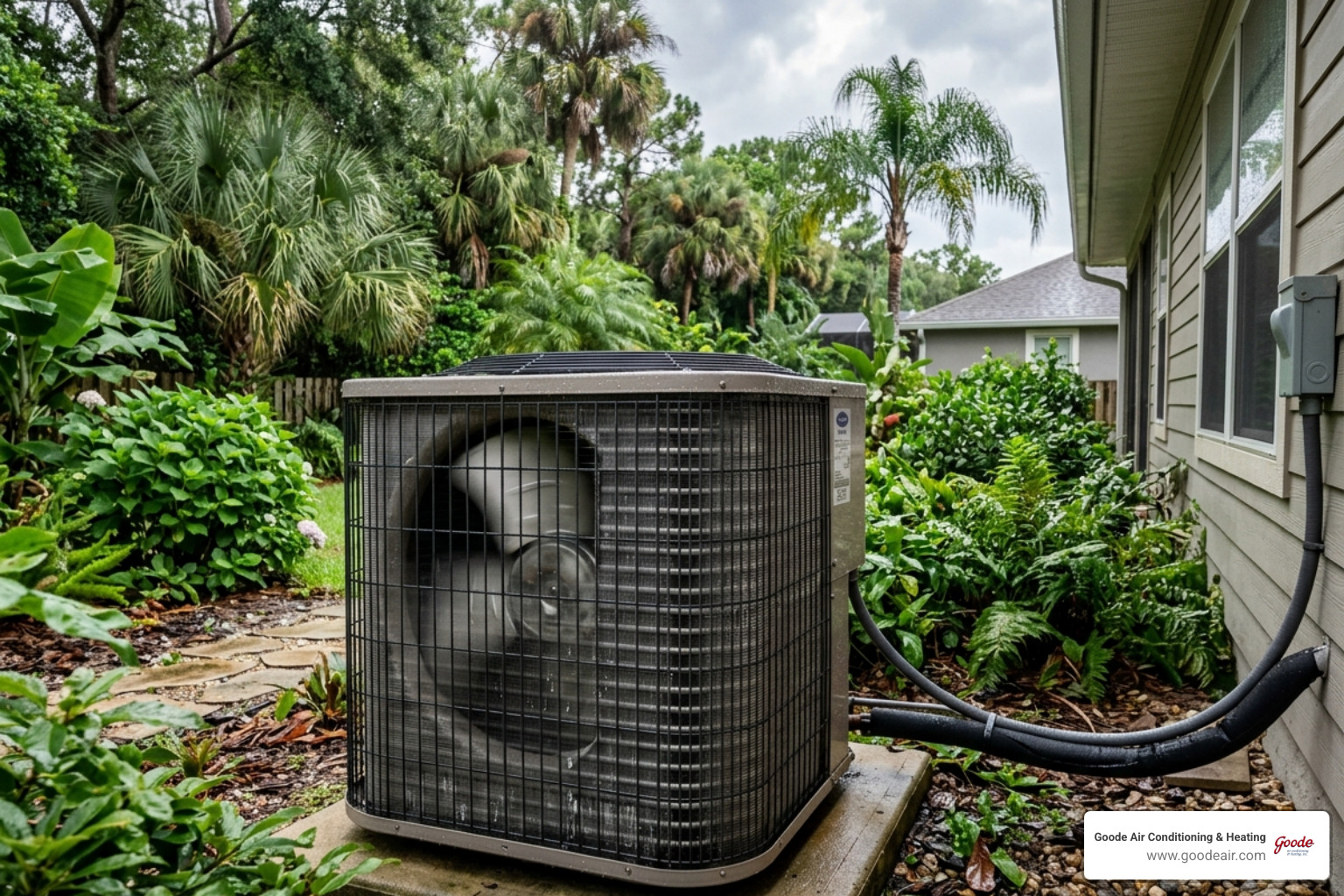
Why Humid Climates Are Hard on HVAC Systems — and What It Means for You
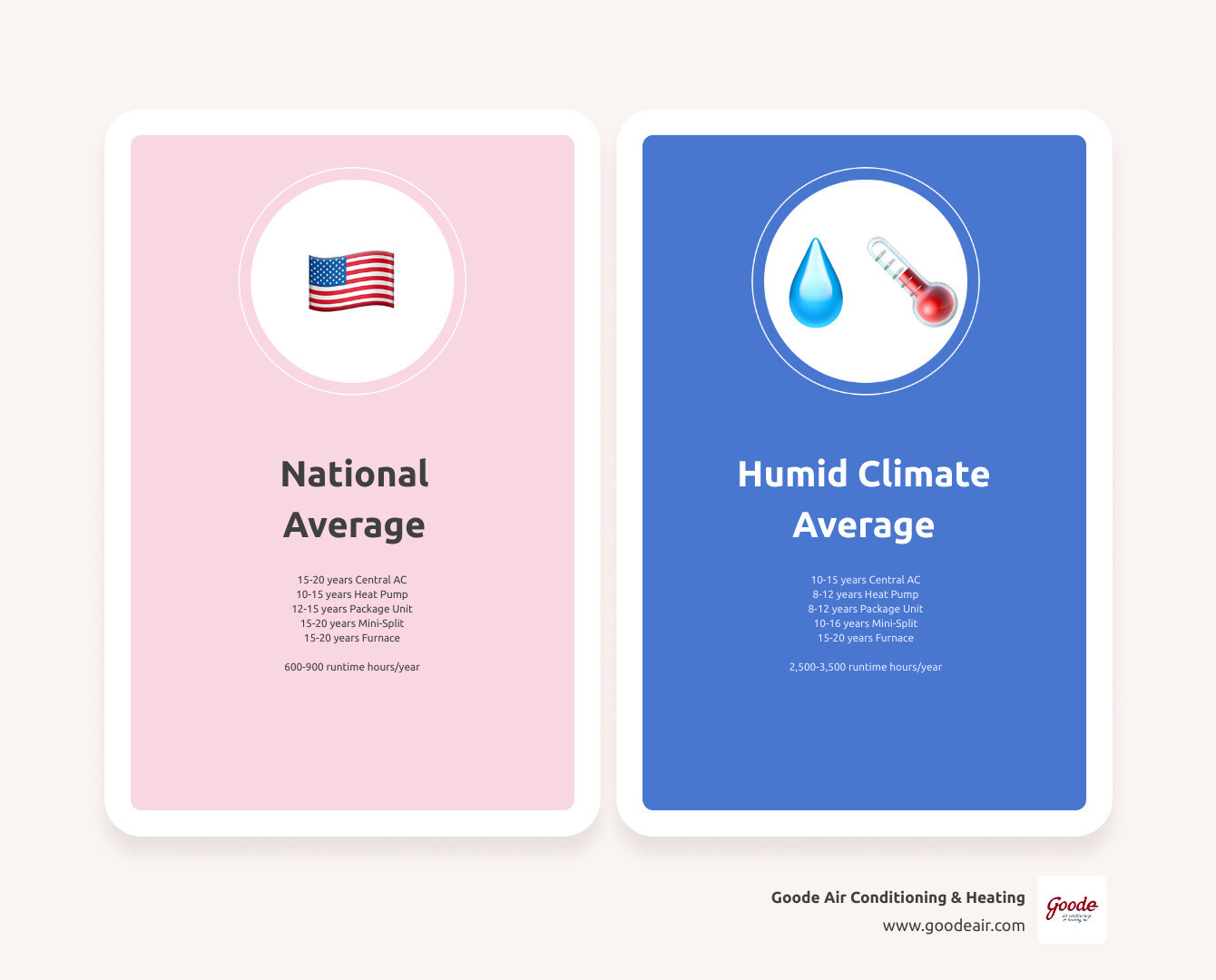
The average lifespan of an HVAC system in humid climates is significantly shorter than most homeowners expect. Here's a quick breakdown before we dive into the details:
| System Type | National Average | Humid Climate Average |
|---|---|---|
| Central Split AC | 15-20 years | 10-15 years |
| Heat Pump | 10-15 years | 8-12 years |
| Package Unit | 12-15 years | 8-12 years |
| Ductless Mini-Split | 15-20 years | 10-16 years |
| Gas Furnace | 15-20 years | 15-20 years |
If you live in Northeast Houston, coastal Florida, Louisiana, or another persistently humid region, your system is working harder than the national averages assume — often running 2,500 to 3,500 hours per year compared to just 600 to 900 hours in cooler, drier northern states.
That extra runtime adds up fast. Compressors wear down sooner. Coils corrode. Drain pans grow mold. And homeowners end up replacing systems years ahead of schedule, often without understanding why.
Think of it this way: a Florida or Houston AC unit can accumulate the equivalent wear of 15 northern years in just 5 to 6 years of operation. That's not a flaw in the equipment — it's simply what humidity and heat do to mechanical systems under sustained stress.
This guide breaks down exactly how long your HVAC system is likely to last in a humid climate, what speeds up the decline, and what you can do to squeeze every possible year out of your investment.
Understanding the Average Lifespan of an HVAC System in Humid Climates
When we talk about the average lifespan of an HVAC system in humid climates, we have to move away from the "20-year promise" often seen in manufacturer brochures. Those numbers are usually based on ideal conditions—think of a mild 75-degree day in a dry climate where the AC takes a nap every twenty minutes. In places like Humble, Kingwood, or Atascocita, your AC doesn't take naps; it runs a marathon every single day from April through October.
In Northeast Houston, the climate is classified as humid subtropical. This means we aren't just dealing with heat; we are dealing with a heavy moisture load that forces the air conditioner to spend about 50% of its energy just on dehumidification. Because the system has to work twice as hard to make the air feel comfortable, the mechanical components age at an accelerated rate.
Regional Benchmarks and the "Houston Tax"
While the national average for a central split AC system is often cited as 15 to 20 years, local data tells a different story. In Houston and surrounding areas like Spring and Crosby, we typically see systems reaching their economic end-of-life between 10 and 15 years.
If you've moved here from the Midwest, you might be shocked when your 12-year-old unit starts showing signs of total failure. It’s not that the equipment is lower quality; it’s simply that it has logged three times as many "miles" as a unit in Ohio. To get a better sense of how our local weather specifically impacts your equipment, check out our guide on How Long Does an AC System Last in Texas.
Why High Humidity Accelerates Component Wear
Humidity isn't just a comfort issue; it's a chemical and mechanical stressor. When the air is saturated with moisture, every part of your HVAC system—from the outdoor condenser to the indoor evaporator coil—is under attack.
Coil Pitting and Corrosion
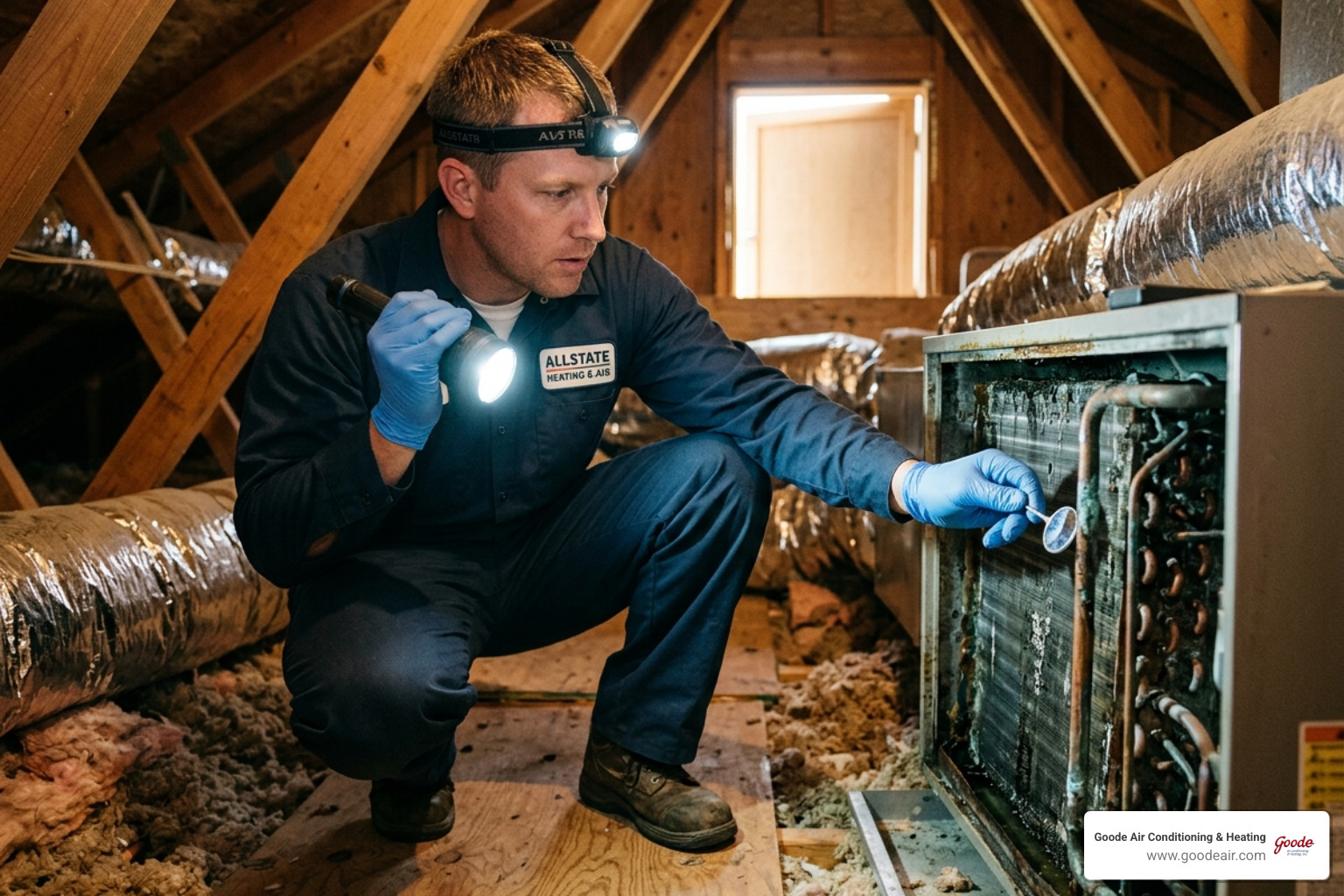
One of the most common reasons the average lifespan of an HVAC system in humid climates is cut short is "formicary corrosion." This happens when moisture on the copper evaporator coils reacts with volatile organic compounds (VOCs) in the air, creating a mild acid. Over time, this acid eats tiny, microscopic holes into the coils. You’ll know this is happening when you start needing "refrigerant top-offs" every year. Eventually, the coil becomes a Swiss cheese of leaks, and replacement is the only option.
Microbial Growth and "Dirty Sock Syndrome"
High humidity creates a playground for mold and mildew. Inside your dark, damp air handler, microbial colonies can thrive on the coils and in the drain pan. This doesn't just cause a foul smell (often called "dirty sock syndrome"); it also restricts airflow. When airflow is restricted, the blower motor has to work harder, and the compressor runs hotter, leading to early mechanical failure. Maintaining clean ducts is a huge part of fighting this. You can learn more about how this works in our article on Duct Cleaning Benefits for Humid Climate Homes.
Thermal Cycling and Compressor Stress
In a humid climate, your system cycles on and off constantly to keep up with the "latent load" (the moisture in the air). In Houston, a compressor might cycle over 10,000 times in a single season. Each start-up sends a surge of electricity through the motor, generating heat and wear. Combine this with the 3,000+ hours of runtime per year, and it’s no wonder compressors in our region rarely see their 20th birthday.
Performance by System Type in High-Moisture Environments
Not all HVAC systems are created equal when it comes to fighting humidity. The type of system you have plays a massive role in how long it will survive the Texas Gulf Coast elements.
Central Split Systems
These are the most common systems in our area, consisting of an outdoor condenser and an indoor air handler. They are reliable but vulnerable to the "split" nature of their design. The outdoor unit faces UV degradation and high heat, while the indoor unit faces the constant moisture of the evaporator coil. In the Northeast Houston area, these typically last 12 to 15 years if well-maintained.
Package Units
Often found on rooftops or small concrete pads, package units house all components in one metal box. These are common in some of our local commercial spaces and certain residential styles. Because the entire system is exposed to the outdoor humidity and heat 24/7, their lifespan is often slightly lower, averaging 8 to 12 years.
Geothermal Durability
Geothermal systems are the marathon runners of the HVAC world. Because the "condenser" part of the process happens underground where temperatures are stable, the indoor equipment is under significantly less stress. While the initial setup is different, the indoor unit can last 18 to 24 years, and the underground loops can last 50+ years. However, the indoor components still have to manage our extreme humidity, so they aren't entirely immune to moisture-related wear.
For a deep dive into which system might be best for your specific home layout, see our comparison on Heat Pump vs AC Texas Cost Comfort.
Average Lifespan of an HVAC System in Humid Climates: Central AC vs. Heat Pumps
There is a common misconception that heat pumps and air conditioners are the same. While they look identical from the outside, their workloads are very different.
- Central AC: This system only works when it's hot. In Houston, that’s a lot of the time, but the unit does get a break during our (admittedly brief) winters.
- Heat Pumps: These systems provide both cooling and heating. This means they are running year-round. Because they never truly have an "off-season," heat pumps in humid climates like Eagle Springs or Summerwood often have a shorter lifespan—usually 8 to 12 years—simply because they accumulate more hours of operation in a shorter calendar period.
If you’re curious about the mechanics behind this, check out Heat Pump Technology Principles Texas.
Mini-Splits and Furnaces in Humid Regions
Ductless Mini-Splits are gaining popularity in areas like Fall Creek and Valley Ranch, especially for home offices or room additions. These systems are excellent at dehumidification because they often use variable-speed compressors that run at lower speeds for longer periods, pulling more moisture out of the air. With proper care, they can last 10 to 16 years.
Gas Furnaces are the survivors of the HVAC world. Because they spend most of the year sitting idle in Houston, and because they don't deal with the corrosive moisture of the cooling process, a furnace can easily last 15 to 20 years or more. The biggest threat to a furnace in a humid climate is rust on the heat exchanger caused by the AC coil sitting right above it.
To understand how these systems can save you money while battling the humidity, read about Texas Heat Pumps Energy Savings.
Proactive Maintenance to Extend Your System's Life
If the average lifespan of an HVAC system in humid climates is 10 to 15 years, how do some people make theirs last 18? The answer is almost always proactive maintenance. In a high-stress environment, you cannot afford to "set it and forget it."
The 1-3 Month Filter Rule
In Houston, your air filter isn't just catching dust; it's preventing a "wet blanket" of debris from forming on your evaporator coil. When a filter gets clogged, airflow drops, and the moisture on the coil can actually freeze, leading to a cascade of mechanical failures. We recommend changing your filters every month during the peak of summer.
Annual Coil Cleaning
As we mentioned, the evaporator coil is the front line of the humidity war. Dust that bypasses the filter mixes with condensation to create a sticky "mud" that blocks airflow and promotes corrosion. A professional cleaning once a year can add 3 to 5 years to your system's life.
Clearing the Drain Lines
High humidity means your AC is pulling gallons of water out of the air every day. If your condensate drain line clogs (usually due to algae growth), that water backs up. At best, it trips a safety switch and shuts down your AC on a 100-degree day. At worst, it overflows and damages your ceiling. Regular flushing of these lines is vital.
Smart Thermostats and Airflow
Using a smart thermostat can help reduce unnecessary "short-cycling." By managing how the system ramps up and down, you can reduce the electrical stress on the compressor. For more tips, see How Often Should You Service Your AC in Texas and our guide on HVAC Maintenance for Maximum Energy Savings.
When to Repair vs. Replace Your Aging Unit
Eventually, every system reaches a point where "one more repair" is just throwing good money after bad. In a humid climate, this decision often comes sooner than you’d like.
The $5,000 Rule
A helpful industry heuristic is the $5,000 Rule. You multiply the age of the system by the cost of the repair. If the total is more than $5,000, it’s time to replace.
- Example: A 12-year-old system needs a $500 repair. (12 x 500 = 6,000). According to the rule, you should replace it.
- Example: A 6-year-old system needs a $500 repair. (6 x 500 = 3,000). In this case, a repair makes sense.
Refrigerant Phase-Outs and SEER2
As of 2026, the industry has moved toward more environmentally friendly refrigerants and higher efficiency standards (SEER2). If your system is old enough to use R-22 (Freon), repairs are likely to be prohibitively expensive because that refrigerant is no longer produced. Even R-410A is being phased down. Upgrading to a modern, high-efficiency system can often pay for itself in 5 to 7 years through reduced utility bills alone.
Signs Your Average Lifespan of an HVAC System in Humid Climates is Ending
If you notice any of the following, your system might be entering its final season:
- Rising Utility Bills: Even if the weather hasn't changed, your bill keeps creeping up because the system is losing efficiency.
- Uneven Cooling: One room is a freezer while the other is a sauna.
- Frequent Repairs: You have your HVAC company on speed dial.
- Excessive Indoor Humidity: The air feels "heavy" or "sticky" even when the AC is running.
- Unusual Noises: Screeching, banging, or grinding sounds from the outdoor unit.
Frequently Asked Questions about HVAC Longevity
Does salt air affect HVAC lifespan in coastal humid areas?
Yes, dramatically. While places like Kingwood and Humble are far enough inland to avoid the worst of it, areas closer to the coast see "salt-air corrosion" that can kill a condenser in as little as 5 to 7 years. If you live in a coastal area, look for units with specialized "seacoast" coatings on the coils.
How often should I change filters in a humid climate?
In Northeast Houston, we recommend checking your filter every 30 days. If you have pets or allergies, you’ll likely need to change it monthly during the summer. During the milder spring and fall months, you can often stretch this to 60 or 90 days.
Can a dehumidifier extend the life of my HVAC system?
Absolutely. A whole-home dehumidifier works alongside your HVAC system to pull moisture out of the air. This allows your AC to focus solely on lowering the temperature. Because the AC doesn't have to run as long to make the air feel comfortable, it reduces the total runtime and wear on the compressor.
Conclusion
Living in Northeast Houston means accepting that the average lifespan of an HVAC system in humid climates is a battle against the elements. While the heat and moisture are relentless, they don't have to win. By understanding the stressors on your system and committing to regular maintenance, you can ensure your home stays a cool, dry sanctuary for years to come.
At Goode Air Conditioning & Heating, we’ve spent 50 years helping our neighbors in Roman Forest, Crosby, Eagle Springs, and throughout the Humble area navigate these exact challenges. As a family-owned business, we believe in transparent pricing and a 100% satisfaction guarantee. Whether you’re looking to squeeze a few more years out of an aging unit or you’re ready to explore high-efficiency replacement options, we’re here to help.
Don’t wait for the next 100-degree day to find out your system is at the end of its rope. If you're in Eagle Springs or any of our surrounding communities, contact us today for an honest assessment of your home comfort system.

Customer Testimonials
See why so many homeowners trust Goode Air Conditioning & Heating, Inc.—our 4.8-star Google rating and hundreds of happy customers speak to the quality, care, and service we deliver every day.

The technician Goode AC is one of the best businesses I know of. I have had their annual maintenance check up for several years. I’m so impressed with the technician who has serviced my AC several times. Always on time, pleasant, considerate, thorough in his work and explains the problems where I can easily understand. Thankful for doing business with professionals.
I have been a customer for at least 30 years. They have replaced 3 air conditioners, a furnace and heat exchanger. Today they replaced the air ducts in my attic that were falling apart and never been cleaned. Wonderful job, polite workers, great clean up. I can already tell the difference in the quality of the air. Love you guys!!
Great experience today with Goode Air Conditioning. Hoger, our technician, was very knowledgeable and provided excellent customer service. We look forward to our Spring maintenance visit.
I have used Goode Air Conditioning and Heating for many years. The company has excellent customer service and the technicians are knowledgeable, thorough and professional.