






More Than Just Heat: How Humidity Affects Your AC Performance
How humidity affects your AC performance is one of the most misunderstood factors in home comfort — especially in Northeast Houston, where sticky, moisture-heavy air is a fact of life from spring through fall.
Here's the short answer:
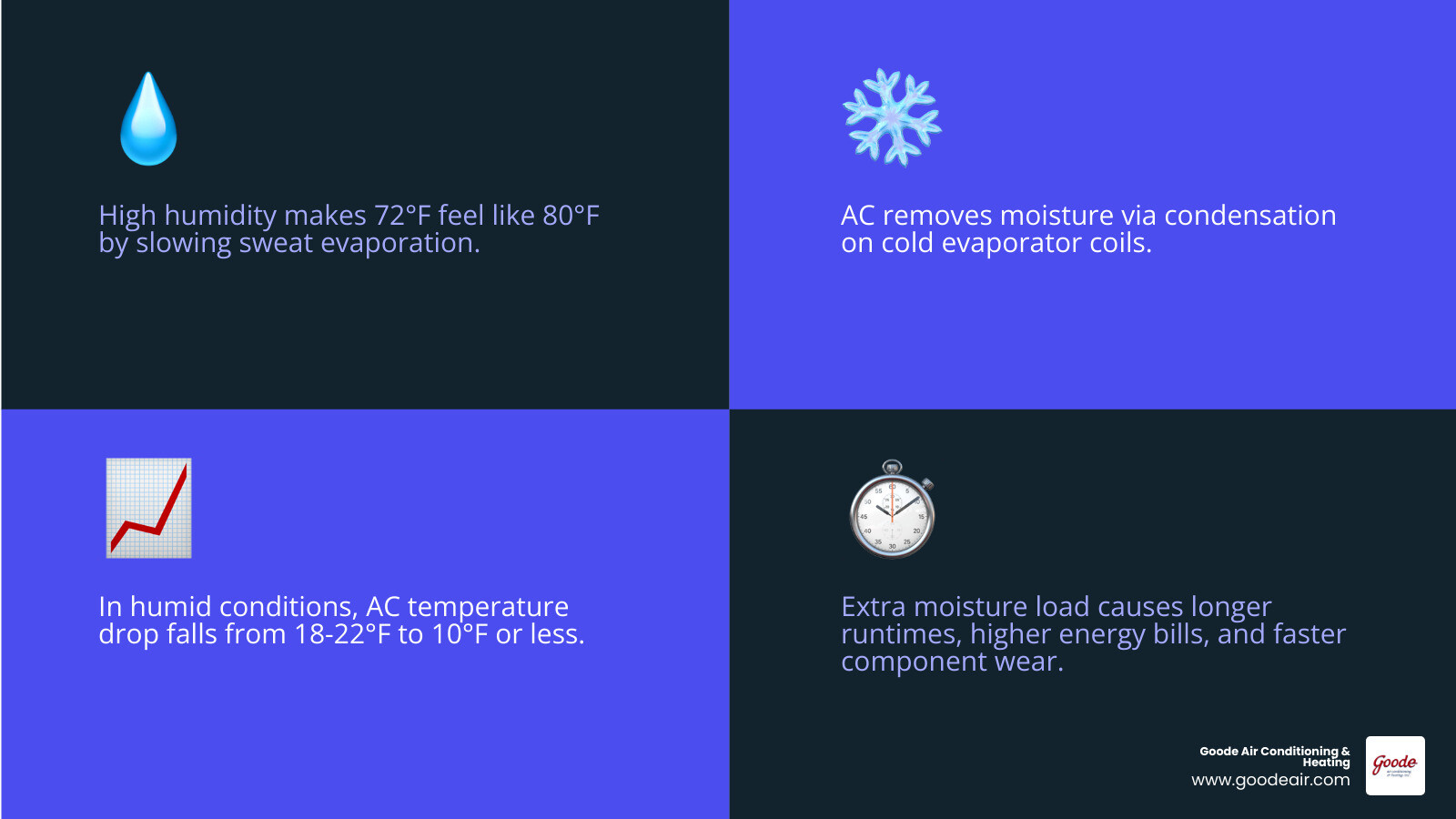
- Your AC removes moisture, not just heat. When humidity is high, your system has to work harder and longer to make your home feel comfortable.
- High humidity makes your home feel warmer than it is. A room at 72°F with 70% relative humidity can feel closer to 80°F, because moisture in the air slows down sweat evaporation — your body's natural cooling mechanism.
- Your AC's cooling power drops. Under normal conditions, an AC system delivers a temperature drop of 18 to 22 degrees. In overly humid conditions, that drop can fall to 10 degrees or less.
- Your system runs longer and wears out faster. The extra moisture load forces your compressor, blower motor, and coils to work overtime — driving up energy bills and shortening system lifespan.
- A home at 76°F with 45% humidity feels more comfortable — and costs less to maintain — than one at 72°F with 70% humidity.
In short, humidity is often the hidden reason your home never quite feels cool enough, even when your AC is running fine.
The Science of Comfort: How Humidity Affects Your AC Performance

To understand how humidity affects your ac performance, we first have to look at how we, as humans, perceive "coolness." Comfort isn't just a number on a dial; it’s a biological process. Our bodies cool down by sweating. When that sweat evaporates off our skin, it takes heat with it.
In a dry climate, this happens instantly. But here in Northeast Houston, the air is often so saturated with water vapor that our sweat has nowhere to go. It just sits there. This is why a humid day feels "heavy" or "sticky."
When we talk about Humidity & Indoor Air Quality, we’re really talking about two different types of heat: sensible heat and latent heat.
- Sensible heat is what you see on the thermometer. It’s the actual temperature of the air.
- Latent heat is the energy contained in the moisture within the air.
Your air conditioner has to deal with both. When the humidity is high, your AC spends a massive amount of its energy dealing with latent heat (removing water) before it can even start to tackle the sensible heat (lowering the temperature). This is why your home might stay at 75 degrees but still feel like a sauna.
Understanding How Humidity Affects Your AC Performance in Houston
In our neck of the woods—from Humble to Kingwood and down to Atascocita—relative humidity regularly soars above 80% during the summer months. This creates a high "apparent temperature," or what weather forecasters call the Heat Index.
When your indoor air is too moist, your Air Conditioning Services provider will tell you that your unit is basically performing "double duty." Instead of just circulating and cooling air, it is acting as a massive sponge. If the air is at its moisture saturation point, the AC has to work significantly harder to wring that water out. This is a primary reason why many homeowners in April 2026 are finding that their older systems simply can't keep up with the increasingly "soupy" Texas summers.
[TABLE] comparing Sensible Heat vs. Latent Heat
| Feature | Sensible Heat | Latent Heat |
|---|---|---|
| What it is | The "Dry" temperature you feel | The "Wet" heat held in water vapor |
| Measurement | Standard Thermometer | Hygrometer / Wet-bulb thermometer |
| AC Action | Lowers the air temperature | Removes moisture via condensation |
| Energy Priority | Secondary (in humid conditions) | Primary (must be removed first) |
| Comfort Impact | Cools the skin | Allows sweat to evaporate |
| System Goal | Hit the thermostat set point | Reach a comfortable relative humidity |
Why High Moisture Levels Strain Your HVAC System
Your air conditioner isn't magic; it’s a heat transfer machine. Inside your home, there is a component called the evaporator coil. As warm, humid air is blown over these cold coils, the moisture in the air hits the cold metal and turns into liquid water—much like how a cold soda can "sweats" on a patio in Crosby, TX.
This water drips into a condensate drain pan and is piped outside. However, when the humidity is extreme, this process becomes a bottleneck. If the air is too wet, the moisture can actually act as an insulator on the coils, making it harder for the refrigerant inside to absorb heat. In extreme cases, this can cause the Evaporator Coils, Air Handlers, & Blower Systems to freeze over entirely, blocking airflow and potentially killing your cooling altogether.
How Humidity Affects Your AC Performance and System Lifespan
If your AC has to run for 45 minutes to achieve what should take 20 minutes, you are putting double the wear and tear on your compressor and blower motor. High humidity leads to "long-cycling," where the system rarely gets a break.
We often get asked, "How Long Does an AC System Last in Texas?" The answer depends heavily on how much moisture the system has to fight. A system in a dry climate might last 15–20 years, but in the humid corridor of Northeast Houston, that lifespan can be shortened significantly if the system is constantly strained by high latent heat loads. The compressor is the "heart" of your AC, and high humidity makes that heart beat faster and harder for longer periods, eventually leading to premature failure.
The Impact of System Sizing on Dehumidification
You might think that a bigger AC unit is always better for a humid home, but the opposite is often true. This is a common issue we see in areas like Walden on Lake Houston. If an AC unit is oversized for the square footage of the home, it will engage in "short-cycling."
Short-cycling happens when the AC is so powerful that it cools the air temperature down to the thermostat setting in just a few minutes. While the air is now "cold," the unit didn't run long enough to actually pull the moisture out of the air. You end up with a home that is cold and clammy—the "cave effect." This is why proper load calculations are vital. For some smaller spaces or additions, Mini-Split AC Systems are often a better choice because they can modulate their speed to provide constant, steady dehumidification.
Signs Your Home Is Overwhelmed by Humidity
How do you know if your AC is losing the war against water vapor? Here are the most common red flags:
- Foggy Windows: If you see condensation on the inside of your windows in the morning, your indoor humidity is likely well above 60%.
- Musty Odors: High moisture leads to mold and mildew growth in carpets, drywall, and even your ductwork. That "old basement" smell in a Texas home is a humidity warning.
- Clammy Skin: If you feel "sticky" even when the air is blowing, the moisture isn't being removed.
- Warping Wood: High humidity can cause wood floors to cup or door frames to swell, making doors hard to close.
- Visible Mold: Check around your Indoor Air Quality vents. If you see black spots or fuzzy growth, you have a moisture problem that needs immediate attention.
Why Your Thermostat Setting Might Be Misleading
Your thermostat is a bit of a liar—or at least, it only tells half the story. It measures sensible heat, not comfort. As we mentioned in the intro, a home at 72 degrees with 70% humidity feels like 80 degrees.
Homeowners often respond by "chasing the thermostat"—cranking it down to 68 or 65 degrees just to feel comfortable. This is the most expensive way to cool your home. It forces the system to run indefinitely, spiking your electric bill and increasing the risk of a breakdown. If you find yourself constantly lowering the temp but never feeling "crisp," you probably need AC Maintenance in Spring, TX to check your system’s dehumidification capacity.
Professional Solutions for Better Moisture Control
If your AC is struggling, you don't have to just "live with it." There are several professional strategies we use at Goode Air Conditioning & Heating to dry out your home and take the load off your AC.
One of the most effective upgrades is Whole-House Dehumidifier Installation in Eagle Springs, TX. Unlike portable units that you have to empty every few hours, a whole-house system is integrated into your existing ductwork. it pulls moisture out of the air before it even reaches your AC coils, allowing your air conditioner to focus solely on cooling the air.
Other solutions include:
- Variable-Speed Blowers: These fans can run at lower speeds for longer periods, which is much more effective at pulling moisture out of the air than a standard "on/off" fan.
- Sealing Air Leaks: If your home isn't "tight," you are constantly pulling in humid Houston air through gaps in windows, doors, and attic hatches. Sealing these leaks can improve efficiency by up to 20%.
Maintenance Strategies for Humid Climates
In April 2026, regular maintenance is more important than ever. High humidity means your condensate drain lines are working overtime, which makes them prone to "algae" clogs. A clogged drain line can back up and cause thousands of dollars in water damage to your ceiling or floors.
During a professional AC Tune-Up in Humble, TX, we focus on:
- Coil Cleaning: Removing dirt and dust that prevents moisture from condensing on the coils.
- Drain Line Flushing: Ensuring the "sponge" has a place to squeeze the water out.
- Refrigerant Levels: If your refrigerant is low, the coils won't get cold enough to properly dehumidify the air.
Upgrading to High-Efficiency Humidity Control
If your system is more than 10–12 years old, it might be time to consider an upgrade. Modern systems with high SEER2 ratings are designed with humidity control in mind. Inverter-driven compressors can adjust their output in tiny increments, providing the exact amount of cooling and dehumidification needed without wasting energy.
When we perform Whole-House Dehumidification in Humble, TX, we often pair these systems with smart thermostats that have built-in hygrometers. This allows you to set a "humidity set point" (like 45%) just as easily as you set your temperature.
Frequently Asked Questions about AC Performance and Humidity
What is the ideal indoor humidity level for my home?
For the best balance of comfort, health, and energy savings, you should aim for a 30% to 50% relative humidity range. Keeping it below 50% prevents mold growth and keeps dust mites at bay, while staying above 30% prevents your skin and throat from feeling too dry. This range is the "sweet spot" for HVAC Maintenance for Maximum Energy Savings.
Should I leave my AC fan on "ON" or "AUTO" in humid weather?
Always use the "AUTO" setting. When the fan is set to "ON," it runs continuously, even when the cooling cycle has stopped. This means the fan will blow air over the wet evaporator coils, evaporating the water right back into your home before it has a chance to drain away. This can spike your indoor humidity levels in minutes. Using "AUTO" ensures the fan stops when the cooling stops, allowing the moisture to drain properly. This is a simple tip we share during any discussion on How Often Should You Service Your AC in Texas?
Can low humidity also affect my HVAC system?
While we spend most of our time fighting high humidity in Houston, winter can bring very dry air. Low humidity can lead to static electricity, dry skin, and scratchy throats. It can also make the air feel cooler than it actually is, causing you to crank up the furnace and waste energy. For homes with Mini-Split AC in Walden on Lake Houston, TX, adding a humidifier during the few cold weeks we get can significantly improve comfort.
Conclusion
At Goode Air Conditioning & Heating, we’ve spent the last 50 years helping our neighbors in Northeast Houston stay comfortable, no matter how high the humidity climbs. Whether you are in Roman Forest, Crosby, or Summerwood, we understand the unique challenges our local climate puts on your HVAC system.
As a family-owned business, we pride ourselves on transparent pricing and a 100% satisfaction guarantee. From Eagle Springs to Kingwood and everywhere in between—like Atascocita, Porter, and New Caney—we are here to provide the repair, replacement, and air quality solutions you need. Don't let the Texas "soup" wear down your AC and drive up your bills. Take control of your home comfort with professional humidity solutions and experience the difference that 50 years of expertise can make.
Give us a call today—we’ll help you turn your home back into the crisp, dry sanctuary it’s supposed to be!

Customer Testimonials
See why so many homeowners trust Goode Air Conditioning & Heating, Inc.—our 4.8-star Google rating and hundreds of happy customers speak to the quality, care, and service we deliver every day.

The technician Goode AC is one of the best businesses I know of. I have had their annual maintenance check up for several years. I’m so impressed with the technician who has serviced my AC several times. Always on time, pleasant, considerate, thorough in his work and explains the problems where I can easily understand. Thankful for doing business with professionals.
I have been a customer for at least 30 years. They have replaced 3 air conditioners, a furnace and heat exchanger. Today they replaced the air ducts in my attic that were falling apart and never been cleaned. Wonderful job, polite workers, great clean up. I can already tell the difference in the quality of the air. Love you guys!!
Great experience today with Goode Air Conditioning. Hoger, our technician, was very knowledgeable and provided excellent customer service. We look forward to our Spring maintenance visit.
I have used Goode Air Conditioning and Heating for many years. The company has excellent customer service and the technicians are knowledgeable, thorough and professional.