






The Central AC vs Ductless Mini Split Comparison Every Houston Homeowner Needs
The central ac vs ductless mini split comparison comes down to one core question: does your home already have ductwork, and how well is it working?
Here is a quick breakdown to help you decide:
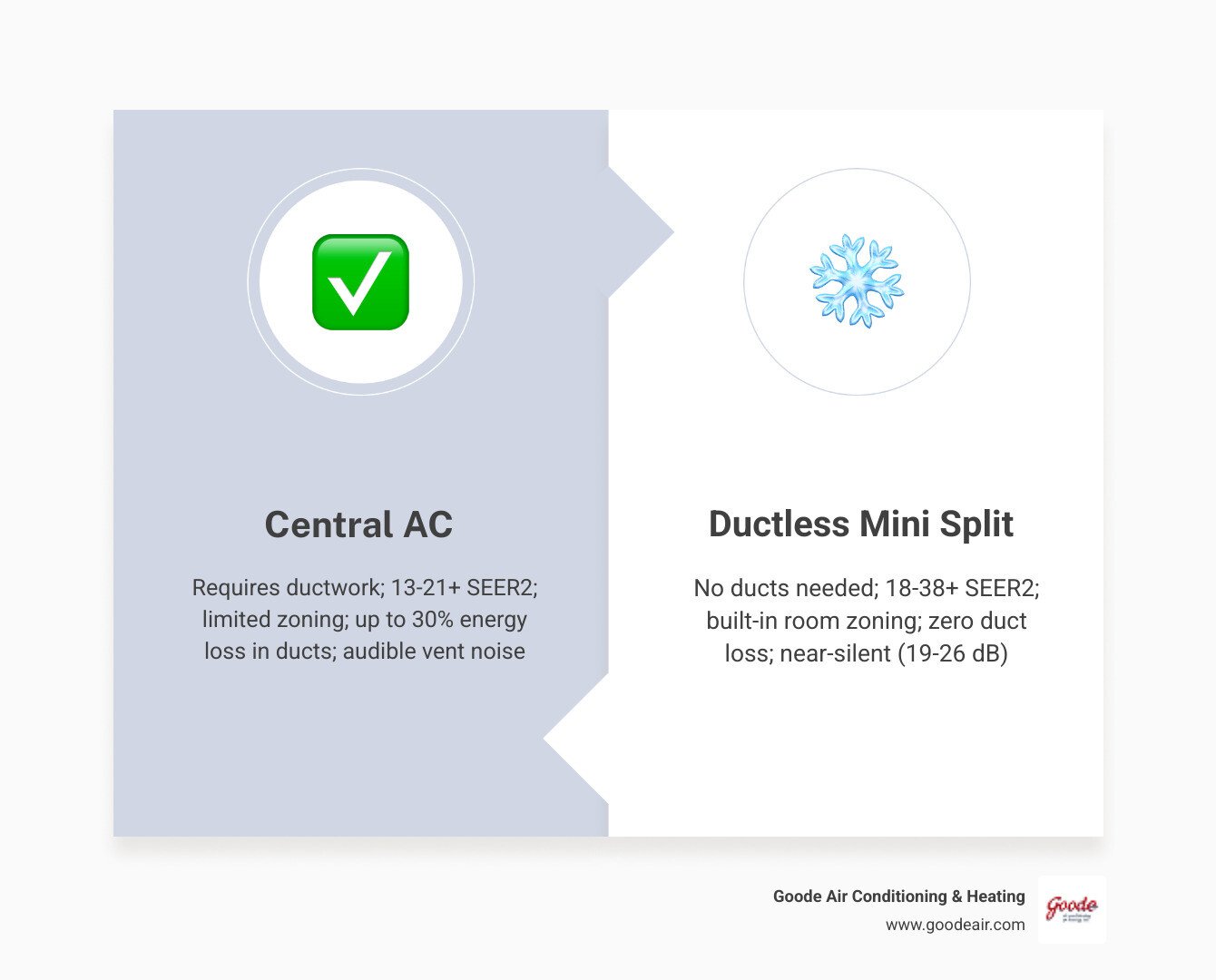
| Factor | Central AC | Ductless Mini Split |
|---|---|---|
| Requires ductwork | Yes | No |
| Best for | Whole-home cooling with existing ducts | Zoned comfort, additions, older homes |
| Energy efficiency (SEER2) | 13-21+ | 18-38+ |
| Zoning capability | Limited (add-on dampers needed) | Built-in, room by room |
| Installation disruption | High if no ducts exist | Minimal |
| Heating capability | Paired with furnace or heat pump | Most units heat and cool in one system |
| Noise level | Audible airflow through vents | Near-silent indoor operation (~19-26 dB) |
| Duct energy loss | Up to 25-30% of cooled air lost | None |
If you live in Northeast Houston, you already know how brutal the summers get. Your cooling system is not a luxury - it is a necessity that runs hard for months on end. Choosing the wrong system means higher energy bills, uneven comfort, and more headaches down the road.
The good news is that both central AC and ductless mini splits are proven, reliable technologies. The better news is that once you understand how each one works and where each one shines, the right choice for your home becomes much clearer.
This guide walks you through everything that matters - efficiency, cost, comfort, noise, maintenance, and more - so you can make a confident decision in April 2026 and beyond.
Understanding the Central AC vs Ductless Mini Split Comparison
When we talk about home comfort in areas like Humble or Kingwood, we are essentially looking at two different philosophies of air distribution. To understand the central ac vs ductless mini split comparison, we first have to look at how they move air.
Central Air Conditioning is what most of us grew up with. It is a "forced air" system. It uses one large, powerful indoor unit to push chilled air through a complex network of hidden ducts. It treats your entire home as one single climate zone. If the thermostat in the hallway says 75 degrees, the system works until that one spot hits the target, regardless of how hot the upstairs bedroom or the kitchen might be.
Mini Splits, on the other hand, are the "surgical" approach to cooling. Instead of one giant unit and a maze of ducts, you have smaller, independent indoor "heads" mounted directly in the rooms you use. These units are connected to an outdoor compressor by small refrigerant lines and electrical wiring. Because they don't rely on ducts, they offer a level of flexibility that traditional systems simply cannot match.
How Central AC Systems Operate
Central systems rely on a heavy-duty cycle of heat exchange. Inside your home, usually in an attic or a closet, sits the evaporator coil and an air handler. The system pulls warm air from your rooms through return vents, passes it over the cold coils to remove heat and humidity, and then blasts that conditioned air back through the supply ducts.
Because this system relies so heavily on those "highways" of air, the condition of your ductwork is everything. Over time, ducts can become leaky or clogged with dust. This is why regular Duct Cleaning and sealing are vital for central systems. If your ducts are 20 years old and full of holes, even the most expensive AC unit in the world will struggle to keep you cool.
The Mechanics of a Ductless Mini Split Comparison
The magic of the mini-split lies in its inverter technology. While most traditional central AC units are either 100% "on" or 100% "off," mini-splits use variable-speed compressors. Think of it like a dimmer switch versus a standard light switch. A mini-split can ramp up or down precisely to maintain a steady temperature without the constant "whoosh" and "click" of a central system starting up.
Most of these systems are actually a Heat Pump, which means they can reverse their operation. In the summer, they move heat out of your house. In our mild Texas winters, they pull heat from the outdoor air and move it inside. This "two-for-one" functionality is a major reason why many homeowners in Atascocita and Summerwood are making the switch.
Energy Efficiency and Performance Standards
Efficiency standards have come a long way. As of April 2026, the industry standard for measuring efficiency is SEER2 (Seasonal Energy Efficiency Ratio 2). This rating tells you how much cooling you get for every dollar of electricity you spend.
| System Type | Typical SEER2 Range | High-End Efficiency |
|---|---|---|
| Central AC | 13 - 21+ | Up to 26 SEER2 |
| Ductless Mini Split | 18 - 38+ | Up to 42 SEER |
The numbers don't lie: mini-splits are generally much more efficient. While a high-end central AC might hit 21 or 26 SEER2, some ultra-efficient mini-split models are soaring into the high 30s and even 40s. For a homeowner looking for Texas Heat Pumps Energy Savings, the ductless option is often the clear winner on paper.
Eliminating Energy Loss from Ductwork
One of the biggest "hidden" costs of central air is duct loss. The Department of Energy estimates that typical duct systems lose about 25% to 30% of their cooling energy through leaks, poor insulation, or "thermal bypass."
Imagine buying a gallon of milk at the grocery store, but by the time you walk to your car, 30% of it has leaked out of the bag. That is exactly what happens with many central systems in Northeast Houston attics. Because ductless systems deliver air directly into the room, they eliminate this waste entirely. This is a primary focus in our Ductless Air Conditioner Valley Ranch TX Guide, as it highlights how much money stays in your pocket when you stop cooling your attic.
Comfort Delivery and Zoning Capabilities
Comfort is subjective, but "zoning" is a game-changer. In a standard central AC home, if you want your bedroom at 68 degrees for sleeping, you have to cool the empty living room, the laundry room, and the kitchen to 68 degrees as well. It is an "all-or-nothing" approach.
Ductless mini-splits offer built-in zoning. Each indoor head has its own thermostat and remote. If you want the guest room at 74 but the master suite at 68, you can do that with the touch of a button. This level of precision is why the Heat Pump vs AC Texas Cost Comfort debate often leans toward ductless for families with different temperature preferences.
Whole-Home Uniformity vs. Room-by-Room Control
Central AC is excellent for open-concept homes where you want a consistent temperature throughout a large, shared space. It provides a uniform feel that many people find comforting.
However, many homes in Porter and New Caney have "problem rooms"—that one bedroom over the garage or the sunroom that never seems to get enough air. A mini-split is the perfect "booster" for these areas. Even if you keep your central AC for the rest of the house, adding a single-zone mini-split can solve those specific comfort gaps. Our Best Ductless Air Conditioner Guide Summerwood TX explores how these targeted solutions can transform your home's livability.
Practical Considerations: Aesthetics, Noise, and Maintenance
When we look at the central ac vs ductless mini split comparison, we have to talk about how these systems look and sound.
Aesthetics: Central AC wins on invisibility. The only things you see are the vents and the thermostat. Mini-splits require an indoor unit mounted on the wall, floor, or ceiling. While modern units are sleek and low-profile, they are still a visible part of your decor.
Noise: This is where mini-splits shine. Indoor mini-split heads often operate at 19 to 26 decibels. To put that in perspective, a quiet library is usually around 30 decibels. You can stand right under a mini-split and barely hear a whisper. Central AC systems, while not necessarily "loud," produce a noticeable "whoosh" of air through the vents every time they kick on.
Air Quality: Central systems have a slight edge here because they can be integrated with whole-home Indoor Air Quality products like HEPA filters, UV lights, and powerful dehumidifiers. Mini-splits have smaller, built-in filters that are great for basic dust and allergens, but they don't typically offer the same level of advanced medical-grade filtration as a ducted system.
Maintenance Requirements for a Long-Term Central AC vs Ductless Mini Split Comparison
Both systems require love and attention to last their full 15 to 20-year lifespan (though some well-maintained mini-splits can reach 30 years!).
- Central AC: You need to change the disposable filters every 1 to 3 months. You also need to keep the outdoor unit clear of grass clippings and debris. Most importantly, you need to have your ducts inspected for leaks every few years.
- Mini-Splits: These use reusable mesh filters. Because they are smaller, they need to be rinsed out more frequently—usually every 2 to 4 weeks, especially if you have pets. You also need to ensure the condensate drain line doesn't get clogged.
Regardless of which you choose, our Services team recommends a professional tune-up at least once a year to keep things running efficiently.
Choosing the Right System for Your Home Layout
Your home's architecture often makes the decision for you.
Choose Central AC if:
- You already have a ductwork system in good condition.
- You prefer "hidden" HVAC components.
- You want a single, centralized control point for the whole house.
- You have an open-concept layout where air flows freely.
Choose a Ductless Mini Split if:
- You live in an older home (like some in Crosby or Huffman) where adding ducts would require tearing up historic walls or ceilings.
- You are building a room addition, converting a garage, or finishing an attic.
- You have a multi-story home with significant temperature differences between floors.
- You want to save energy by only cooling the rooms you are currently using.
When it comes to resale value, central AC is still the "standard" in the Texas real estate market and can add up to 10% to a home's value. However, as energy costs rise and more people work from home, the demand for high-efficiency zoned Heating and cooling is rapidly catching up.
The Hybrid Approach to Home Comfort
You don't always have to pick a side. Many of our most comfortable customers use a "hybrid" approach. They use a traditional central AC system to handle the main living areas (kitchen, dining, living room) where the existing ductwork is efficient. Then, they install a mini-split in the master suite for precise sleeping comfort, or in a home office to stay cool during the day without wasting money on the rest of the house.
This "best of both worlds" strategy is a frequent topic on our Blog, as it allows for maximum comfort with the lowest possible monthly operating costs.
Frequently Asked Questions about Cooling Systems
Can mini-splits provide effective heating during colder Texas months?
Absolutely. Most modern mini-splits are high-efficiency heat pumps. They don't "create" heat; they move it. Even when it is chilly outside in Crosby or Eagle Springs, there is still thermal energy in the air. A mini-split can extract that heat and bring it inside. Many "cold-climate" models can provide efficient heating even when temperatures drop well below freezing, making them a reliable year-round solution for our region.
Are there government incentives for high-efficiency cooling systems in 2026?
Yes! Under the Inflation Reduction Act, federal tax credits are available for qualifying high-efficiency heat pump systems. You could be eligible for a credit of up to $2,000 for installing a system that meets specific SEER2 and HSPF2 requirements. Because these incentives are designed to promote energy independence, they often favor the higher efficiency ratings found in ductless systems.
Which system is quieter during operation?
In the central ac vs ductless mini split comparison, the mini-split is the undisputed champion of quiet. Because the noisy compressor is located outside and the indoor fan is small and precisely balanced, the noise level is often lower than a whisper. Central AC units are much quieter than they used to be, but you will always hear the sound of air moving through the ductwork and the mechanical "click" of the system engaging.
Conclusion
Choosing between central AC and a ductless mini-split is not about finding a "winner"—it is about finding the right fit for your specific Northeast Houston home. Whether you are in a historic home in Kingwood or a new build in Tavola, your comfort depends on a system that matches your lifestyle and your home’s layout.
At Goode Air Conditioning & Heating, we have 50 years of trusted service helping our neighbors in Roman Forest, Fall Creek, and across the Houston area stay comfortable. We believe in family values, transparent pricing, and a 100% satisfaction guarantee. Whether you need a traditional system replacement or you are ready to explore Mini Splits, our team is here to provide the expert guidance you deserve.
Ready to see which system is right for you? Contact us today for a professional comfort assessment and let’s get your home ready for the Texas heat!


Customer Testimonials
See why so many homeowners trust Goode Air Conditioning & Heating, Inc.—our 4.8-star Google rating and hundreds of happy customers speak to the quality, care, and service we deliver every day.

The technician Goode AC is one of the best businesses I know of. I have had their annual maintenance check up for several years. I’m so impressed with the technician who has serviced my AC several times. Always on time, pleasant, considerate, thorough in his work and explains the problems where I can easily understand. Thankful for doing business with professionals.
I have been a customer for at least 30 years. They have replaced 3 air conditioners, a furnace and heat exchanger. Today they replaced the air ducts in my attic that were falling apart and never been cleaned. Wonderful job, polite workers, great clean up. I can already tell the difference in the quality of the air. Love you guys!!
Great experience today with Goode Air Conditioning. Hoger, our technician, was very knowledgeable and provided excellent customer service. We look forward to our Spring maintenance visit.
I have used Goode Air Conditioning and Heating for many years. The company has excellent customer service and the technicians are knowledgeable, thorough and professional.