





Why the Standard Efficiency vs High Efficiency AC Comparison Matters for Your Home Comfort
The standard efficiency vs high efficiency ac comparison comes down to a few key differences that directly affect your energy bills, indoor comfort, and long-term value:
| Factor | Standard Efficiency | High Efficiency |
|---|---|---|
| SEER2 Rating | 13.4 – 15 | 16 and above (some 20+) |
| Compressor Type | Single-stage (on/off) | Two-stage or variable-speed |
| Humidity Control | Basic | Advanced |
| Energy Savings | Baseline | Up to 30–40% less energy use |
| Noise Level | Higher | Noticeably quieter |
| ENERGY STAR Eligible | Rarely | Yes (SEER2 15.2+) |
When summer temperatures climb in Northeast Houston, your air conditioner works harder than almost anywhere else in the country. High heat and heavy humidity put serious demand on your cooling system — and that shows up fast on your monthly energy bill.
Not all AC units handle that demand the same way. Standard efficiency models do the gas, but they run at full blast every time they kick on. High efficiency systems are built differently — they adjust to what your home actually needs in the moment, using less energy and keeping your indoor air more comfortable in the process.
Understanding the difference between these two types of systems can help you make a smarter decision the next time you're replacing or upgrading your AC — whether you're dealing with a breakdown, rising bills, or just an aging unit that's not keeping up.
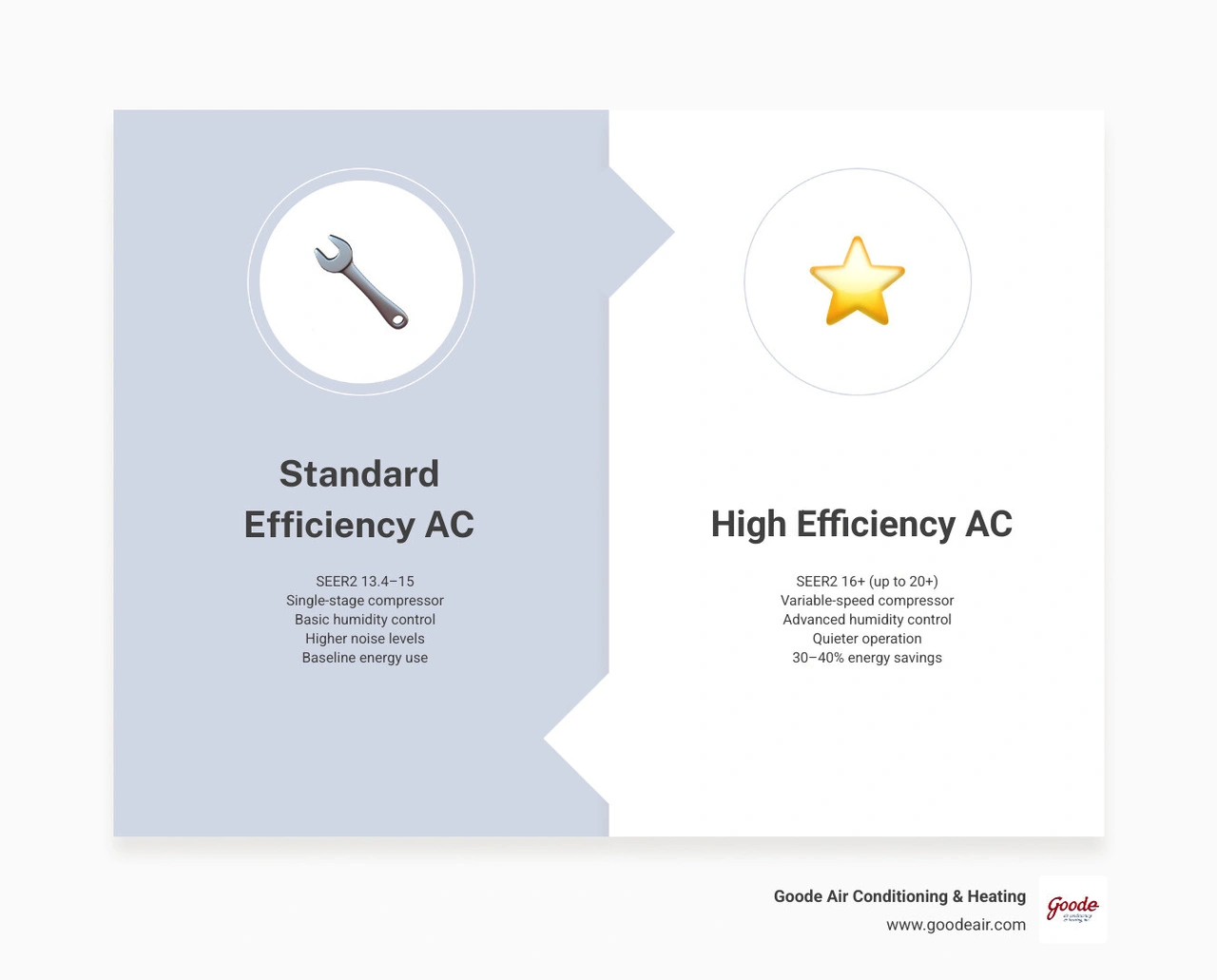
Standard Efficiency vs High Efficiency AC Comparison: Key Differences

When we look at a standard efficiency vs high efficiency ac comparison, we aren't just talking about how much electricity the unit pulls from the grid. We are talking about the "brain" of the system. A standard unit is relatively simple: when the thermostat says it's too warm, the AC turns on at 100% capacity. When the house is cool enough, it shuts off completely.
In contrast, high-efficiency Air Conditioning systems are designed with nuance. They use sophisticated compressors and motors that can "throttle" down. Imagine driving a car where you could only go 0 mph or 100 mph—that’s a standard unit. A high-efficiency unit is like a modern car that can cruise at 35 mph through a neighborhood or 70 mph on the highway, using only the fuel necessary for the task.
Technical Specifications at a Glance
| Feature | Standard Efficiency | High Efficiency |
|---|---|---|
| Compressor | Single-Stage | Two-Stage or Variable-Speed |
| Blower Motor | PSC (Fixed Speed) | ECM (Variable Speed) |
| Sound Levels | 72–80+ decibels | 55–70 decibels |
| Humidity Removal | Moderate (cycles off quickly) | Superior (runs longer at lower speeds) |
| Refrigerant | Standard | Often advanced/eco-friendly |
Humidity management is perhaps the biggest "hidden" difference. Because high-efficiency units run for longer periods at a lower speed, they move more air across the cold evaporator coil over time. This allows the system to pull significantly more moisture out of the air. In places like Humble, Kingwood, or Atascocita, that extra dehumidification is the difference between feeling "cool and crisp" and "cold and clammy."
Understanding SEER2 in a Standard Efficiency vs High Efficiency AC Comparison
You have likely seen the term "SEER2" on yellow Energy Guide labels. SEER2 stands for Seasonal Energy Efficiency Ratio 2. It measures how much cooling a system puts out for every watt of electricity it uses, averaged over an entire cooling season.
As of April 2026, the Department of Energy (DOE) has strict regional requirements. In our part of Texas (the Southeast/Southwest region), the minimum allowable SEER2 for a new split-system installation is 14.3. Anything below this is no longer compliant for new installs.
- Standard Efficiency (14.3 – 15 SEER2): These units meet the legal baseline. They are reliable and have a lower upfront cost, but they lack the advanced energy-saving features of premium models.
- High Efficiency (16 – 20+ SEER2): These units often carry the ENERGY STAR label, which requires a minimum of 15.2 SEER2 for split systems. Some ultra-high-efficiency units can reach 23 or even 25 SEER2.
When you are looking at an AC Installation Humble TX Complete Guide, it is important to remember that every single-point increase in SEER2 represents roughly a 7-10% improvement in efficiency. Over the 15-to-20-year lifespan of a system in the Texas heat, those percentages add up to thousands of dollars in saved utility costs.
Single-Stage vs Variable-Speed Technology
The "heart" of any AC is the compressor. In a standard efficiency vs high efficiency ac comparison, the compressor technology is the primary driver of both cost and comfort.
- Single-Stage (Standard): This is an "all or nothing" system. It creates a "sawtooth" temperature pattern in your home—the AC kicks on, the temperature drops quickly, it shuts off, and then the temperature creeps back up until the cycle repeats. This constant on-off cycling is also when the system uses the most power, as compressors draw a massive "surge" of electricity just to start up.
- Two-Stage (Mid-to-High): These have a "high" and "low" setting. Most of the time, they run on the low setting (about 60-70% capacity), which is quieter and more efficient. They only jump to high on those 100-degree August afternoons.
- Variable-Speed/Inverter (High Efficiency): These are the gold standard. They can adjust their output in tiny increments—sometimes as small as 1% at a time. They stay on almost constantly but at a very low power level. This eliminates temperature fluctuations and provides the most consistent HVAC Maintenance for Maximum Energy Savings because the system never has to work hard to "catch up."
Performance and Comfort in the Texas Climate
In Northeast Houston, we don't just deal with heat; we deal with "soup-like" humidity. A standard AC unit often cools the air so quickly that it reaches the target temperature and shuts off before it has had a chance to properly dehumidify the home. This leads to that "sticky" feeling where you find yourself lowering the thermostat to 68 degrees just to feel comfortable.
High-efficiency units solve this. Because they run longer cycles at lower speeds, they are masters of moisture removal. You might find that with a high-efficiency system, you feel perfectly comfortable at 72 or 73 degrees because the air is much drier.
The Heat Pump Factor
We also see more neighbors in Porter and New Caney opting for high-efficiency heat pumps. When looking at Heat Pump vs AC Texas Cost Comfort, it is vital to know that a Heat Pump is essentially an air conditioner that can run in reverse. Modern high-efficiency heat pumps are incredibly effective in our climate, providing both cooling and heating with much higher efficiency than a standard furnace-and-AC combo.
Long-Term Savings: A Standard Efficiency vs High Efficiency AC Comparison
Is the higher upfront price of a high-efficiency unit worth it? For most homeowners in our service area—from Crosby to Spring—the answer is a resounding "yes," provided you plan to stay in your home for more than a few years.
- Utility Bill Reduction: The Department of Energy notes that replacing an old, inefficient system with a modern high-efficiency model can reduce your cooling bills by up to 40%.
- Operational ROI: While a high-efficiency unit costs more initially, the Texas Heat Pumps Energy Savings and reduced electricity usage often allow the unit to "pay for itself" through lower monthly bills within 5 to 7 years.
- Environmental Impact: High-efficiency units use less electricity, which reduces your home's carbon footprint. Furthermore, newer systems are transitioning to more eco-friendly refrigerants (like R-454B) which have a much lower Global Warming Potential (GWP) than older gases.
Advanced Features for Enhanced Air Quality
High-efficiency systems aren't just about the outdoor unit. They usually include an ECM (Electronically Commutated Motor) blower motor in the indoor unit. These motors use about 60% less electricity than standard motors.
More importantly, they can run at a very low "whisper" speed 24/7. This provides continuous air circulation, which means your air is constantly being pulled through your filters. This leads to:
- Fewer hot and cold spots in the house.
- Better filtration of dust, pollen, and pet dander.
- Increased home value, as How a New HVAC System Increases Home Value is a major selling point for modern buyers looking for "smart" and "green" homes.
Choosing the Right System for Your Home
Selecting between standard and high efficiency isn't just about picking a number off a chart. We have to look at your specific home.
- Home Sizing: A system that is too large (oversized) will "short-cycle," turning on and off rapidly. This destroys the efficiency of even the most expensive unit. We always perform a Manual J load calculation to ensure the size is perfect for your square footage and insulation levels.
- Ductwork Integrity: There is no point in buying a 20 SEER2 unit if your ducts are leaking 30% of that cold air into your attic. Before an upgrade, we often recommend a duct inspection.
- Usage Patterns: If you are in a "forever home" in Eagle Springs or Summerwood, high efficiency is a no-brainer. If you are selling the home in six months, a standard efficiency unit might be the more practical choice to get the system running for the next owner.
When making the Repair vs Replace Your HVAC Decision Guide, also consider that high-efficiency systems often qualify for significant federal tax credits (under the Inflation Reduction Act) and local utility rebates that can shave hundreds or even thousands off the total investment.
Maintenance and Durability Considerations
A common question we get is: "Are high-efficiency units more fragile because they have more electronics?"
Actually, the opposite is often true. Because high-efficiency units use variable-speed technology, they avoid the violent "hard starts" that standard units experience 30 to 50 times a day. This reduces wear and tear on the compressor—the most expensive part of the system.
However, they do require professional care. Knowing How Long Does an AC System Last in Texas (usually 15-20 years) depends heavily on maintenance. Because these systems are more complex, you should follow the guide on How Often Should You Service Your AC in Texas—which is twice a year (once before the cooling season and once before the heating season).
Frequently Asked Questions about AC Efficiency
What is the primary difference between standard and high-efficiency units?
The primary difference is the compressor and fan technology. Standard units are single-stage (on/off), while high-efficiency units use two-stage or variable-speed technology to match their output to your home's actual cooling needs, saving energy and improving comfort.
Is a high-efficiency AC worth it for a smaller home?
Yes, especially in humid climates. While the energy savings might be smaller in absolute dollars compared to a mansion, the comfort benefits—specifically humidity control—are just as valuable in a 1,200-square-foot home as they are in a 4,000-square-foot one.
How does humidity control differ between these systems?
Standard systems run at full speed, cool the air quickly, and shut off. This often leaves moisture in the air. High-efficiency systems run longer, slower cycles, which allows the evaporator coil to pull significantly more humidity out of the air, making the home feel cooler at higher temperatures.
Conclusion
Choosing the right air conditioner is one of the biggest investments you'll make in your home. Whether you go with a dependable standard unit or a cutting-edge high-efficiency system, the goal is the same: keeping your family comfortable without breaking the bank.
At Goode Air Conditioning & Heating, we've spent over 50 years serving our neighbors in Humble, Kingwood, Atascocita, and the surrounding areas. As a family-owned business, we believe in transparent advice and a 100% satisfaction guarantee. We don't just sell boxes; we design comfort solutions tailored to your specific home and budget.
Ready to see how a high-efficiency system could change your home life? We're here to help you navigate the standard efficiency vs high efficiency ac comparison with ease.
Explore our full range of HVAC Services or Schedule your high-efficiency AC consultation with Goode Air Conditioning & Heating today!


Customer Testimonials
See why so many homeowners trust Goode Air Conditioning & Heating, Inc.—our 4.8-star Google rating and hundreds of happy customers speak to the quality, care, and service we deliver every day.

The technician Goode AC is one of the best businesses I know of. I have had their annual maintenance check up for several years. I’m so impressed with the technician who has serviced my AC several times. Always on time, pleasant, considerate, thorough in his work and explains the problems where I can easily understand. Thankful for doing business with professionals.
I have been a customer for at least 30 years. They have replaced 3 air conditioners, a furnace and heat exchanger. Today they replaced the air ducts in my attic that were falling apart and never been cleaned. Wonderful job, polite workers, great clean up. I can already tell the difference in the quality of the air. Love you guys!!
Great experience today with Goode Air Conditioning. Hoger, our technician, was very knowledgeable and provided excellent customer service. We look forward to our Spring maintenance visit.
I have used Goode Air Conditioning and Heating for many years. The company has excellent customer service and the technicians are knowledgeable, thorough and professional.