





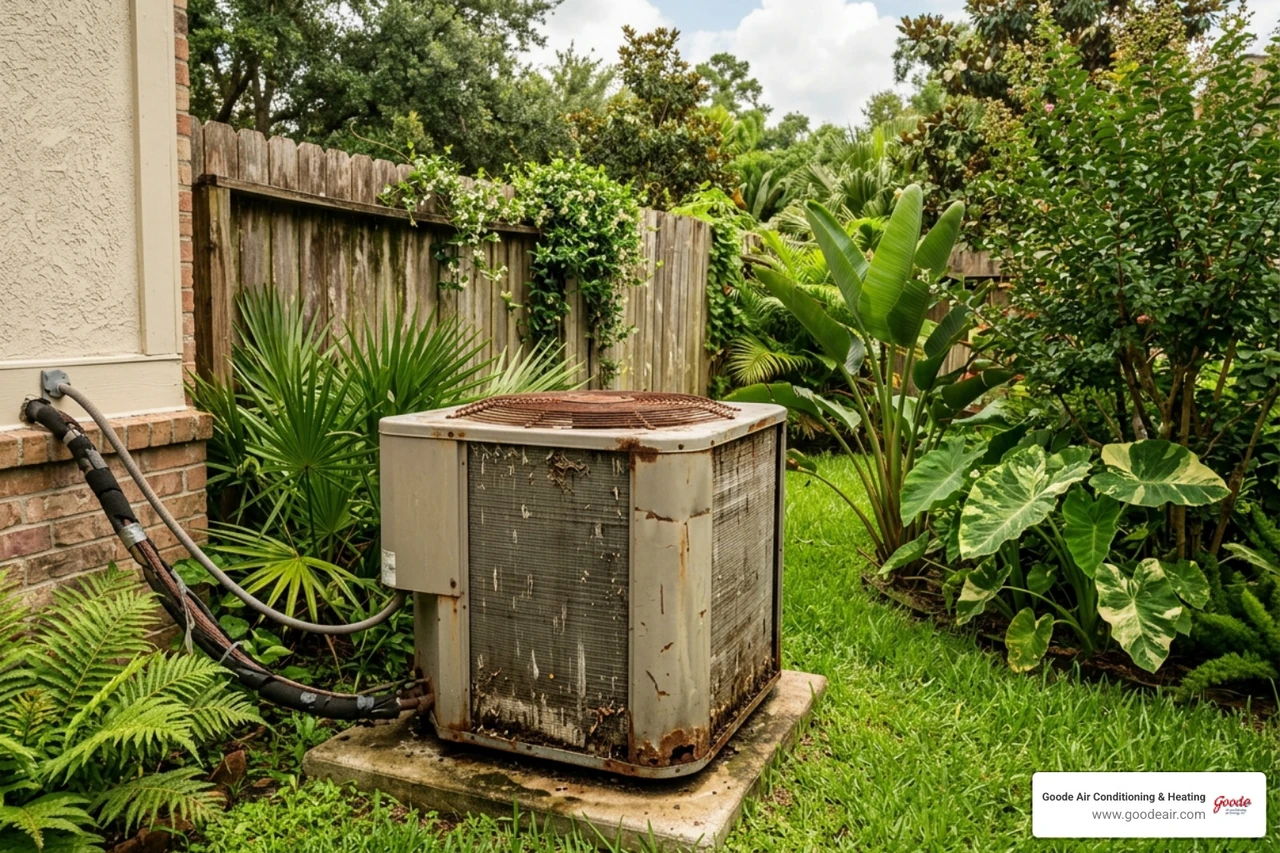
Is It Time to Say Goodbye? How to Know When Should You Replace Your AC
Knowing when should you replace your AC can save you from sweating through a Houston summer with a failing system. If your unit is more than 10–15 years old, your energy bills keep climbing, repairs are becoming frequent, or your home just won't cool down the way it used to — those are the clearest signs it's time to replace.
Quick Answer: When Should You Replace Your AC?
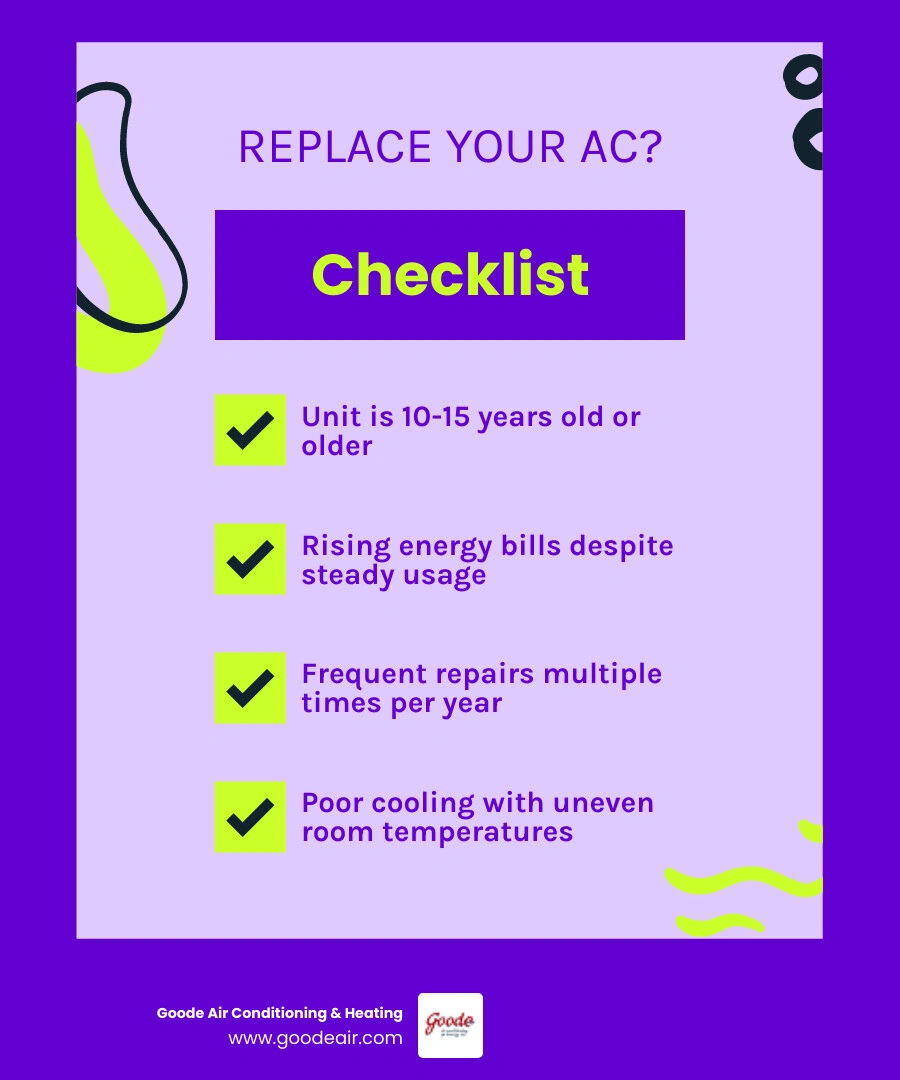
Consider replacing your AC if any of the following apply:
- Age: Your unit is 10–15 years old or older
- Rising energy bills: Costs keep going up without a change in usage
- Frequent repairs: You're calling for service multiple times a year
- Poor cooling: Rooms stay hot or temperatures are uneven
- R-22 refrigerant: Your system uses the now-banned Freon
- Unusual noises or smells: Grinding, squealing, burning, or musty odors
- High humidity indoors: The system struggles to remove moisture
- Repair cost warning: Use the 5,000 rule — multiply the unit's age by the repair cost; if it exceeds $5,000, replacement is likely smarter
For Northeast Houston homeowners, the heat and humidity here put extra strain on cooling systems year-round. That means your AC may reach the end of its useful life sooner than you'd expect — and the cost of ignoring the warning signs adds up fast. Up to 50% of your home's energy use goes toward heating and cooling, so an inefficient or failing unit hits your wallet hard every single month.
This guide walks you through every sign, every decision point, and everything you need to know to make a confident call about your AC.
Understanding the Average Lifespan of Your Cooling System
When we talk about the lifespan of an air conditioner, we usually look at a window of 10 to 15 years. While some high-quality, meticulously maintained systems can stretch to 20 years, that is the exception rather than the rule—especially here in Northeast Houston. Our climate is essentially a "stress test" for mechanical equipment. With temperatures regularly hitting the 90s (and staying there well into September), your AC works significantly harder than a unit in a milder climate.
In places like Kingwood or Atascocita, humidity levels are the real silent killer. Your AC doesn’t just cool the air; it’s also a giant dehumidifier. Over a decade of pulling gallons of moisture out of the air every day, components naturally begin to degrade. The coils can corrode, the compressor loses its "oomph," and the fan motors start to tire out.
If you’ve been diligent about scheduling AC Maintenance Kingwood TX, you might be on the higher end of that 15-year estimate. However, if your system has been neglected, it might start showing its age as early as year seven or eight. We often see that units over 10 years old are no longer under warranty, meaning any major component failure will come straight out of your pocket. If you aren't sure how your system is holding up, a professional AC Service Kingwood TX can give you a clear picture of its remaining life expectancy.
Telltale Signs for When Should You Replace Your AC
Sometimes your AC doesn't just quit; it sends you "warning shots" first. Recognizing these signs early can be the difference between a planned upgrade and a 2:00 AM emergency call when it's 100 degrees outside in Humble or Porter.
One of the most common signs is weak airflow. If you feel like you have to stand directly under a vent to feel anything, your compressor might be failing, or your blower motor is on its last legs. While sometimes this is just a ductwork issue, in older units, it often signals a system-wide decline.
Another red flag is frequent breakdowns. We like to use the "car analogy." If you’re fixing one thing this month only for something else to break next month, you’re just pouring money into a sinking ship. If you’ve had to call for AC Repair Kingwood TX or AC Repair Humble TX more than twice in a single season, your system is likely trying to tell you it's done.
You should also keep an eye out for moisture pooling or short cycling. If your system turns on and off every few minutes without ever really cooling the house, it’s short cycling. This puts immense strain on the hardware and skyrockets your energy usage. If you find yourself constantly searching for AC Repair Near Me TX or AC Repair Porter TX, it’s time to look at the math of replacement.
Unusual Noises and Smells
Your AC should be seen and felt, but rarely heard or smelled. If your unit starts sounding like a blender full of marbles, that’s a problem. Grinding sounds often indicate that the motor bearings have dried out or failed. Squealing belts or rattling components are signs that parts are loose or misaligned.
Smells are equally important. A burning odor usually points to electrical issues or a motor that is literally overheating. Musty scents, on the other hand, often mean mold or mildew is growing inside the unit or the ductwork—a common issue in our humid Texas climate. For a deeper dive into what these sounds and smells might mean, check out our AC Repair Kingwood TX Complete Guide.
Determining When Should You Replace Your AC Based on Efficiency
If your monthly power bill looks more like a mortgage payment, your AC is likely the culprit. Air conditioning accounts for roughly 12% to 27% of a typical monthly power bill, but an inefficient unit can push that much higher.
Efficiency is measured by the SEER2 (Seasonal Energy Efficiency Ratio) rating. As of 2023, the U.S. Department of Energy raised the bar. In the southern U.S., all new residential AC units must have a minimum SEER2 rating of 15. If your current unit is 10 or 12 years old, it might only have a rating of 10 or 13. Upgrading to a modern, high-efficiency unit can save you up to 20% on your cooling costs.
Using Air Conditioning Services to evaluate your current efficiency is a smart move. Sometimes, a simple AC Tune-Up Kingwood TX can help, but if the unit is fundamentally outdated, no amount of tuning will bring it up to modern standards.
The Role of Refrigerant and the R-22 Phase-Out
One of the biggest "deal-breakers" in the repair-vs-replace debate is the type of refrigerant your system uses. If your AC was manufactured before 2010, there is a very high chance it uses R-22 refrigerant, commonly known as Freon.
Because R-22 is an ozone-depleting substance, the EPA officially banned its production and importation in the U.S. back in 2020. This means that if your old unit develops a leak, we can only use recycled or "reclaimed" R-22 to fix it. Because the supply is so limited, the cost of R-22 has become astronomical.
If you have an R-22 system with a major leak or a failed compressor, it almost never makes sense to repair it. You would be investing a large sum of money into a system that is fundamentally obsolete. Modern systems use more sustainable refrigerants like R-410A (which is also being phased down for newer alternatives like R-32 or R-454B). Transitioning to a new system ensures your unit is "future-proof" and much easier to service. You can learn more about the modern installation process in our AC Installation Kingwood TX Complete Guide.
The Decision Matrix: Repair vs. Replace
Deciding whether to sink more money into an old unit or invest in a new one is the most common dilemma we help our neighbors in Atascocita and Kingwood solve. To make it easier, we use a few industry standard "rules of thumb."
| Factor | Consider Repair If... | Consider Replacement If... |
|---|---|---|
| Age | System is under 10 years old | System is 12-15+ years old |
| Repair Cost | Minor (under $500) | Major (over $1,500 or 50% of new unit) |
| The 5,000 Rule | Age x Repair Cost < $5,000 | Age x Repair Cost > $5,000 |
| Refrigerant | System uses R-410A | System uses R-22 (Freon) |
| Warranty | Parts are still covered | Warranty has expired |
| Efficiency | Bills are stable | Bills are skyrocketing |
The 5,000 Rule is a great way to take the emotion out of the decision. For example, if your 12-year-old unit needs a $600 repair, 12 x 600 = 7,200. Since that’s over 5,000, the math says you should replace it.
If you are looking for AC Replacement Kingwood TX, AC Replacement Atascocita TX, or AC Replacement Valley Ranch TX, we can help you walk through these numbers to ensure you're making the most cost-effective choice for your family.
Strategic Timing for When Should You Replace Your AC
Most people wait until their AC dies on a 100-degree day in July to think about replacement. That is the most stressful way to do it! You’re stuck in a hot house, HVAC companies are booked out for days, and you might feel rushed into a decision.
The "pro move" is to replace your unit during the shoulder seasons—typically spring (March/April) or fall (October/November). During these months, the weather is mild, so you won't suffer while the power is off for the installation. Plus, contractors often have more flexible schedules and may offer seasonal promotions.
Planning your AC Replacement Eagle Springs TX or AC Replacement Tavola TX proactively means you can take your time choosing the right SEER2 rating and features without the pressure of a heatwave.
Frequently Asked Questions about AC Replacement
How long does a typical AC replacement take?
A standard AC replacement usually takes between 4 to 8 hours. If we are just swapping out the indoor and outdoor units and they are easily accessible, we can often be done in half a day. However, if your home requires significant ductwork modifications, new electrical runs, or if the unit is in a tight attic space, it might extend to a second day. We always perform a thorough ductwork inspection during the process to ensure your new high-efficiency unit isn't being choked by old, leaky ducts.
Can maintenance extend my unit's life?
Absolutely. Think of it like a car—if you never change the oil, the engine won't last 100,000 miles. For your AC, the most important DIY task is changing your filters every 1 to 3 months. Clogged filters restrict airflow, making the motor work harder and eventually burn out. Annual professional inspections are also key; we clean the coils, check refrigerant levels, and tighten electrical connections to prevent minor issues from turning into system-killing failures.
What are the benefits of a high-efficiency upgrade?
Beyond the lower monthly bills, high-efficiency units provide much better comfort and humidity control. Modern systems often feature variable-speed compressors that don't just blast on and off; they ramp up and down to maintain a perfectly steady temperature. This also helps remove significantly more moisture from the air, making your home feel cooler at a higher temperature setting. You'll also enjoy improved indoor air quality and quieter operation.
Conclusion
Deciding when should you replace your AC is a big step, but you don't have to do it alone. At Goode Air Conditioning & Heating, we’ve spent the last 50 years helping our neighbors in Northeast Houston stay cool. As a family-owned business, we value transparency and honesty—we’ll never push you into a replacement if a repair makes more sense, and we’ll never suggest a repair that we know won't last.
Whether you're in Kingwood, Humble, Atascocita, or any of our surrounding communities, we provide expert guidance backed by a 100% satisfaction guarantee. If your system is showing the signs of old age, don't wait for the next Houston heatwave to leave you stranded.
Schedule your professional AC replacement consultation today and let us help you find the perfect, energy-efficient solution for your home.

Customer Testimonials
See why so many homeowners trust Goode Air Conditioning & Heating, Inc.—our 4.8-star Google rating and hundreds of happy customers speak to the quality, care, and service we deliver every day.

The technician Goode AC is one of the best businesses I know of. I have had their annual maintenance check up for several years. I’m so impressed with the technician who has serviced my AC several times. Always on time, pleasant, considerate, thorough in his work and explains the problems where I can easily understand. Thankful for doing business with professionals.
I have been a customer for at least 30 years. They have replaced 3 air conditioners, a furnace and heat exchanger. Today they replaced the air ducts in my attic that were falling apart and never been cleaned. Wonderful job, polite workers, great clean up. I can already tell the difference in the quality of the air. Love you guys!!
Great experience today with Goode Air Conditioning. Hoger, our technician, was very knowledgeable and provided excellent customer service. We look forward to our Spring maintenance visit.
I have used Goode Air Conditioning and Heating for many years. The company has excellent customer service and the technicians are knowledgeable, thorough and professional.