





Why HVAC Challenges in the Houston Area Are Unlike Anywhere Else in Texas
HVAC challenges in the Houston area are some of the toughest in the entire country — and if you own a home in Kingwood, Humble, Atascocita, or anywhere in Northeast Houston, you already feel it every summer.
Here's a quick look at the most common HVAC challenges Houston homeowners face:
| Challenge | What It Means for You |
|---|---|
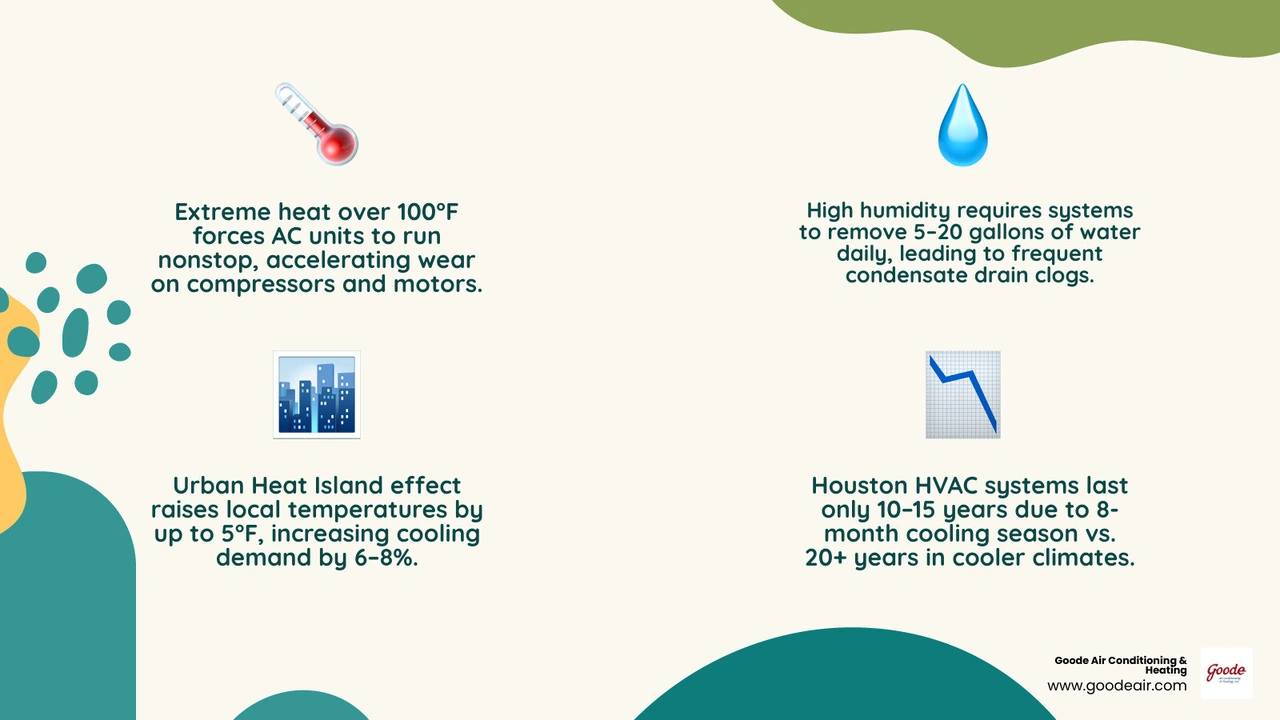
| Extreme heat (100°F+) | Your AC runs almost nonstop, wearing out parts faster |
| High humidity | Forces your system to remove moisture AND cool the air simultaneously |
| Urban Heat Island effect | Developed areas like Humble and Atascocita can run up to 5°F hotter than surrounding regions |
| Short system lifespan | Houston HVAC systems typically last only 10–15 years vs. 20+ years in cooler climates |
| Condensate drain clogs | A residential AC can pull 5–20 gallons of water per day from the air in peak summer |
| Higher energy bills | Urban heat stress can raise cooling energy demand by 6–8% or more |
Houston's cooling season stretches from March all the way through October — that's nearly eight months of near-constant operation for your HVAC system. Most homeowners don't realize just how much that relentless workload shortens equipment life and drives up energy costs until something breaks down on the hottest day of the year.
The scale of the problem goes beyond just residential homes. In May 2025 alone, Houston ISD logged over 1,600 HVAC work orders across its campuses — including 123 emergency requests — showing just how hard Southeast Texas heat is on any cooling system, residential or commercial.
Whether your system is struggling to keep up, your energy bills keep climbing, or you're simply trying to get ahead of the next breakdown, this guide walks you through everything you need to know.
Navigating Common HVAC Challenges in the Houston Area
If you live in Humble, Kingwood, Atascocita, Porter, New Caney, Crosby, or the surrounding Northeast Houston communities we serve, your AC is not dealing with a normal summer. It is dealing with marathon conditions.
That is why so many local homeowners notice the same pattern: the system seems fine in spring, then July arrives and suddenly it cannot quite keep up. For a deeper local overview, see How Southeast Texas Climate Affects Your HVAC System.
The Impact of Extreme Heat and Humidity
Houston-area heat does not just feel uncomfortable. It creates a measurable equipment burden.
When outdoor temperatures climb into the upper 90s and over 100 degrees, your system runs longer cycles and may barely get a chance to shut off. Add high humidity, and now your AC has two jobs:
- Lower the air temperature
- Pull moisture out of the air
That second job matters more than many homeowners realize. In peak summer, a residential AC in our climate can remove roughly 5 to 20 gallons of water from indoor air each day. That is a lot of moisture moving through coils and drains.
Humidity can also make your home feel warmer than the thermostat suggests. If your house is 74 degrees but still feels sticky, your system may be cooling somewhat but not dehumidifying effectively. We explain this in more detail in How Humidity Affects Your AC Performance.
The biggest climate-related stressors around Northeast Houston include:
- Long cooling season from March through October
- More days over 100 degrees
- Warm nights above 80 degrees that reduce overnight recovery
- Heavy latent load from Gulf Coast humidity
- Frequent summer storms that can add moisture and strain equipment
Urban Heat Islands in Atascocita and Humble
In developed parts of Humble, Atascocita, Fall Creek, Summerwood, and similar neighborhoods, pavement, rooftops, and reduced tree cover can create an urban heat island effect. Research shows this can push temperatures up by as much as 5 degrees compared to less developed nearby areas.
That may sound small, but HVAC systems definitely notice.
Urban heat island conditions can increase cooling energy demand by 6 to 8 percent, and some studies show cooling loads can rise much more depending on the site. In plain English: your AC has to fight harder just because the neighborhood itself holds heat longer.
This is why homes in dense subdivisions often struggle most in late afternoon and early evening. The sun is still radiating off roads, driveways, brick walls, and attic spaces long after you wish it would calm down.
Why Southeast Texas Systems Have Shorter Lifespans
In cooler parts of the country, an HVAC system may last 20 years or more. In Southeast Texas, 10 to 15 years is much more common. If you want a local breakdown, read How Long Does an AC System Last in Texas.
Why the shorter life? A few big reasons:
- Longer runtime throughout most of the year
- More humidity exposure
- Greater strain on compressors and blower motors
- Higher risk of clogged drains and dirty coils
- Stronger weather extremes, including extreme heat and storm season
Think of it as the "Texas Tax" on HVAC equipment. Your system ages by use, and in our part of Texas, it gets a lot of use.
Combating the "Texas Tax" on Your Equipment
The parts that take the biggest beating are usually the ones doing the heaviest lifting.
- Compressors wear down from long, repeated cooling cycles
- Motors fatigue when airflow is restricted by dirty filters or dirty coils
- Electrical components age faster under prolonged heat stress
- Condensate systems work overtime because of humidity
- Evaporator and condenser coils can corrode faster in a damp environment
The good news is that lifespan is not completely out of your hands. Smart maintenance, clean airflow, duct improvements, and humidity control can add years to a system's useful life. We cover more ways to help in How to Extend the Life of Your AC in Texas.
Lessons from the 2025 HISD HVAC Crisis
One of the clearest real-world examples of local HVAC stress came from Houston ISD in May 2025. District data showed 1,646 HVAC work orders in a single month, including 123 emergency requests and 700 urgent requests.
The campuses with the most reported issues in May 2025 were:
- T.H. Rogers School: 28 work orders
- The Rice School: 28 work orders
- Sutton Elementary: 24 work orders
- Navarro Middle School: 24 work orders
- Lamar High School: 24 work orders
Even though that total represented a 26 percent drop from May 2024, when work orders topped 2,220, the numbers still reveal a district-wide reality: in Houston heat, aging HVAC infrastructure gets exposed fast.
Addressing HVAC Challenges in the Houston Area Schools and Large Buildings
Large buildings deal with many of the same issues homeowners do, just at a bigger scale.
In local reporting, schools faced problems such as:
- Chiller alarms
- Leaks
- Rooms too hot or too cold
- Emergency cooling failures
- Early dismissals and room relocations during heat events
Some campuses needed replacement of chillers that were already around 24 years old, well beyond the practical life expectancy for heavily used equipment in this climate. Temporary rental cooling equipment was used in some cases while permanent systems were being built and delivered.
Another notable takeaway: maintenance teams reportedly started as early as 4:30 AM to monitor digital controls and respond before the school day began. That tells us something important. In Houston heat, HVAC problems are not casual inconveniences. They are operational emergencies.
Proactive Responses and Infrastructure Upgrades
Houston ISD's response also shows what proactive planning looks like under climate pressure.
Reported district actions included:
- A planned $40 million allocation in the 2025-26 budget for HVAC repairs and related health and safety needs
- $21.2 million approved for HVAC upgrades at 25 campuses through April 2026
- Prioritizing high-use, high-enrollment buildings for replacement projects
- Using temporary cooling solutions while waiting on new equipment
For homeowners, the lesson is simple: waiting until total failure is usually the hardest path. Replacing or upgrading equipment before repeated breakdowns pile up often leads to better comfort, fewer emergencies, and less stress in peak summer.
Proactive Maintenance to Prevent Humidity-Related Failures
In our area, maintenance is not optional if you want reliability. It is how you keep humidity from quietly turning into water damage, mold issues, airflow problems, and AC breakdowns.
A strong monthly checklist for homeowners includes:
- Change or inspect air filters every month during heavy summer use
- Check the thermostat for unusually long run times
- Look for water near the indoor unit or drain pan
- Make sure supply vents are open and unobstructed
- Keep the outdoor unit clear of grass, leaves, and debris
- Watch for musty smells, which can signal moisture trouble
- Listen for buzzing, rattling, or hard starts
For a fuller local checklist, visit HVAC Maintenance Tips Southeast Texas Guide.
Managing Condensate Drains and Coil Corrosion
Humidity is especially rough on three areas: evaporator coils, condensate drains, and compressors.
Evaporator coils:
- Stay wet frequently in humid weather
- Can collect dirt more quickly when filters are neglected
- May corrode over time, reducing heat transfer and efficiency
Condensate drains:
- Handle gallons of water removal every day in summer
- Can clog with algae, sludge, or debris
- May overflow and trigger water shutdown safeties
Compressors:
- Run longer when the house is humid and hot
- Work harder if coils are dirty or refrigerant charge is off
- Fail faster when airflow problems force longer cycles
Common signs these parts are struggling include:
- Sticky indoor air
- Warm air from vents
- Ice on refrigerant lines
- Water around the air handler
- Repeated drain line clogs
- Musty odors near vents
- System short cycling or never reaching set temperature
Moisture control matters for indoor air quality too. Learn more in How Proper HVAC Maintenance Prevents Mold Growth and Duct Cleaning Benefits for Humid Climate Homes.
Seasonal Tune-Ups for Year-Round Reliability
We recommend seasonal professional tune-ups because local systems rarely get a true off-season. Spring maintenance prepares for cooling demand, and fall service helps catch wear after a brutal summer.
Regular service helps us:
- Clean coils and drain components
- Check refrigerant operation
- Test electrical connections and capacitors
- Confirm airflow and blower performance
- Spot corrosion or weak parts before failure
- Verify humidity removal is working properly
Some industry sources note that seasonal tune-ups can help prevent a very large share of avoidable system failures. At minimum, they give homeowners a better shot at catching problems before the first 100-degree week lands like a punchline no one asked for.
More guidance is available in Benefits of Regular AC Maintenance in Texas and How Often Should You Service Your AC in Texas.
Future-Proofing Your Home with New Technology
New HVAC technology is not just about convenience. In Houston-area conditions, it can directly address comfort problems that older single-stage systems often struggle with.
Smart IoT and Low-GWP Refrigerant Trends
Several major trends are shaping HVAC upgrades in 2026 and beyond:
- Smart HVAC systems with connected monitoring
- Variable-speed compressors for steadier cooling and humidity control
- More efficient heat pumps
- Indoor air quality add-ons
- Transition toward lower-GWP refrigerants
Smart HVAC technology is projected to grow quickly, with research pointing to a 15.1 percent compound annual growth rate from 2023 to 2030. That growth makes sense locally because smart features can help identify issues sooner, track runtime, and improve comfort control room by room.
For homeowners, useful smart upgrades include:
- Smart thermostats with schedule and humidity awareness
- Remote monitoring alerts
- Zoning controls
- Variable-speed air handlers
- Whole-home dehumidification
- Predictive maintenance tools that flag performance changes early
AI-based predictive maintenance is especially promising for catching trends before a breakdown happens. Instead of waiting for the unit to fully fail, connected systems can spot warning signs like abnormal runtimes, temperature drift, or airflow changes.
Heat pumps are also becoming more appealing for Southeast Texas homes because our winters are generally mild. Learn more in Heat Pump Benefits for Southeast Texas Homeowners and Texas Heat Pumps Energy Savings.
When to Repair vs. Replace Your System
At some point, every homeowner asks the same question: should we fix this thing again, or is it time to move on?
A repair often makes sense when the system is younger, the issue is isolated, and the equipment still cools effectively. Replacement becomes more attractive when the unit is older, less efficient, and breaking down repeatedly during heavy-use months.
| Situation | Repair May Make Sense | Replacement May Make More Sense |
|---|---|---|
| System age | Under 10 years | Around 10-15+ years in Southeast Texas |
| Breakdown pattern | First major repair | Repeated summer failures |
| Comfort | Home cools evenly | Hot spots, humidity issues, poor airflow |
| Efficiency | Energy use still reasonable | Bills keep climbing despite maintenance |
| Equipment condition | Core components sound | Compressor, coil, or major parts worn |
If your AC is nearing the typical Southeast Texas lifespan and struggling in July and August, replacing before total failure can spare you a lot of discomfort. We cover survival strategies in How to Make Sure Your AC Survives a Texas Summer.
Solving HVAC Challenges in the Houston Area with High-Efficiency Upgrades
High-efficiency systems can reduce energy use significantly, with some upgrades cutting consumption by up to 50 percent in the right situation. Some high-efficiency equipment also delivers up to 20 percent annual electricity savings compared to older systems.
For local homes, the most helpful upgrades often include:
- Variable-speed systems for better humidity control
- Higher-efficiency equipment with stronger part-load performance
- Duct sealing in older homes
- Attic insulation improvements
- Smart thermostat integration
- Whole-home dehumidifiers
- Mini-splits for room additions or problem zones
- Heat pump upgrades for all-electric comfort
If you are comparing options, Heat Pump vs AC Texas Cost Comfort is a useful next read.
Frequently Asked Questions about Houston HVAC
Why does my AC struggle more in the afternoon?
Afternoon is when the home takes the biggest heat load. Outdoor temperatures peak, attic temperatures soar, sun hits roofs and walls, and urban heat island effects keep surrounding surfaces hotter. If your insulation is weak or your ducts leak, the problem gets worse. Your system may be sized correctly and still run longer at that time of day because the heat gain is simply highest.
How often should I change my filters in Humble, TX?
In summer, check filters monthly. Many homes in Humble, Kingwood, Atascocita, and nearby communities benefit from monthly replacement during heavy cooling use, especially if you have pets, high pollen exposure, nearby construction, or indoor air quality concerns. A clogged filter reduces airflow, hurts dehumidification, and adds stress to the blower and compressor.
What are the signs of humidity-related AC failure?
Watch for these common warning signs:
- Sticky or clammy indoor air
- Musty smells from vents
- Visible mold around registers
- Water near the indoor unit
- Frequent drain line clogs
- Ice on the evaporator coil or refrigerant line
- Longer cooling cycles
- Rooms that feel cool but still damp
If you notice several of these at once, the system may be struggling with drainage, airflow, coil performance, or overall humidity control.
Conclusion
Houston-area homeowners deal with a unique mix of heat, moisture, and long cooling seasons that can punish even good equipment. That is the reality behind so many HVAC challenges in the Houston area.
At Goode Air Conditioning & Heating, we have spent 50 years helping families protect comfort in Kingwood, Atascocita, Humble, Porter, New Caney, Crosby, and nearby Northeast Houston communities. We bring family values, transparent service, and a 100% satisfaction guarantee to every visit.
If your system is showing signs of strain, do not wait for the next triple-digit day to find out what is wrong. Schedule your professional HVAC maintenance in Humble, TX and let us help you stay ahead of Houston heat.

Customer Testimonials
See why so many homeowners trust Goode Air Conditioning & Heating, Inc.—our 4.8-star Google rating and hundreds of happy customers speak to the quality, care, and service we deliver every day.

The technician Goode AC is one of the best businesses I know of. I have had their annual maintenance check up for several years. I’m so impressed with the technician who has serviced my AC several times. Always on time, pleasant, considerate, thorough in his work and explains the problems where I can easily understand. Thankful for doing business with professionals.
I have been a customer for at least 30 years. They have replaced 3 air conditioners, a furnace and heat exchanger. Today they replaced the air ducts in my attic that were falling apart and never been cleaned. Wonderful job, polite workers, great clean up. I can already tell the difference in the quality of the air. Love you guys!!
Great experience today with Goode Air Conditioning. Hoger, our technician, was very knowledgeable and provided excellent customer service. We look forward to our Spring maintenance visit.
I have used Goode Air Conditioning and Heating for many years. The company has excellent customer service and the technicians are knowledgeable, thorough and professional.