





Why Adding Cooling Without Ductwork Options Compared Matters for Houston Homeowners
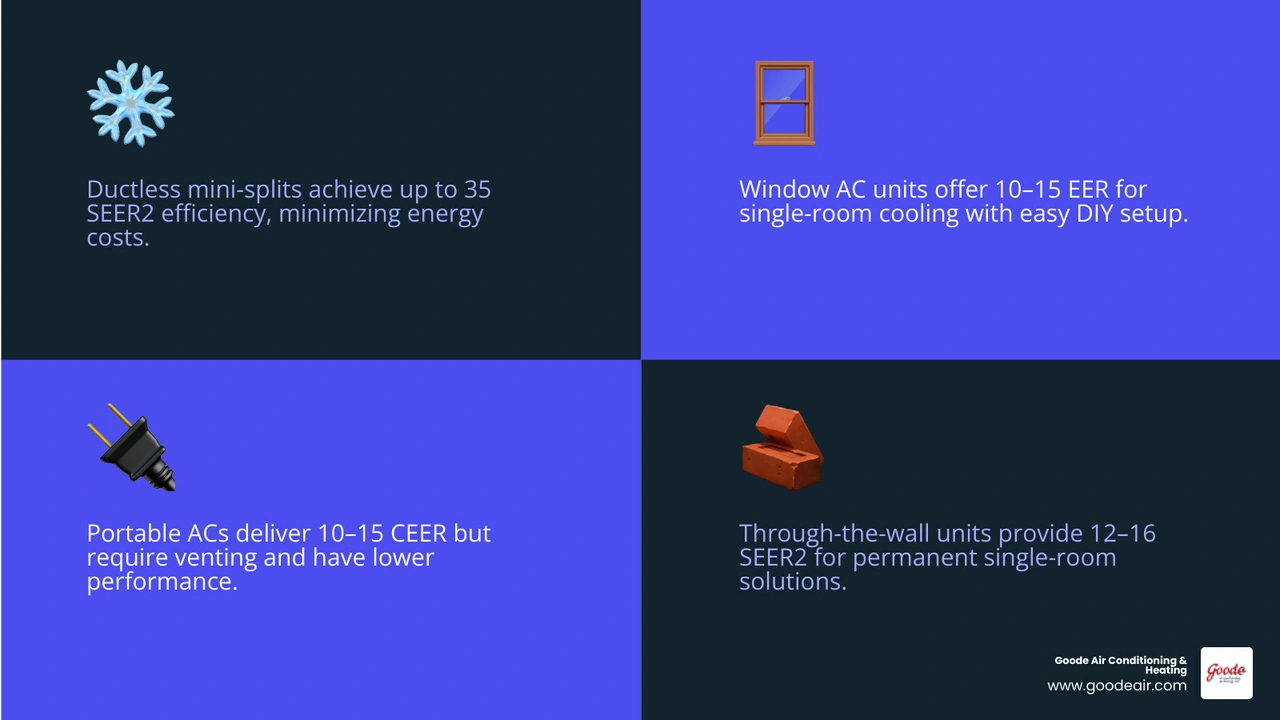
Adding cooling without ductwork options compared side by side helps you quickly find the right fit for your home, budget, and comfort goals:
| System | Best For | Efficiency | Installation |
|---|---|---|---|
| Ductless mini-split | Whole rooms, year-round use | Highest (up to 35 SEER2) | Professional required |
| Window AC unit | Single rooms, renters | Moderate (10–15 EER) | DIY-friendly |
| Portable AC | Temporary or flexible use | Lowest (10–15 CEER) | DIY, no permanent install |
| Through-the-wall (PTAC) | Permanent single-room install | Moderate (12–16 SEER2) | Wall opening required |
Millions of homes — especially older ones — were built without ductwork. Adding traditional central air means tearing into walls, ceilings, and floors. In fact, installing new ductwork in an existing home can add up to $18,000 on top of the cost of the AC system itself. That is a lot of disruption and expense, especially when you just need one room, a new addition, or a converted garage to stay cool through a Houston summer.
The good news is there are solid ductless options available today, and they are better than ever. Whether you are a homeowner dealing with an older property in Northeast Houston, finishing a bonus room, or just tired of window units rattling in your bedroom, understanding the real differences between these systems will save you time, money, and headaches.
This guide breaks down every major ductless cooling option so you can make a confident, informed decision.
Primary Methods for Adding Cooling Without Ductwork Options Compared
When we talk about cooling a home in places like Atascocita or Kingwood without using traditional vents, we are usually looking at four main contenders. Each has a specific "personality" and set of requirements.
Ductless Mini-Splits
The "gold standard" of ventless cooling is the Mini Split system. It consists of an outdoor compressor connected to one or more indoor air-handling units by a small conduit. This conduit only requires a three-inch hole in your exterior wall—no drywall destruction required. These systems are incredibly flexible; you can have up to eight indoor units attached to a single outdoor unit, allowing for customized temperatures in every room.
Window AC Units
These are the familiar boxes that sit in a window frame. They are an all-in-one system, meaning the compressor and the fan are in the same housing. While they are great for renters because they aren't permanent, they do block your view and can be a security risk if not properly secured.
Portable Air Conditioners
If you need a "quick fix" for a home office or a guest room, a portable unit stands on the floor and vents heat through a flexible hose tucked into a window. While they offer the most flexibility, they are generally the least efficient option because the unit itself generates heat while it's trying to cool the room.
Through-the-Wall Units (PTAC)
You’ve likely seen these in hotels. A Through-the-Wall unit or PTAC (Package Terminal Air Conditioner) requires cutting a permanent hole in an exterior wall to fit a sleeve for the unit. They are more permanent than window units and don't block your natural light, but they do require structural modification to your home's exterior.
Zoned Comfort
The biggest win for all these systems is zoned comfort. Instead of cooling the whole house to 72 degrees just to sleep comfortably in one bedroom, you can cool only the space you’re using. This is a game-changer for large homes in areas like Summerwood or Eagle Springs where certain rooms might stay empty during the day.
Benefits of Adding Cooling Without Ductwork Options Compared to Central Air
One of the most shocking statistics in the HVAC world is that duct losses in central forced-air systems can account for more than 30% of energy consumption. Think about that: nearly a third of the money you spend on electricity is literally vanishing into your attic or walls before the air ever reaches your living room.
By choosing a Ductless Air Conditioner in Humble, TX, you eliminate those leaks entirely. The cooled air is delivered directly into the room. This targeted approach is why ductless systems are often 20% to 40% more efficient than traditional central air.
Furthermore, mini-split systems are a natural fit for room additions or converted garages. Instead of trying to "tap into" your existing central system—which often results in undersizing the main unit and leaving the whole house warm—a ductless system provides dedicated power to that new space.
Limitations of Adding Cooling Without Ductwork Options Compared to Permanent Systems
While we love ductless tech, we believe in being transparent. There are trade-offs to consider.
- Noise Levels: While a modern Mini Split AC in Summerwood, TX is whisper-quiet (about 22–40 dB), window and portable units can be quite loud (up to 70 dB). That’s the difference between a library and a vacuum cleaner.
- Security: Window units can potentially be pushed in from the outside, which is a concern for ground-floor rooms.
- Negative Pressure: Portable units, especially single-hose models, pull air out of the room to cool the machinery, which can actually pull warm air in from other parts of the house through cracks in doors and windows.
- SACC Ratings: When shopping for portable units, look for the SACC (Seasonally Adjusted Cooling Capacity) rating. A unit labeled "12,000 BTU" might only provide 7,000 BTUs of actual cooling once you account for the heat the machine itself creates.
The Efficiency and Performance of Ductless Mini-Split Systems
If efficiency is your top priority, the mini-split is the undisputed heavyweight champion. Modern systems use inverter technology, which is essentially a "dimmer switch" for your AC. Instead of the compressor being either 100% on or 100% off, it adjusts its speed to match the cooling needs of the room perfectly.
This technology allows some Mini Split Installation in Kingwood, TX projects to reach staggering SEER2 ratings of up to 35. For comparison, a standard central AC system usually lands between 15 and 25 SEER2.
Because they don't have to push air through miles of dusty metal ducts, these systems also provide better indoor air quality. Most units come with advanced multi-stage filtration that can trap allergens and dust, which is a huge plus for families in the pollen-heavy Northeast Houston area.
Key Factors for Choosing Your Ductless Cooling Solution
Choosing the right system isn't just about picking the most efficient model; it's about matching the equipment to your specific home.
Room Size and BTU Calculation
A unit that is too small will run constantly and never get the room cool. A unit that is too large will "short cycle," turning on and off so quickly that it never has a chance to remove humidity—and in Houston, humidity is the real enemy. A general rule of thumb is to multiply your square footage by 20 to 25 to find the required BTUs, but factors like west-facing windows or high ceilings can increase that need.
Climate Suitability
Our local climate in places like Spring and Humble is characterized by high heat and even higher humidity. You need a system that excels at dehumidification. Many Ductless AC Systems in Summerwood, TX feature a "dry mode" specifically designed to pull moisture from the air without over-cooling the room.
Electrical Infrastructure
While window units and portables often run on a standard 115V outlet, larger mini-splits and PTAC units may require a dedicated 230V circuit. Before you commit, it’s vital to ensure your electrical panel can handle the additional load.
Year-Round Comfort: Heating and Cooling Without Vents
One of the best-kept secrets of ductless systems is that many of them are actually heat pumps. This means they can reverse the cooling process to provide highly efficient heat during our occasional Houston cold snaps.
Heat Pump Technology
Unlike an electric space heater that creates heat (which is very expensive), a heat pump moves heat. Even when it feels cold outside in New Caney, there is still heat energy in the air. The system captures that energy and pumps it indoors. This process can cut your heating bills by up to 60% compared to electric baseboard heaters.
Cold-Climate Performance
While we don't often see sub-zero temperatures, modern "cold-climate" mini-splits can maintain their heating capacity even when temperatures drop well below freezing. This makes a Mini Ductless AC in New Caney, TX a true year-round comfort solution.
Dehumidification
As mentioned, the cooling process naturally removes moisture. The condensate is collected and drained outside through a small tube in the wall conduit. This keeps your home feeling crisp and comfortable, preventing that "sticky" feeling that often leads to mold or mildew in non-ventilated spaces.
Frequently Asked Questions about Ductless Cooling
Can a ductless system cool an entire house?
Yes! While many people start with a single-zone system for one room, you can install a multi-zone system. A single outdoor condenser can power up to eight indoor heads. This allows you to have a unit in the living room, kitchen, and every bedroom, each with its own thermostat. If you're looking into a Mini Split Replacement in Roman Forest, TX, we can design a whole-home layout that eliminates the need for central ducts entirely.
How long do ductless mini-split systems last?
With proper care, a high-quality mini-split system typically lasts between 15 and 20 years. This is comparable to, and often longer than, traditional central AC units. Because the components are high-tech and the indoor units are protected from the elements, they are incredibly durable. If you ever run into a hiccup, a quick Mini Split Repair in Valley Ranch, TX can usually get things back on track without needing a full system overhaul.
Do ductless units require a lot of maintenance?
Not "a lot," but consistency is key. You should clean the indoor filters every few weeks—most just pop out and can be rinsed in the sink. Beyond that, we recommend an annual professional service to check refrigerant levels and clean the outdoor coils. Keeping up with this simple Ductless Air Conditioner maintenance in Porter, TX ensures your system stays efficient and your air stays clean.
Conclusion
Adding cooling without ductwork options compared reveals that while there are many ways to beat the Houston heat, the right choice depends on your long-term goals. For temporary or budget-friendly fixes, window and portable units serve a purpose. However, for true energy efficiency, whisper-quiet operation, and year-round comfort, the ductless mini-split is the clear winner for homeowners.
At Goode Air Conditioning & Heating, we’ve spent the last 50 years helping our neighbors in Northeast Houston stay comfortable. From Roman Forest to Humble and everywhere in between, we bring family values and transparent pricing to every job. Whether you need a brand-new installation or a quick repair, we stand behind our work with a 100% satisfaction guarantee.
Ready to reclaim your comfort without tearing down your walls? Explore our Mini Splits solutions today and see why so many Houstonians are making the switch to ductless.

Customer Testimonials
See why so many homeowners trust Goode Air Conditioning & Heating, Inc.—our 4.8-star Google rating and hundreds of happy customers speak to the quality, care, and service we deliver every day.

The technician Goode AC is one of the best businesses I know of. I have had their annual maintenance check up for several years. I’m so impressed with the technician who has serviced my AC several times. Always on time, pleasant, considerate, thorough in his work and explains the problems where I can easily understand. Thankful for doing business with professionals.
I have been a customer for at least 30 years. They have replaced 3 air conditioners, a furnace and heat exchanger. Today they replaced the air ducts in my attic that were falling apart and never been cleaned. Wonderful job, polite workers, great clean up. I can already tell the difference in the quality of the air. Love you guys!!
Great experience today with Goode Air Conditioning. Hoger, our technician, was very knowledgeable and provided excellent customer service. We look forward to our Spring maintenance visit.
I have used Goode Air Conditioning and Heating for many years. The company has excellent customer service and the technicians are knowledgeable, thorough and professional.