





What Homeowners Need to Know About Federal Tax Credits for Heat Pump Upgrades in 2026
Federal tax credits for heat pump upgrades were one of the most valuable incentives available to homeowners under the Inflation Reduction Act — and if you had a qualifying system installed by December 31, 2025, you can still claim the credit when you file your 2025 tax return this season.
Here is a quick summary of how the credit worked:
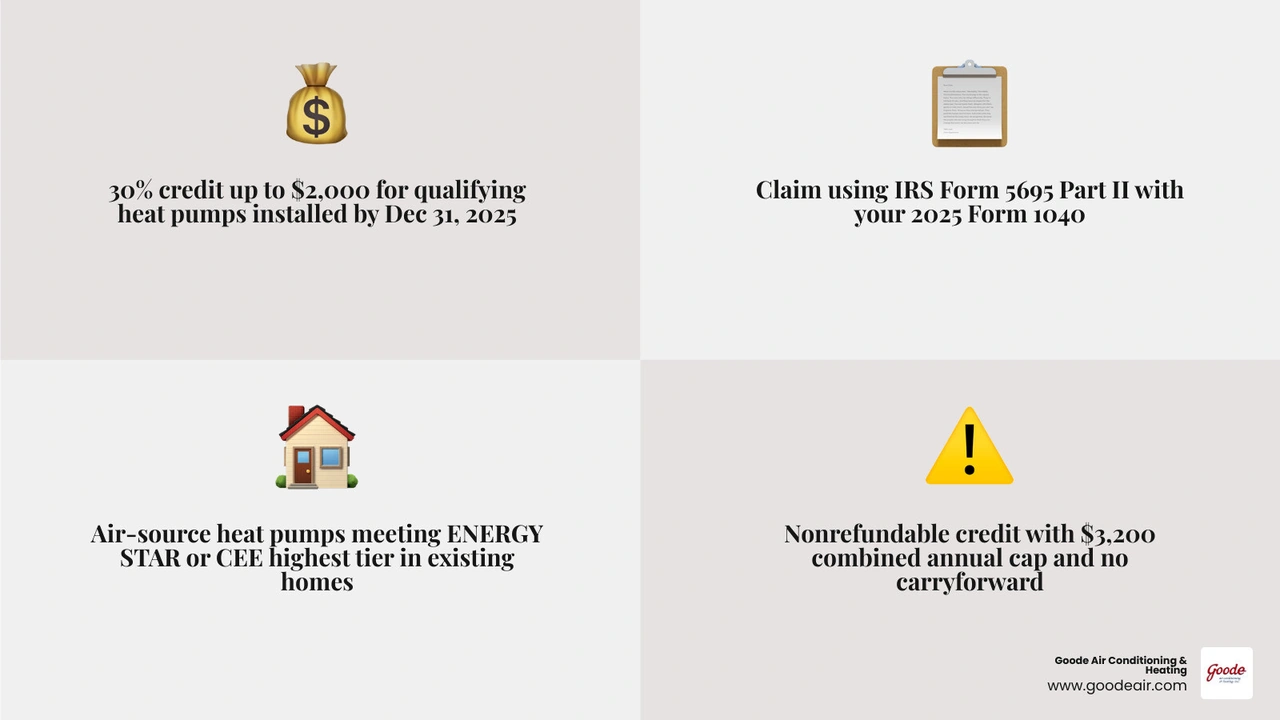
- Credit amount: 30% of qualified installation costs, up to $2,000 per year for heat pumps
- Combined annual cap: Up to $3,200 total when paired with other qualifying home improvements
- Eligibility period: January 1, 2023 through December 31, 2025 (now expired)
- What qualifies: Air-source heat pumps meeting CEE highest efficiency tier or ENERGY STAR Most Efficient standards, installed in an existing U.S. residence
- How to claim: File IRS Form 5695, Part II with your Form 1040 for the tax year the system was placed in service
- Is it refundable? No — the credit reduces your tax bill but cannot exceed what you owe, and unused amounts cannot be carried forward
- Who qualifies: Homeowners and renters who paid for eligible improvements to a primary or qualifying secondary residence; no income limits apply
If your heat pump was installed in 2025, you have not missed your window to benefit — you just need to file correctly. If your installation happened in 2026 or later, the 25C federal credit is no longer available, but state and utility rebates may still help offset your costs.
In 2024 alone, more than 2.3 million families claimed over $2 billion in energy efficiency tax credits, averaging around $880 per household. For Northeast Houston homeowners who made the upgrade before the deadline, understanding how to file accurately can make a real difference on this year's tax bill.
Federal Tax Credits for Heat Pump Upgrades: What the 25C Credit Covered
The federal heat pump tax credit most homeowners are asking about was the Energy Efficient Home Improvement Credit under Internal Revenue Code Section 25C. From 2023 through the end of 2025, it allowed eligible taxpayers to claim 30% of qualified costs for certain home efficiency improvements.
For heat pumps, the big headline was simple: up to $2,000 per year. That amount sat inside a broader annual 25C limit of up to $3,200 when combined with other eligible upgrades.
A few important details mattered:
- The credit applied to existing homes, not new construction
- The system had to be installed and placed in service during the eligible period
- Qualified installation labor counted for heat pumps
- Heat pump water heaters had their own place within the same $2,000 category
- Biomass stoves and boilers also shared that same $2,000 annual bucket

How much the federal tax credit was worth for qualifying heat pumps
For qualifying heat pumps, the credit was:
- 30% of qualified expenses
- Up to $2,000 per tax year
- Available annually during the 2023 through 2025 window
- Not subject to the old lifetime limit that existed before the Inflation Reduction Act updates
That last point matters. Before these updates, many energy credits were much more restrictive. Under the newer rules, there was no lifetime dollar cap for 25C, but there were annual caps. In plain English: if you made qualifying improvements in different eligible years, you could potentially claim credits in each of those years.
Which heat pump upgrades counted under federal tax credits for heat pump upgrades
Generally, eligible upgrades included qualified:
- Air-source heat pumps
- Ducted split heat pump systems
- Ductless mini-split heat pumps
- Packaged heat pump systems
- Heat pump water heaters
For HVAC equipment, the home had to be an existing residence in the United States, and the equipment had to be placed in service during the qualifying period. "Placed in service" is tax language for installed and operational, not just sitting in a garage waiting for a future appointment.
What did not qualify under 25C
Several common situations did not qualify:
- New construction homes
- Used or previously installed equipment
- Equipment purchased but not installed by the deadline
- Rental-only property with no personal residence use
- Purely commercial or nonresidential installations
- Amounts above the applicable annual cap
So yes, buying a qualifying unit in 2025 but installing it in 2026 was the tax-credit version of showing up one minute after the gates close.
2026 Status and Deadlines: Can You Still Claim Federal Tax Credits for Heat Pump Upgrades?
As of May 2026, the 25C credit for air-source heat pump installations has expired for new projects. The eligibility window ended on December 31, 2025.
That said, many homeowners can still claim it now when filing taxes in 2026, as long as their qualifying system was installed in 2025.
Key deadlines to know:
- January 1, 2023: 25C expanded credit period began
- December 31, 2025: last day a qualifying heat pump could be installed and placed in service for 25C
- 2026 tax season: when eligible taxpayers claim 2025-installed systems on their 2025 return
- 2026 and later installations: not eligible for the expired 25C heat pump credit
The installation deadline that determined eligibility
The critical date was the installation date, not the purchase date.
To qualify, the heat pump had to be:
- Fully installed
- Operational
- Placed in service on or before December 31, 2025
If your equipment was backordered, half-installed, or waiting on final startup in 2026, it generally would not qualify for 25C. The IRS ties this credit to the year the property is installed, not the year you signed the contract or made a deposit.
When to claim the credit on your tax return
If your heat pump was installed in 2025, you claim the credit on your 2025 federal income tax return, which most people file during the 2026 tax season.
The usual filing path is:
- Complete IRS Form 5695
- Use Part II for the Energy Efficient Home Improvement Credit
- Transfer the allowed credit amount to your Form 1040 as instructed
Are 2026 heat pump installations still eligible?
For the expired 25C air-source heat pump credit, no. A heat pump installed in 2026 does not qualify for that federal credit.
However, homeowners in Humble, Kingwood, Porter, Spring, Atascocita, and nearby Northeast Houston communities may still find value in utility programs, manufacturer promotions, or local rebates that continue after the federal deadline. If you are planning a new system now, our Heat Pump Installation Guide Humble TX is a practical next read.
Efficiency Requirements and Product Rules for Qualifying Systems
Not every heat pump qualified. The system had to meet specific federal efficiency requirements, and those rules became more structured by 2025.
Generally, qualifying products needed to meet the highest efficiency tier established by the Consortium for Energy Efficiency, often called CEE. For many 2025 air-source heat pumps, ENERGY STAR Most Efficient status became the clearest shortcut for eligibility.
Federal tax credits for heat pump upgrades: efficiency standards homeowners needed to verify
Homeowners needed to verify that the product met the required efficiency pathway for the year installed. Depending on the system type, that could involve benchmarks such as:
- SEER2
- EER2
- HSPF2
- CEE highest efficiency tier
- ENERGY STAR Most Efficient qualification
Research sources consistently point to these examples for 2025-style qualifying levels:
- Split ducted and packaged heat pumps around SEER2 15.2 or higher, with accompanying EER2 and HSPF2 thresholds
- Non-ducted heat pumps around SEER2 16 or higher, again with other required performance metrics
But homeowners should not rely on one rating alone. A unit could look efficient on paper and still miss the tax-credit rules if it failed another required metric.
By 2025, ENERGY STAR guidance also recognized different product pathways, including:
- Cold-climate pathway
- Cooling-dominated or dual-fuel pathway
Another important change: regional restrictions were removed, so the eligibility pathway was not locked to your zip code. That was helpful for homeowners in our humid Southeast Texas climate, where cooling performance often gets just as much attention as heating.
2025 manufacturer requirements, QMID codes, and product identification
Starting in 2025, extra manufacturer reporting requirements applied to many qualifying products.
The main terms to know are:
- Qualified manufacturer
- PIN or product identification number
- QMID or four-digit qualified manufacturer code
For 2025 claims, the IRS and related guidance indicated that eligible products needed to come from qualified manufacturers, and taxpayers may need to report manufacturer identification information on the return. In many cases, that meant using the manufacturer's four-digit code and retaining the product identification details supplied with the equipment documentation.
The safest approach is to keep:
- The manufacturer certification statement
- Product model numbers
- Any PIN or QMID provided with the product paperwork
- Installation invoice showing the installed date
Heat pump vs heat pump water heater vs electrical upgrades
Here is where homeowners sometimes get tripped up.
| Improvement type | Credit rate | Annual cap |
|---|---|---|
| Air-source heat pump | 30% | Up to $2,000 |
| Heat pump water heater | 30% | Up to $2,000 shared category |
| Electrical panel upgrade tied to qualifying equipment | 30% | Up to $600 |
| Other 25C improvements like windows, doors, insulation | 30% | Subject to separate limits inside the $1,200 category |
A panel upgrade did not create a second heat pump-sized credit. It generally fell into the separate $1,200 category, with its own sublimit. It also had to meet code-related requirements and be associated with the qualifying improvement rules in effect at the time.
Who Qualified and How Eligibility Worked
Eligibility under 25C was broader than many people realized. There were no income limits, and both homeowners and some renters could qualify.
The main rule was that the improvement had to be made to a residence in the United States used by the taxpayer.
Primary residence, second homes, and rental property rules
For heat pumps and other residential energy property under 25C, the most common qualifying situation was a primary residence. Guidance also indicated that certain second homes used as residences could qualify.
In general:
- Primary residences qualified if all other rules were met
- Second homes used as residences could qualify for some improvements
- Rental-only properties generally did not qualify for this personal tax credit
- New homes did not qualify under 25C because the home had to be an existing home
If a property was purely a landlord-owned rental with no personal residential use by the taxpayer, that was usually outside the scope of this credit.
Can renters claim the credit for heat pump upgrades?
Possibly, yes.
If a renter paid for a qualifying improvement to a residence they used, certain 25C credits could be available. This surprises people, but renters were not automatically excluded across the board.
That said, the renter had to actually bear the cost of the eligible improvement and meet the residence-use requirements. In real life, many rental situations never get this far because the landlord owns the equipment and pays for installation. But if the renter truly paid for a qualifying heat pump improvement in a qualifying residence, the credit rules did not automatically block them.
Business-use homes and partial personal use rules
If part of the home was used for business, the credit may need to be reduced based on the business-use percentage.
For mixed-use homes:
- Personal-use portion may qualify
- Business-use portion may need to be excluded or prorated
- Home office situations can make the calculation more complicated
If you use part of your home for business, it is wise to keep very clear records and confirm the allocation with a tax professional. The HVAC side may be simple. The tax math may be less charming.
How to Claim the Credit and Calculate It Correctly
Claiming the credit was not especially hard, but accuracy mattered. Filing the wrong year, using the wrong cost basis, or skipping product identification details could create headaches.
Step-by-step filing process for federal tax credits for heat pump upgrades
For an eligible 2025 installation, the basic process is:
- Confirm the system was installed and placed in service in 2025.
- Verify the product met the applicable efficiency rules.
- Gather your invoice, proof of payment, and manufacturer documentation.
- Complete IRS Form 5695, Part II.
- Enter the allowed credit on your return as directed by the form instructions.
- File your 2025 tax return with Form 1040 during the 2026 tax season.
If you use a tax preparer, give them the product information and manufacturer identification details up front. It is much easier than the follow-up call that starts with, "Do you still have that paperwork from last summer?"
What documents to keep in case of an IRS question
Keep a complete file with:
- Itemized invoice
- Proof of payment
- Installation date
- Product make and model
- Manufacturer certification statement
- Any QMID, QM code, or PIN provided
- Records showing any rebates or subsidies received
A conservative record retention rule is at least three years after filing, though some homeowners keep energy tax records longer for peace of mind.
How rebates, subsidies, and utility incentives affect the credit amount
This is one of the most important calculation rules.
In general, rebates, subsidies, and similar incentives that reduce your out-of-pocket cost reduce the expense base used to calculate the federal credit. You usually calculate the credit on your net qualifying cost, not the gross project total.
For example, if part of the project cost was covered by a utility rebate or other non-taxable assistance, that amount generally needs to be subtracted before applying the 30% credit rate.
The core idea is simple:
- Start with qualified expense
- Subtract applicable rebates or subsidies that reduce your cost
- Apply the 30% credit rate
- Then apply the annual cap
Nonrefundable rules, annual caps, and combining incentives
The 25C heat pump credit was nonrefundable. That means:
- It can reduce your federal tax liability
- It cannot create a refund beyond your tax owed
- Unused amounts generally cannot be carried forward
The key annual limits were:
- Up to $2,000 for heat pumps, heat pump water heaters, and biomass systems
- Up to $1,200 for many other qualifying efficiency improvements
- Up to $3,200 total combined annual 25C credit
That means you could potentially pair a qualifying heat pump with other eligible upgrades in the same year, such as:
- Insulation or air sealing
- Exterior windows
- Exterior doors
- Home energy audit
- Certain electrical panel upgrades
25C vs 25D and Smart Upgrade Planning
Not all "heat pump credits" were the same. This is where 25C and 25D often get mixed together.
25C covered energy-efficient home improvements like air-source heat pumps. Section 25D, the Residential Clean Energy Credit, applies to different equipment categories, including geothermal heat pumps.
The difference between the Energy Efficient Home Improvement Credit and the Residential Clean Energy Credit
Here is the short version:
- 25C covered qualifying air-source heat pumps and had annual caps
- 25D covers geothermal heat pumps and other clean energy systems
- 25D generally offers 30% and has no annual dollar cap in the same way 25C does
- 25D can allow carryforward to future years, unlike 25C
So if a homeowner is talking about a standard air-source heat pump replacement, that was typically a 25C conversation. If they are talking about geothermal, that falls into 25D territory.
How to combine a heat pump with other qualifying home improvements
When the credit was active, one smart strategy was to pair a heat pump with other qualifying upgrades in the same year or spread them across different years to maximize annual limits.
Examples of pairable improvements included:
- Insulation
- Air sealing
- Windows
- Exterior doors
- Home energy audits
- Electrical panel upgrades tied to eligibility rules
For many Southeast Texas homeowners, a heat pump works best as part of a whole-home efficiency plan. Better insulation and tighter ductwork can help the equipment perform more effectively in our long cooling season. If you want a practical homeowner-focused overview, see Heat Pump Benefits for Southeast Texas Homeowners.
Upgrade planning for Northeast Houston homeowners
In Northeast Houston communities like Kingwood, Spring, Kenswick, Porter, Humble, and Atascocita, heat pump planning is not just about tax forms. It is also about humidity control, system sizing, duct condition, and replacement timing.
A few practical planning tips:
- Do not choose equipment based on tax credit eligibility alone
- Verify ductwork and airflow before replacing the system
- Consider your cooling demand, not just heating efficiency
- Keep all installation paperwork from day one
- Ask about available local or utility incentives now that 25C has expired
If you are researching your next step, these local guides can help:
- Heat Pump Replacement Guide Kingwood TX
- Heat Pump Installation Guide Spring TX
- Heat Pump Installation Guide Kenswick TX
- Heat Pump Replacement Guide Porter TX
Frequently Asked Questions About Federal Tax Credits for Heat Pump Upgrades
Can I still claim the federal heat pump credit in 2026 if my system was installed in 2025?
Yes. If your qualifying heat pump was installed and placed in service by December 31, 2025, you can still claim the credit when filing your 2025 federal return during the 2026 tax season.
Do labor and installation count toward the heat pump tax credit?
Yes, for qualifying heat pumps under 25C, installation labor was included in qualified costs. That is one reason proper invoices matter.
Can I claim both a heat pump credit and other home efficiency credits in the same year?
Yes, if all improvements qualify and the total stays within the annual caps. The heat pump category had a separate cap of up to $2,000, and many other improvements fell under the separate $1,200 category, for a combined annual maximum of up to $3,200.
Conclusion
The biggest 2026 takeaway is straightforward: the 25C federal credit for new air-source heat pump installations has expired, but homeowners who installed a qualifying system in 2025 may still be able to claim it now on their 2025 tax return.
The keys are to confirm the system met the efficiency rules, make sure it was placed in service by the deadline, calculate the credit using your net qualified cost after applicable rebates, and file Form 5695 correctly.
For Northeast Houston homeowners, heat pump upgrades still make sense even without the expired federal credit. Heat pumps can deliver efficient heating and cooling in one system, and many homeowners see meaningful utility savings over time. In fact, research shows switching to a heat pump can reduce annual heating and cooling bills by roughly $100 to $1,300, with average savings around $667 per year.
If you are planning your next upgrade in Porter, Humble, Kingwood, Spring, or nearby areas, we are here to help you think through the comfort side of the decision with the same family values, transparent approach, and trusted service we have delivered for decades. For more local guidance, read our Heat Pump Installation Guide Porter TX and visit our current promotions page.


Customer Testimonials
See why so many homeowners trust Goode Air Conditioning & Heating, Inc.—our 4.8-star Google rating and hundreds of happy customers speak to the quality, care, and service we deliver every day.

The technician Goode AC is one of the best businesses I know of. I have had their annual maintenance check up for several years. I’m so impressed with the technician who has serviced my AC several times. Always on time, pleasant, considerate, thorough in his work and explains the problems where I can easily understand. Thankful for doing business with professionals.
I have been a customer for at least 30 years. They have replaced 3 air conditioners, a furnace and heat exchanger. Today they replaced the air ducts in my attic that were falling apart and never been cleaned. Wonderful job, polite workers, great clean up. I can already tell the difference in the quality of the air. Love you guys!!
Great experience today with Goode Air Conditioning. Hoger, our technician, was very knowledgeable and provided excellent customer service. We look forward to our Spring maintenance visit.
I have used Goode Air Conditioning and Heating for many years. The company has excellent customer service and the technicians are knowledgeable, thorough and professional.