





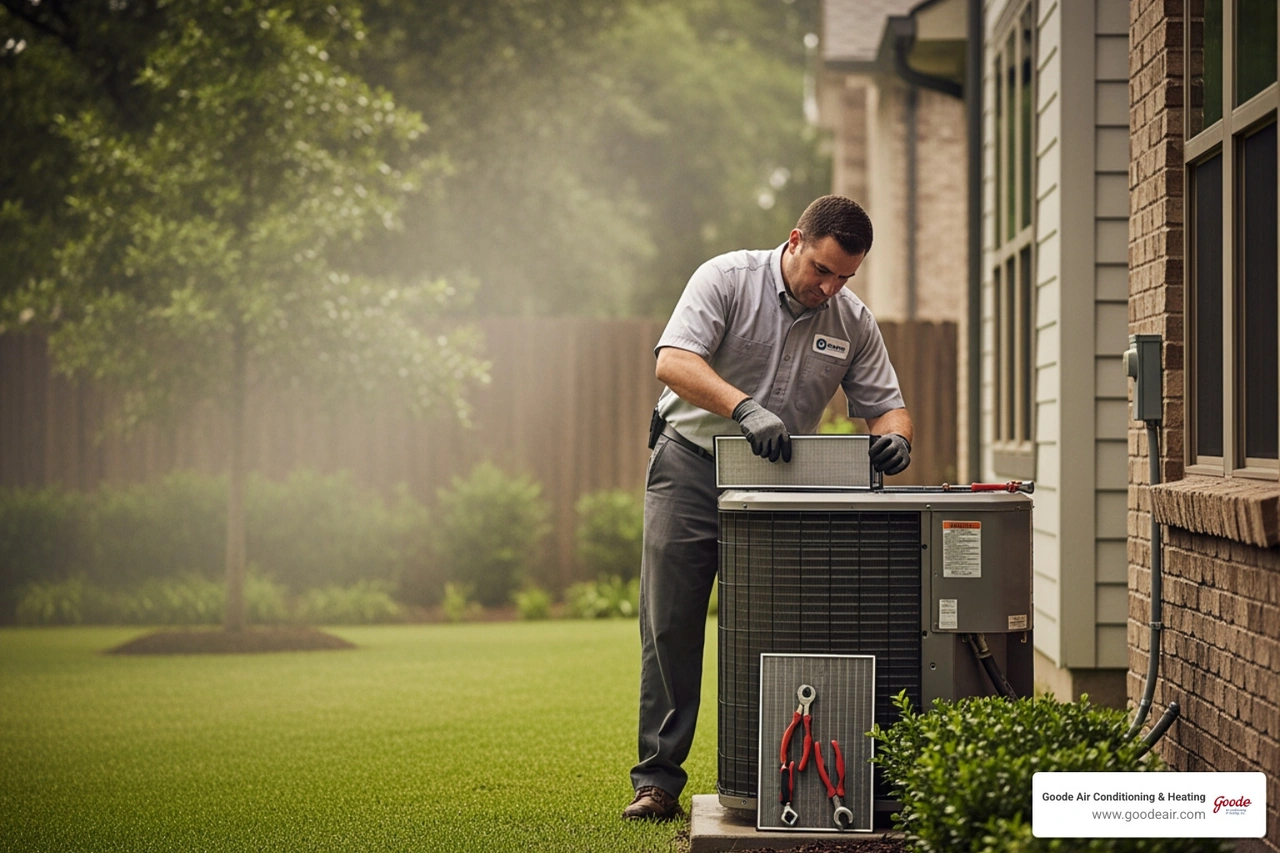
Why Humidity Is Your AC's Biggest Enemy in Northeast Houston
If you've ever wondered how to maintain your AC in extreme humidity, you're not alone — in Northeast Houston, where the air feels like a warm, wet blanket from May through October, your cooling system is fighting a battle most homeowners never see.
Here's a quick answer to get you started:
How to Maintain Your AC in Extreme Humidity — Quick Reference
- Replace air filters every 30 days during peak season to prevent airflow restriction
- Set your thermostat fan to "Auto" — never "On" — to let moisture drain off the coils
- Flush your condensate drain line monthly with white vinegar to prevent algae clogs
- Keep indoor humidity between 30% and 50% using a hygrometer to monitor levels
- Schedule professional AC tune-ups twice a year to check refrigerant, coils, and drainage
- Consider upgrading to a variable-speed system for more consistent moisture removal
- Seal leaky ductwork to stop humid attic air from sneaking into your living space
Northeast Houston's outdoor humidity routinely sits between 70% and 90%. That means your AC isn't just cooling your home — it's constantly wrestling moisture out of the air at the same time. This dual workload is called latent heat removal, and it's one of the most misunderstood strains on your system.
When your AC struggles with humidity, the consequences aren't just discomfort. Mold can begin forming in as little as 24 to 48 hours in a high-moisture environment. A thin layer of dust on your evaporator coils — just 1/16th of an inch — can cut system efficiency by 21%. And an oversized or poorly maintained unit can leave your home feeling cold and clammy at the same time, which is a sign that temperature is being managed but moisture is not.
The good news? Most of the damage is preventable with the right maintenance habits and a few smart upgrades.
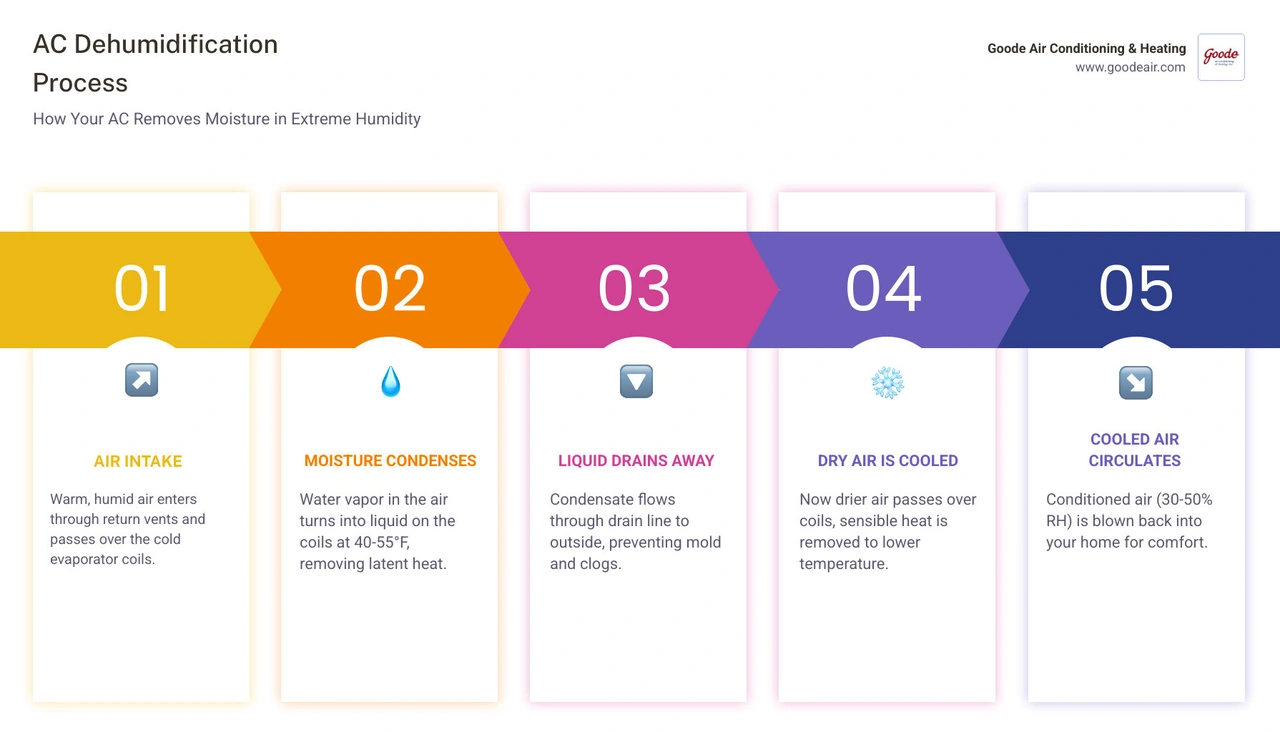
The Science of Latent Heat: Why Humidity Makes Your AC Work Harder
In Northeast Houston, we often talk about the "heat index" or how "soupy" the air feels. From a technical perspective, your air conditioner has to deal with two types of heat: sensible heat and latent heat.
Sensible heat is what you see on the thermometer—the actual temperature of the air. Latent heat is the energy stored in the moisture (humidity) within that air. Before your AC can effectively lower the temperature in your Kingwood or Atascocita home, it must first strip away that moisture. This is why How Humidity Affects Your AC Performance is such a critical topic for Texas homeowners.

When humidity levels are extreme, your evaporator coils become saturated with water. This forces the system to run longer cycles to achieve the same cooling effect. This "long-cycling" leads to significantly higher energy consumption and accelerates component wear. In more moderate climates, an AC might last 15 to 20 years. However, How Southeast Texas Climate Affects Your HVAC System usually means a shorter lifespan of 10 to 12 years due to the relentless mechanical workload of fighting moisture.
Furthermore, moisture can act as an insulator on your coils. If the coils are dirty, the water can't drain properly, which may lead to the system freezing up. When your coils turn into a block of ice, they stop removing humidity entirely, leaving you with a home that feels like a sauna.
How to Maintain Your AC in Extreme Humidity: A Step-by-Step Guide
Maintaining your system in a place like Spring or Humble requires a proactive approach. Because the environment is so demanding, standard "once-a-year" advice often isn't enough.
Below is a comparison of what you can handle yourself and what requires our professional touch to ensure your home stays dry and comfortable.
| Maintenance Task | Frequency | DIY or Professional? | Benefit |
|---|---|---|---|
| Filter Replacement | Every 30 Days | DIY | Improves airflow and moisture extraction |
| Condensate Drain Flush | Every 30-60 Days | DIY | Prevents algae clogs and water damage |
| Clear Outdoor Debris | Monthly | DIY | Ensures proper heat release from condenser |
| Evaporator Coil Cleaning | Annually | Professional | Restores 21% efficiency loss from dust |
| Refrigerant Charge Check | Bi-Annually | Professional | Prevents coil freezing and compressor failure |
| Duct Inspection/Sealing | Every 2-3 Years | Professional | Stops humid attic air from entering home |
Understanding How to Extend the Life of Your AC in Texas starts with these basic steps. If the air can't move freely, the moisture can't be removed.
Essential steps for how to maintain your ac in extreme humidity
The most impactful thing you can do for your system is to manage your air filters. In high-humidity areas like Porter and New Caney, your AC runs almost constantly. This means it pulls in more dust, pet dander, and pollen than a unit in a drier climate.
We recommend a 30-day filter replacement cycle during the peak summer months. When choosing a filter, look for a MERV rating between 8 and 11. This provides a perfect balance—it's strong enough to catch the particulates that lead to mold growth but doesn't restrict airflow so much that your system struggles to breathe. Following this simple rule is a major part of How to Make Sure Your AC Survives a Texas Summer.
Why how to maintain your ac in extreme humidity is critical for mold prevention
In the humid corridors of Northeast Houston, moisture isn't just a comfort issue; it’s a health issue. When your AC removes water from the air, that water drips into a condensate drain pan and exits through a PVC pipe.
Because our air is so full of organic material and moisture, these drain lines are prone to algae and "slime" growth. If the line clogs, the water backs up into your home, which can lead to catastrophic ceiling damage and rapid mold growth. Mold can begin forming within 24 to 48 hours of a moisture failure.
To prevent this, flush your drain line with a quarter-cup of distilled white vinegar every month. This simple DIY fix kills algae before it can form a clog. This is a cornerstone of How Proper HVAC Maintenance Prevents Mold Growth in our local climate.
Optimizing Your System for Maximum Moisture Removal
Sometimes, even a well-maintained system needs the right settings to tackle a Texas humidity spike. Your thermostat is your primary tool for this.
One of the most common mistakes we see in places like Fall Creek and Summerwood is homeowners setting their thermostat fan to "On" instead of "Auto." When the fan is "On," it runs continuously. After the cooling cycle ends, the evaporator coils are still dripping with water. If the fan keeps blowing, it picks up that moisture and pushes it right back into your living room. In just one hour, this can increase your indoor humidity by up to 15%. Always use the "Auto" setting to allow moisture to drain away properly.
If you have a modern system, check for a "Dry Mode" (often represented by a water drop icon). This setting prioritizes dehumidification by slowing down the fan, allowing the air to stay in contact with the cold coils longer, which pulls more water out of the air.
Another critical factor is "short-cycling." If your AC is oversized for your home—a common issue known as the "bigger is better" myth—it will cool the air so fast that it shuts off before it has a chance to remove the humidity. This results in the "cave effect," where your home feels cold but sticky. We use Manual J load calculations to ensure every system we install in the Crosby and Huffman areas is perfectly sized to run long enough to dry the air out. To learn more about how settings impact your health, see our guide on Humidity & Indoor Air Quality.
Advanced Solutions: Upgrades and Professional Care
If you've followed the DIY steps and your home still feels clammy, it might be time for a technical upgrade. Modern HVAC technology has come a long way in managing the "soupy" air of Southeast Texas.
Variable-Speed Compressors: Unlike standard units that are either 100% on or 100% off, variable-speed systems can run at lower speeds for longer periods. This allows them to remove up to 400% more moisture than single-stage units while using less electricity.
Thermal Expansion Valves (TXV): A TXV regulates the flow of refrigerant into the evaporator coil. In high humidity, it ensures the coil stays at the perfect temperature to maximize condensation. Think of it like a gym water bottle—the TXV makes sure the "bottle" (your coil) stays full of "water" (refrigerant) so it can do the heavy lifting required during a Houston July.
Whole-Home Dehumidifiers: For some homes, especially newer, tightly-sealed houses, the AC alone may not be enough. A whole-home dehumidifier integrates directly into your ductwork, removing gallons of water daily without significantly lowering the temperature.
Regular professional care is the best way to ensure these components are working. There are many Benefits of Regular AC Maintenance in Texas, including checking the refrigerant charge. If your refrigerant is even slightly low, the coils can't get cold enough to reach the "dew point," meaning they won't pull any moisture out of the air. We recommend asking How Often Should You Service Your AC in Texas and sticking to a bi-annual schedule—once in the spring and once in the fall.
Frequently Asked Questions about Humidity and AC
What are the ideal indoor humidity levels to target?
You should aim to keep your indoor relative humidity between 30% and 50%. Once you cross the 60% threshold, you enter the "danger zone" where mold thrives, dust mite populations explode, and the air begins to feel heavy and uncomfortable. We recommend placing a few inexpensive hygrometers (humidity monitors) around your home in Eagle Springs or Valley Ranch to keep an eye on these levels.
Why does my AC cool the air but fail to reduce humidity?
This is usually caused by one of three things:
- Oversized Unit: The system is too powerful and cools the room too fast to complete a dehumidification cycle.
- Dirty Evaporator Coils: A layer of dust prevents the moisture from condensing and draining.
- Frozen Evaporator: If the coils are frozen due to low refrigerant or a dirty filter, they can't absorb heat or moisture.
How can sealing ductwork help manage humidity?
In many Northeast Houston homes, the ductwork runs through a scorching, humid attic. If your ducts have leaks, the system creates negative pressure that sucks in that 90% humidity attic air and distributes it throughout your house. Sealing these leaks ensures that only the air you've already paid to cool and dry is being circulated. Additionally, Duct Cleaning Benefits for Humid Climate Homes include removing the dust and organic material that mold needs to grow in high-moisture environments.
Conclusion: Keeping Your Northeast Houston Home Comfortable
Living in the Houston area means accepting that humidity is a part of life, but it doesn't have to be a part of your living room. By understanding how to maintain your AC in extreme humidity, you can protect your equipment, lower your monthly bills, and ensure your family stays healthy.
At Goode Air Conditioning & Heating, we've spent 50 years helping our neighbors in Humble, Kingwood, Atascocita, and the surrounding communities navigate the challenges of our unique climate. From Roman Forest to Crosby, we pride ourselves on transparent pricing and family values. We don't just fix air conditioners; we provide peace of mind that your home will remain a dry, cool sanctuary no matter how thick the air gets outside.
Don't wait for the mold to start or the "cave effect" to ruin your comfort. Schedule your professional AC maintenance in Humble, TX today and let our experts ensure your system is ready for the next Texas humidity spike.

Customer Testimonials
See why so many homeowners trust Goode Air Conditioning & Heating, Inc.—our 4.8-star Google rating and hundreds of happy customers speak to the quality, care, and service we deliver every day.

The technician Goode AC is one of the best businesses I know of. I have had their annual maintenance check up for several years. I’m so impressed with the technician who has serviced my AC several times. Always on time, pleasant, considerate, thorough in his work and explains the problems where I can easily understand. Thankful for doing business with professionals.
I have been a customer for at least 30 years. They have replaced 3 air conditioners, a furnace and heat exchanger. Today they replaced the air ducts in my attic that were falling apart and never been cleaned. Wonderful job, polite workers, great clean up. I can already tell the difference in the quality of the air. Love you guys!!
Great experience today with Goode Air Conditioning. Hoger, our technician, was very knowledgeable and provided excellent customer service. We look forward to our Spring maintenance visit.
I have used Goode Air Conditioning and Heating for many years. The company has excellent customer service and the technicians are knowledgeable, thorough and professional.